BY:SpaceEyeNews.
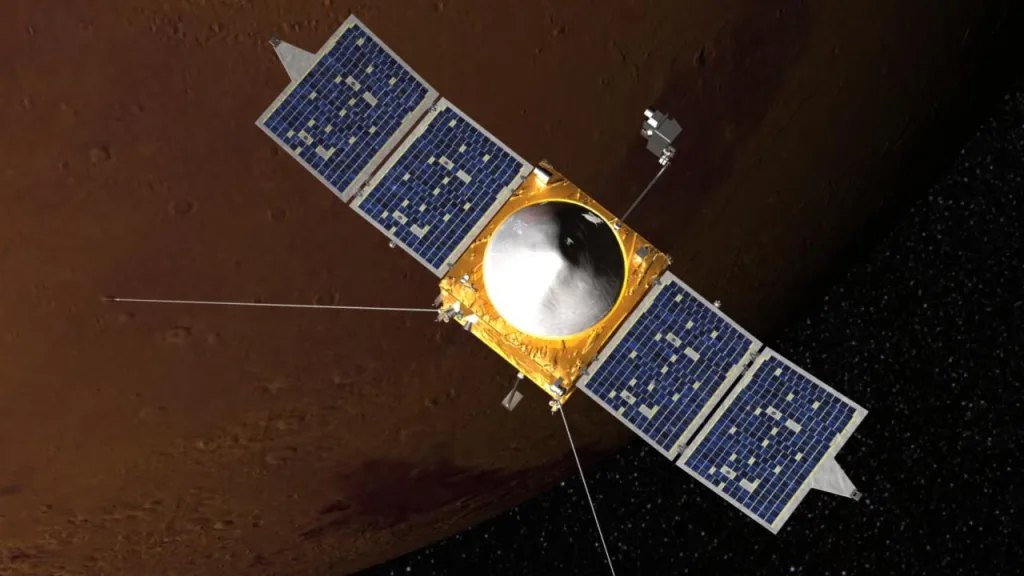
NASA has officially ended the MAVEN Mars Mission after months of unsuccessful attempts to restore contact with the spacecraft. The announcement closes one of the most successful chapters in Mars exploration.
For more than a decade, MAVEN helped scientists understand how Mars transformed from a world that may have once supported rivers and lakes into the cold, dry planet we see today. Although the spacecraft is now silent, its scientific legacy will continue for years.
The MAVEN Mars Mission launched in 2013 and arrived at Mars in 2014. Engineers originally planned for a much shorter mission. Instead, the spacecraft operated for more than 11 years and delivered a wealth of scientific discoveries.
Now, as NASA says goodbye to MAVEN, researchers are looking back at a mission that fundamentally changed our understanding of the Red Planet.
MAVEN Mars Mission Falls Silent After Months of Recovery Attempts
NASA received the final transmission from MAVEN on Dec. 6, 2025.
At the time, the spacecraft moved behind Mars during normal orbital operations. When it emerged again, telemetry indicated something had gone wrong.
Engineers discovered that the spacecraft had entered safe mode. Data also suggested that MAVEN had begun tumbling in space.
What Went Wrong Behind Mars?
The exact cause remains under investigation.
According to NASA’s anomaly review board, MAVEN likely experienced a serious issue that disrupted its ability to maintain orientation.
That loss of control may have prevented the spacecraft’s solar panels from generating enough power. As energy levels dropped, communications systems eventually shut down.
NASA’s Deep Space Network continued searching for signals during the following months.
No response ever arrived.
Why NASA Declared the Mission Over
Mission teams explored every realistic recovery option.
Engineers repeatedly attempted to contact the spacecraft. They used different communication strategies and monitored for any sign of activity.
Nothing worked.
After six months of silence, NASA concluded that MAVEN had entered an unrecoverable state.
The decision marked the official end of the MAVEN Mars Mission.
For many team members, the announcement felt deeply personal.
Several NASA officials compared the experience to losing a longtime companion after years of successful exploration.
How the MAVEN Mars Mission Outlived Its Original Plan
MAVEN was never expected to remain active for more than a decade.
NASA launched the spacecraft aboard an Atlas V rocket in November 2013. It entered Mars orbit about ten months later.
The mission initially carried a much shorter operational timeline.
Instead, MAVEN continued performing science observations year after year.
A Mission Designed for Atmospheric Science
The primary objective was clear.
Scientists wanted to understand how Mars lost much of its atmosphere.
Previous missions had identified evidence suggesting that ancient Mars possessed a thicker atmosphere and more abundant surface water.
However, researchers still lacked detailed measurements showing how atmospheric loss occurred.
The MAVEN Mars Mission filled that gap.
Its instruments examined interactions between the Martian atmosphere and the solar wind. These observations allowed scientists to measure atmospheric escape with unprecedented accuracy.
A Decade of Continuous Discovery
MAVEN consistently exceeded expectations.
The spacecraft survived changing environmental conditions and continued gathering valuable data long after completing its original objectives.
As the years passed, the mission became one of NASA’s most productive Mars science programs.
Its observations helped researchers answer questions that had remained unresolved for decades.
MAVEN Mars Mission Solved One of Mars’ Biggest Mysteries
One of MAVEN’s greatest achievements involved explaining how Mars lost much of its atmosphere.
Scientists had long suspected that the solar wind played a major role.
MAVEN finally provided direct evidence.
Understanding Atmospheric Escape
Mars lacks a global magnetic field like Earth’s.
Without that protective shield, charged particles from the sun can interact directly with the upper atmosphere.
Over billions of years, those interactions gradually removed atmospheric particles from the planet.
The MAVEN Mars Mission measured these processes in detail.
Researchers observed how solar activity accelerated atmospheric escape.
They also tracked how different atmospheric layers responded to changing space weather conditions.
These measurements helped scientists reconstruct Mars’ environmental history.
Connecting Atmosphere Loss to Water Loss
Atmospheric loss affects more than air.
A thicker atmosphere helps maintain stable surface conditions.
As Mars lost much of its atmosphere, liquid water became increasingly difficult to sustain on the surface.
MAVEN helped scientists better understand this connection.
Its findings strengthened the theory that atmospheric escape played a central role in transforming Mars from a potentially wetter world into the desert planet seen today.
Unexpected Scientific Discoveries
The mission also delivered surprises.
MAVEN observed unusual auroras around Mars.
It monitored powerful solar storms.
It captured valuable data about the interaction between the solar wind and the Martian environment.
Many discoveries emerged years after the spacecraft began operating.
Researchers continue analyzing large portions of the dataset.
Scientists expect new findings to appear for many years.
The Hidden Role of the MAVEN Mars Mission
Many people remember MAVEN for its atmospheric science.
However, the spacecraft performed another important job.
Supporting Surface Missions on Mars
MAVEN served as a communications relay for spacecraft operating on the Martian surface.
The orbiter helped transfer information between Mars rovers and Earth.
That role became increasingly important as surface exploration expanded.
Reliable communication infrastructure remains essential for every Mars mission.
Without orbiters, sending data across millions of kilometers becomes far more difficult.
Part of a Larger Mars Network
MAVEN worked alongside several other spacecraft.
These included NASA’s Mars Odyssey and Mars Reconnaissance Orbiter.
European missions also contributed to the communication network.
Together, these orbiters formed an important support system for Mars exploration.
Although MAVEN is gone, other spacecraft continue providing relay services and scientific observations.
What Happens Next for Mars Exploration?
The end of the MAVEN Mars Mission does not slow Mars research.
NASA still operates Mars Odyssey and the Mars Reconnaissance Orbiter around the Red Planet.
Both spacecraft continue performing science observations and communication support.
Remarkably, both missions have also exceeded their original design lifetimes.
MAVEN’s Data Will Keep Producing Discoveries
The spacecraft may no longer communicate with Earth, but its scientific contribution remains far from complete.
Researchers have collected more than a decade of observations.
Those records contain valuable information about atmospheric evolution, solar activity, and planetary climate processes.
Scientists will continue studying the archive for years.
Future discoveries may emerge from data already stored on Earth.
That reality highlights one of the most important aspects of space exploration.
A mission’s impact often extends well beyond its operational lifetime.
Conclusion
The MAVEN Mars Mission has officially come to an end, but its influence on planetary science remains enormous.
For more than 11 years, MAVEN helped researchers understand how Mars lost its atmosphere and how that transformation shaped the planet we observe today.
The spacecraft survived far longer than originally planned and delivered groundbreaking science throughout its extended mission.
Although engineers could not restore communication after the spacecraft’s final anomaly, MAVEN leaves behind an extraordinary scientific legacy.
Its observations continue to guide research into Mars, planetary evolution, and atmospheric escape.
The spacecraft may be silent, but the knowledge it provided will help scientists explore Mars for decades to come.
Main Sources:
NASA:
https://www.nasa.gov/news-release/nasa-says-farewell-to-maven-mars-mission-hosts-media-call-today/
LASP MAVEN Mission:
https://lasp.colorado.edu/maven/
Reuters:
https://www.reuters.com/science/nasa-announces-end-long-operating-mars-probes-mission-2026-06-03/