
BY:SpaceEyeNews.
Introduction
The Red Dwarf Gap may sound like a minor detail in a star chart, but it is becoming one of the most intriguing discoveries in stellar astronomy. While studying an ancient globular cluster, astronomers found a mysterious shortage of stars within a specific region of the Hertzsprung-Russell diagram. This feature had appeared before among nearby stars, but scientists had never confirmed it inside a globular cluster.
The discovery provides rare insight into processes occurring deep inside red dwarfs. These stars are the most common stars in the Milky Way. Yet many aspects of their internal structure remain difficult to observe directly.
By detecting the Red Dwarf Gap inside the ancient cluster NGC 6397, researchers have strengthened theories about stellar evolution and opened a potential new method for measuring distances across the galaxy.
The Mystery Behind the Red Dwarf Gap
A Strange Feature in Stellar Data
Astronomers rely on the Hertzsprung-Russell diagram to classify stars and study their evolution. The diagram compares stellar brightness with temperature. Most stars form predictable patterns across the chart.
In 2018, scientists analyzing data from the Gaia mission noticed something unusual. A narrow region among red dwarfs contained far fewer stars than expected. Instead of a smooth distribution, the stellar population appeared interrupted by a thin gap.
Researchers named this feature the Red Dwarf Gap.
At first, astronomers wondered whether observational limitations caused the missing stars. However, further analysis suggested that the gap represented a genuine physical phenomenon.
Why Stars Appear to Vanish
The missing stars are not truly absent. Instead, they pass through a brief evolutionary phase.
The phenomenon affects stars with masses between approximately 0.34 and 0.36 times the mass of the Sun. Within this range, changes occur inside the stellar interior. Energy transport becomes unstable for a short period.
As a result, the stars temporarily change their size, brightness, and temperature.
Because this stage happens relatively quickly compared with the stars’ extremely long lifetimes, astronomers observe fewer stars in that state. The result appears as a visible gap in the stellar distribution.
A Window Into Stellar Interiors
Scientists cannot directly observe the deep interiors of stars. Even the most powerful telescopes only see their outer layers.
Instead, astronomers study indirect clues. Variations in brightness, temperature, and population patterns help reveal what happens beneath the surface.
The Red Dwarf Gap acts as one of those clues. It provides evidence that theoretical models describing low-mass stellar interiors accurately capture important physical processes.
Why NGC 6397 Became the Perfect Test Case
An Ancient Stellar Laboratory
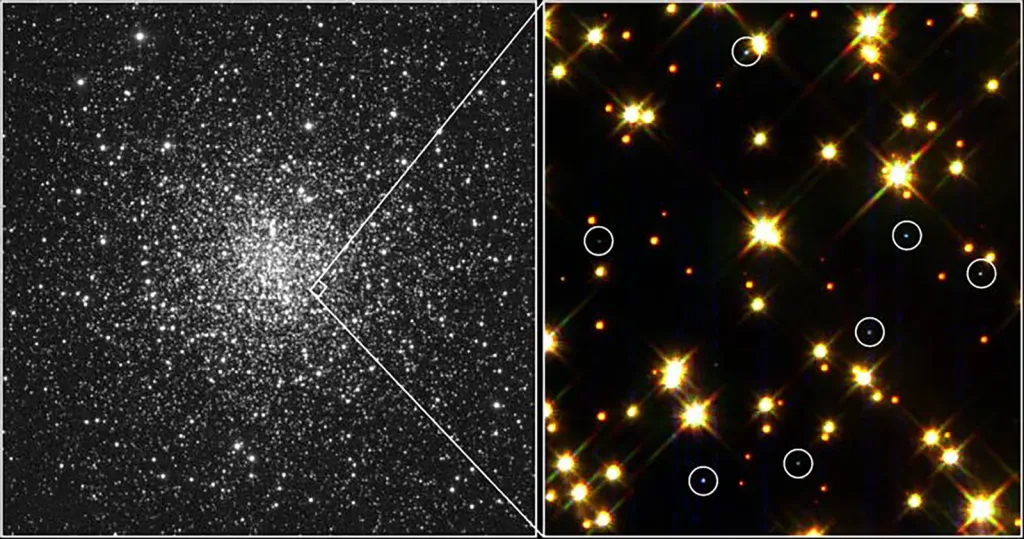
To verify the existence of the Red Dwarf Gap, researchers turned to NGC 6397.
NGC 6397 is one of the closest globular clusters to Earth. It lies approximately 8,000 light-years away in the constellation Ara. The cluster contains hundreds of thousands of stars and formed roughly 13.4 billion years ago.
Globular clusters offer unique advantages for scientific studies.
Unlike stars scattered throughout the Milky Way, stars inside a globular cluster generally formed at nearly the same time. They also share similar chemical compositions and evolutionary histories.
These similarities reduce uncertainties and allow astronomers to compare stars under controlled conditions.
Using Euclid and Hubble Together
The research team combined observations from the European Space Agency’s Euclid Space Telescope and NASA’s Hubble Space Telescope.
Euclid provides a wide field of view that can capture enormous numbers of stars simultaneously. Hubble contributes decades of high-precision observations and measurement techniques.
Researchers also used specialized analysis tools developed at the Space Telescope Science Institute. Scientists refined these tools over more than twenty years while studying crowded stellar environments with Hubble.
The combination proved powerful.
NGC 6397 contains an exceptionally dense concentration of stars. Separating individual stars within such crowded regions remains challenging. Advanced processing techniques helped researchers identify faint stars with remarkable accuracy.
The Gap Appears Again
Scientists originally examined NGC 6397 to study stellar motions and cluster dynamics.
Instead, they discovered something unexpected.
The same Red Dwarf Gap that appeared among nearby younger stars also emerged within this ancient stellar population.
The finding surprised researchers because the cluster’s stars formed billions of years earlier than many stars previously studied.
Despite enormous differences in age, the same pattern appeared.
That result strongly supports the idea that the gap arises from fundamental stellar physics rather than local environmental conditions.
What the Red Dwarf Gap Reveals About Stellar Evolution
Understanding Energy Transport
One of the most important questions in stellar astronomy involves energy transport.
Stars generate energy through nuclear fusion in their cores. That energy must travel outward before escaping into space.
Different stars transport energy in different ways. Some rely heavily on radiation. Others use convection, a process similar to the movement of boiling water.
Low-mass red dwarfs occupy an important transition region.
Near the mass range associated with the Red Dwarf Gap, changes in internal convection alter the structure of the star. These adjustments affect temperature, brightness, and radius.
Although astronomers cannot directly observe these interior processes, the gap provides evidence that the predicted transitions are occurring.
Confirming Long-Standing Models
Theoretical models have predicted these effects for years.
However, testing those predictions remained difficult.
The new observations provide one of the strongest confirmations yet. The appearance of the gap in an ancient globular cluster demonstrates that the process operates across different stellar populations.
As a result, astronomers can place greater confidence in current models of red dwarf evolution.
Why Red Dwarfs Matter
Red dwarfs deserve attention because they dominate the galaxy.
Most stars in the Milky Way belong to this category. Many known exoplanets orbit red dwarf hosts.
Understanding how these stars evolve improves our understanding of planetary systems, stellar populations, and galactic history.
Every new insight into red dwarf behavior strengthens broader models of the universe.
A New Tool for Measuring Cosmic Distances
Turning a Gap Into a Cosmic Ruler
The significance of the Red Dwarf Gap extends beyond stellar physics.
Researchers believe it may become a valuable tool for measuring astronomical distances.
The gap occurs at a very specific stellar mass range. Because stars within this transition display predictable brightness characteristics, astronomers can use the feature as a reference point.
Known reference points are extremely valuable in astronomy.
Distance measurements underpin many areas of research. They influence calculations involving star clusters, galactic structure, and cosmic evolution.
Improving Cluster Measurements
Traditional distance measurements often depend on multiple assumptions.
The Red Dwarf Gap could provide an additional independent method.
If astronomers determine the precise luminosity associated with the gap, they can compare observed brightness with expected brightness. This comparison allows distance calculations with improved accuracy.
Such measurements could help refine estimates for globular clusters throughout the Milky Way.
Future Opportunities
The discovery represents only the beginning.
Researchers plan to examine additional globular clusters using Euclid. Future observations from the Nancy Grace Roman Space Telescope could expand the sample even further.
By studying more clusters, astronomers hope to determine how universal the Red Dwarf Gap really is.
A larger dataset could transform the feature from an interesting observation into a widely used scientific tool.
Why the Discovery Matters
Astronomy often advances through unexpected observations.
Researchers searching for one phenomenon frequently uncover something entirely different. That is exactly what happened in NGC 6397.
A subtle shortage of stars revealed hidden processes deep inside red dwarfs. It confirmed predictions about stellar interiors. It strengthened models of stellar evolution. It also introduced a promising new technique for measuring distances across the galaxy.
Most importantly, the discovery demonstrates that even the most common stars can still surprise scientists.
Conclusion
The Red Dwarf Gap has evolved from a curious feature in a stellar diagram into an important scientific discovery. By identifying the same gap inside the ancient globular cluster NGC 6397, astronomers confirmed that hidden structural changes occur within low-mass red dwarfs across vastly different stellar populations.
The finding offers new evidence for existing theories of stellar evolution. It also provides a potential new standard for measuring cosmic distances. Future observations with Euclid and the Nancy Grace Roman Space Telescope may reveal the feature in many more globular clusters.
Sometimes the most important discoveries do not come from finding new stars. Instead, they emerge from noticing where stars appear to be missing. In the case of the Red Dwarf Gap, that empty space may help astronomers better understand both stellar interiors and the structure of our galaxy.
Main Sources:
- Universe Magazine
https://universemagazine.com/en/mysterious-gap-in-diagram-reveals-processes-deep-within-red-dwarfs/ - Space Telescope Science Institute (STScI)
https://www.stsci.edu/contents/news-releases/2026/news-2026-405 - European Space Agency (Euclid Mission)
https://www.esa.int/Science_Exploration/Space_Science/Euclid - Astronomy & Astrophysics Journal (Research Paper)
https://www.aanda.org/ - NASA Hubble Space Telescope
https://hubblesite.org/