BY:SpaceEyeNews.
Earth Became Habitable Thanks to Jupiter
For decades, scientists believed Jupiter’s greatest contribution to Earth was its role as a giant shield. The massive planet helped reduce the number of dangerous objects reaching the inner Solar System. However, new research suggests Jupiter may have played an even more important role long before life appeared on Earth.
A new study indicates that Earth became habitable thanks to Jupiter in a way few researchers expected. Rather than simply protecting our planet, Jupiter may have controlled the distribution of critical chemical ingredients needed for life. By altering the movement of material during the Solar System’s earliest years, the gas giant helped determine where essential elements accumulated.
The findings offer a new perspective on planetary habitability. They also raise important questions about how often life-friendly worlds might emerge elsewhere in the galaxy.
Why Earth Became Habitable Thanks to Jupiter and Life’s Essential Elements
All known life relies on a small group of chemical ingredients. Scientists often refer to them using the acronym CHNOPS:
- Carbon
- Hydrogen
- Nitrogen
- Oxygen
- Phosphorus
- Sulfur
These elements form the foundation of biological systems. They help build DNA, RNA, proteins, and cellular structures.
Why Phosphorus Matters
Phosphorus plays a critical role in biology. It forms part of DNA and RNA. It also helps create ATP, the molecule that stores and transfers energy inside cells.
Without phosphorus, life could not operate as we know it.
Why Nitrogen Is Equally Important
Nitrogen is another key ingredient. It helps create amino acids, which form proteins. It also appears in nucleic acids that carry genetic information.
Because phosphorus and nitrogen are so important, scientists wanted to understand how Earth acquired the right balance of both elements.
Meteorites Provide Clues From the Early Solar System
To answer that question, researchers turned to meteorites.
These ancient space rocks preserve information from the Solar System’s earliest history. They act like natural time capsules that reveal conditions from more than 4.5 billion years ago.
Two Different Types of Meteorites
The study focused on two major meteorite groups.
Iron meteorites represent remnants of the earliest planetesimals. These small bodies formed during the Solar System’s first stages.
Chondrites formed later. They appeared roughly two to three million years after the earliest planetesimals emerged.
Because these meteorites formed at different times, they provide snapshots of changing conditions throughout the young Solar System.
Mapping Ancient Chemistry
Researchers measured phosphorus-to-nitrogen ratios in both meteorite types.
They then combined laboratory measurements with advanced geochemical models. This approach allowed them to reconstruct a chemical map of the Solar System during its formative years.
The results revealed a surprising pattern.
The earliest planetesimals showed higher phosphorus-to-nitrogen ratios farther from the Sun. Closer regions contained lower ratios.
Later planetesimals displayed the exact opposite trend.
Something significant had changed between these two periods.
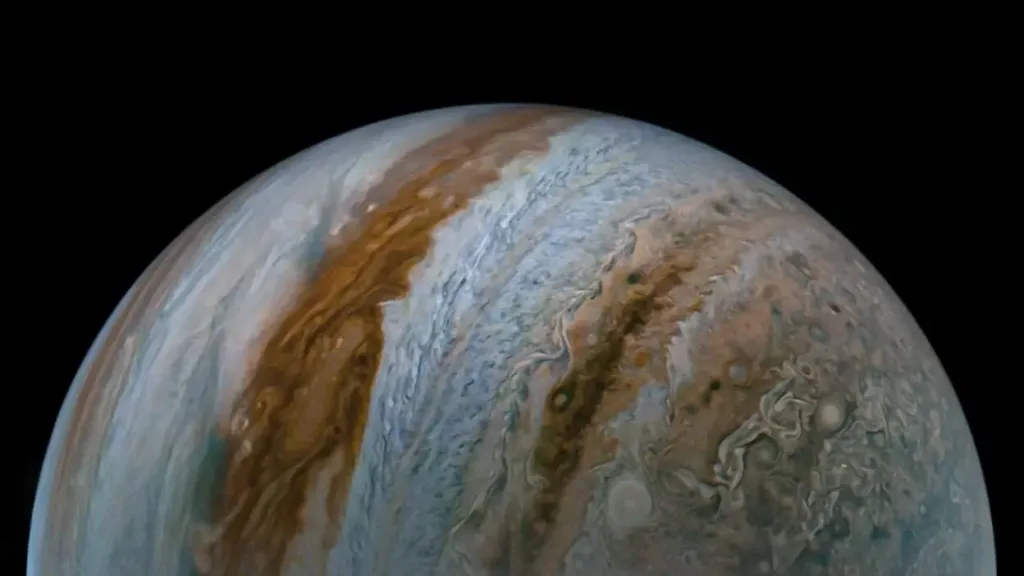
The Moment Jupiter Changed the Solar System
The researchers traced the shift to a familiar source: Jupiter.
Jupiter’s Rapid Growth
During the Solar System’s early history, Jupiter grew rapidly. As it accumulated gas and material, its gravitational influence increased dramatically.
Eventually, Jupiter became the dominant planetary body in the Solar System.
That growth had major consequences.
A Giant Barrier Forms
As Jupiter gained mass, it altered the movement of material throughout the protoplanetary disk.
The planet effectively acted as a gravitational barrier.
Before Jupiter reached its enormous size, phosphorus-rich and nitrogen-rich material could move more freely between the inner and outer Solar System.
Afterward, that movement became much more restricted.
A Chemical Divide Emerges
The new study suggests Jupiter prevented significant amounts of material from crossing between regions.
As a result, the distribution of phosphorus and nitrogen changed.
The inner Solar System retained more phosphorus relative to nitrogen. The outer Solar System developed a different chemical balance.
This shift influenced the composition of future planetesimals and, eventually, planets.
Earth happened to form within the region most affected by these changes.
How Earth Became Habitable Thanks to Jupiter’s Influence
The next step involved understanding Earth’s chemical origins.
Researchers used accretion models to determine where our planet likely obtained its phosphorus and nitrogen.
The answer surprised many scientists.
Earth’s Building Blocks Came From Nearby
The simulations showed that Earth’s current phosphorus-to-nitrogen ratio closely matches material from the inner Solar System.
Researchers found little evidence that large amounts of these elements arrived from distant regions beyond Jupiter.
Instead, Earth appears to have inherited most of its critical ingredients from nearby sources.
A Different View of Planet Formation
For years, many studies emphasized the importance of material delivered from outer Solar System regions.
This new research offers a different picture.
Earth may have received many of its most important biological ingredients locally. Jupiter’s presence helped make that possible by reshaping the Solar System’s chemical architecture.
The Right Ingredients at the Right Place
Timing was crucial.
Jupiter grew while planetesimals continued forming throughout the Solar System.
Its increasing gravity changed where phosphorus and nitrogen accumulated. Those changes occurred before Earth fully formed.
As a result, our planet emerged from material that already contained the chemical balance needed for future biological processes.
That connection helps explain why Earth possesses the elemental resources required to support life.
What This Means for the Search for Life Beyond Earth
The implications extend far beyond our Solar System.
Scientists currently search for habitable worlds by focusing on factors such as liquid water and surface temperature.
This study suggests another factor may deserve equal attention.
Habitability Is More Than Location
Many discussions focus on the habitable zone. This region surrounds a star where liquid water can exist.
However, water alone does not guarantee habitability.
Planets also require the right chemical ingredients.
Without sufficient phosphorus, nitrogen, and other essential elements, life may struggle to emerge.
The Importance of Giant Planets
If Earth became habitable thanks to Jupiter, giant planets may play a larger role in habitability than previously thought.
Their gravity can influence the movement of material across entire planetary systems.
That influence may determine where key life-supporting elements accumulate.
A New Question for Exoplanet Research
Astronomers have discovered thousands of exoplanets.
Many orbit stars very different from our Sun. Some systems contain giant planets, while others do not.
The new findings raise an important question.
Can life-friendly chemistry develop in systems that lack Jupiter-like planets?
Scientists do not yet know the answer.
Future observations may help reveal whether giant planets commonly assist in creating habitable environments.
A New Understanding of Jupiter’s Legacy
Jupiter has long occupied a special place in discussions about Earth’s history.
Its massive gravity shaped the architecture of the Solar System. It influenced asteroid populations and planetary orbits.
Now researchers suggest another contribution.
Jupiter may have helped determine where life’s building blocks accumulated billions of years ago.
That possibility transforms how scientists think about planetary habitability.
The giant planet may not simply have protected Earth. It may have helped create the chemical conditions that allowed life to emerge in the first place.
Conclusion
The idea that Earth became habitable thanks to Jupiter adds a fascinating new chapter to the story of our Solar System. By analyzing ancient meteorites and reconstructing the distribution of phosphorus and nitrogen, researchers uncovered evidence that Jupiter’s growth reshaped the chemical environment where Earth formed. The giant planet appears to have acted as a gravitational barrier that preserved life-essential ingredients within the inner Solar System. These findings expand our understanding of habitability and suggest that giant planets may influence the chances for life across the galaxy. As scientists continue studying distant planetary systems, Jupiter’s hidden role may become a key piece of the search for other living worlds.
Main Sources:
NASA Astrobiology:
https://science.nasa.gov/science-research/planetary-science/astrobiology/nasa-finds-new-way-earth-may-have-received-elements-needed-for-life/
Universe Magazine:
https://universemagazine.com/en/earth-became-habitable-thanks-to-jupiter/
Science Advances (Research Paper):
https://www.science.org/doi/10.1126/sciadv.adu8824