
BY:SpaceEyeNews.
Hidden Supermassive Black Hole Pairs Could Soon Step Out of the Dark
For decades, astronomers have expected the universe to contain large numbers of Hidden Supermassive Black Hole Pairs. Computer simulations, galaxy merger studies, and theoretical models all point to the same conclusion. When galaxies merge, their central black holes should eventually form tightly bound binaries.
Yet finding these systems has proven remarkably difficult.
Scientists have identified several supermassive black hole pairs separated by large distances. However, the most interesting systems are the closest ones. These binaries orbit each other at relatively small separations and slowly spiral inward over millions of years. They are also expected to become some of the strongest gravitational-wave sources in the universe.
Now, a new study from researchers at the University of Oxford and the Max Planck Institute for Gravitational Physics proposes a different strategy. Instead of searching for the black holes directly, astronomers could search for repeating flashes of starlight caused by their gravity.
If successful, this approach could finally reveal a population of Hidden Supermassive Black Hole Pairs that has remained invisible for decades.
Why Hidden Supermassive Black Hole Pairs Matter
Galaxy Mergers Naturally Create Black Hole Binaries
Most large galaxies host a supermassive black hole at their center. When two galaxies merge, their central black holes do not immediately combine. Instead, they begin a long gravitational dance.
Over time, the pair loses energy and moves closer together. Eventually, the two black holes form a binary system.
Astronomers expect this process to occur throughout cosmic history. Galaxy mergers are common. As a result, researchers believe many galaxies should contain supermassive black hole binaries at various stages of evolution.
The Missing Population Problem
Despite strong theoretical expectations, only a small number of candidate systems have been identified.
The challenge comes from distance and scale. Even the largest black holes occupy tiny regions when viewed across millions or billions of light-years.
As the separation between the two black holes shrinks, direct observation becomes increasingly difficult.
This creates a major scientific problem. Researchers know these systems should exist, yet the closest binaries remain largely hidden from view.
That gap has motivated astronomers to search for indirect detection methods.
A Gateway to Future Gravitational-Wave Science
These binaries are more than cosmic curiosities.
As they orbit one another, they emit gravitational waves. Those waves carry energy away from the system and slowly shrink the orbit.
Future missions such as the Laser Interferometer Space Antenna (LISA) aim to detect these signals directly. However, identifying promising targets beforehand would provide a huge advantage.
That is where the new study becomes especially important.
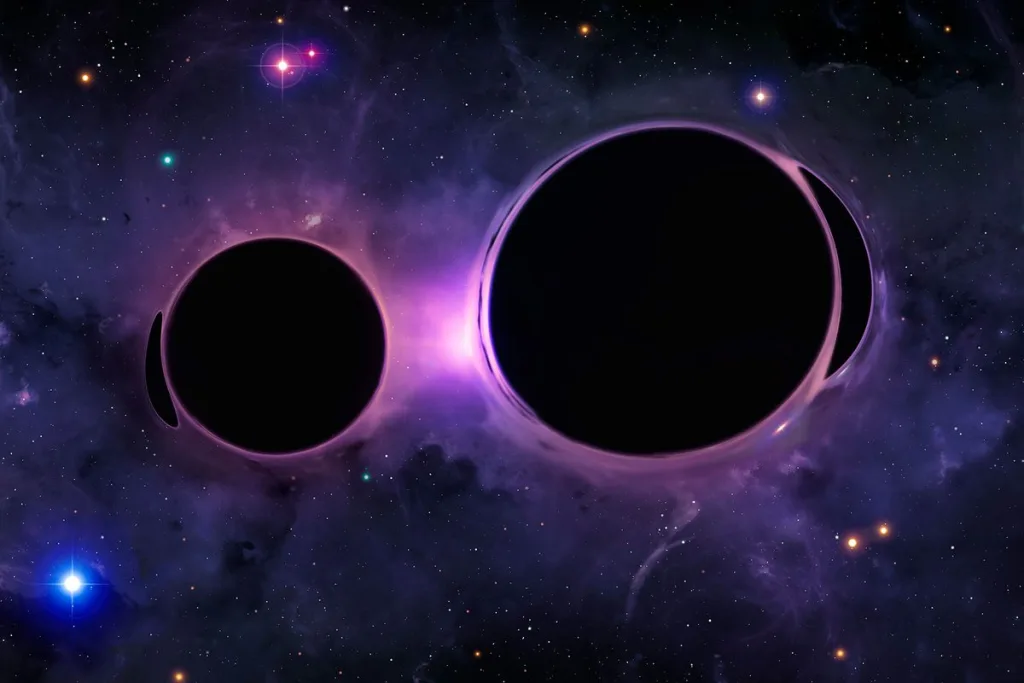
Hidden Supermassive Black Hole Pairs May Reveal Themselves Through Light
Black Holes Can Act as Natural Cosmic Telescopes
The new proposal relies on a phenomenon known as gravitational lensing.
Massive objects bend spacetime around them. As light passes nearby, its path changes.
Supermassive black holes create particularly strong lensing effects because of their enormous mass concentrated within a relatively small region.
Under the right conditions, a black hole can magnify the light from a background star and make it appear dramatically brighter.
Why Binary Systems Create Stronger Signals
A single black hole can produce lensing events. However, the alignment must be nearly perfect.
A binary system behaves differently.
The gravitational fields from two orbiting black holes combine to create a more complex lensing structure. This structure forms special regions where light amplification becomes much more likely.
Researchers describe one of these regions as a diamond-shaped caustic curve.
When a star crosses this region, its brightness can increase dramatically.
Repeating Stellar Flashes Become the Key Signature
The real breakthrough comes from the motion of the binary itself.
As the two black holes orbit each other, the caustic structure rotates and changes shape.
That moving lens sweeps across large numbers of stars in the host galaxy.
Whenever a bright star crosses the caustic region, astronomers would observe a sudden burst of light.
Unlike ordinary lensing events, these bursts would not occur only once.
The orbital motion of the binary causes the process to repeat.
Scientists could therefore search for recurring flashes that follow recognizable patterns.
Those flashes may become one of the clearest indicators of Hidden Supermassive Black Hole Pairs.
Reading the Properties of Hidden Supermassive Black Hole Pairs
The Flashes Should Follow Predictable Patterns
One of the most promising aspects of the new method is its predictability.
The researchers found that the flashes should not appear randomly.
Instead, their timing and brightness should follow measurable trends linked directly to the binary’s motion.
This creates a unique observational fingerprint.
Astronomers could distinguish these events from other forms of stellar variability by studying how the flashes evolve over time.
Gravitational Waves Leave Observable Clues
As the binary emits gravitational waves, its orbit gradually shrinks.
The black holes move closer together. Their orbital speed increases. The lensing structure changes.
Those changes influence the repeating flashes.
Intervals between bursts may shift. Brightness levels may evolve. The overall pattern may become increasingly distinctive.
Remarkably, astronomers could track the effects of gravitational-wave emission without detecting the waves themselves.
That possibility makes the method especially valuable.
Measuring the Hidden System
The recurring flashes could reveal important properties of the binary.
Researchers believe they may estimate:
- Black hole masses
- Orbital size
- Orbital evolution
- Inspiral rate
- Future merger behavior
In other words, ordinary starlight could become a powerful diagnostic tool for studying Hidden Supermassive Black Hole Pairs.
Rubin and Roman Could Transform the Search
Vera Rubin Observatory’s Role
The upcoming Vera C. Rubin Observatory will repeatedly survey large portions of the sky with unprecedented sensitivity.
Its observing strategy makes it ideal for detecting transient events and changing sources.
Because the proposed flashes repeat over time, Rubin may become one of the first facilities capable of identifying candidate systems.
Nancy Grace Roman Space Telescope Advantages
NASA’s Nancy Grace Roman Space Telescope could provide another major boost.
Roman will observe vast areas of space while delivering high-quality measurements of faint objects.
Its capabilities may help confirm and characterize candidate binaries discovered through optical surveys.
Finding Targets Before LISA Launches
Perhaps the most exciting aspect of the proposal is timing.
Future gravitational-wave observatories remain years away from operation.
This new method could identify inspiraling binaries before those missions begin collecting data.
Astronomers may therefore enter the gravitational-wave era with a catalog of known targets already in hand.
That would dramatically improve future observations and scientific returns.
A New Era for Hidden Supermassive Black Hole Pairs
The new study does not announce the discovery of a supermassive black hole binary.
Instead, it introduces a practical roadmap for finding systems that have remained hidden for decades.
The concept is elegant. Watch for stars that brighten repeatedly. Track the timing. Measure the pattern. Follow the clues left behind by orbiting black holes.
If upcoming observatories detect these signals, astronomers could finally uncover the long-sought population of Hidden Supermassive Black Hole Pairs.
More importantly, they may identify these systems years before future gravitational-wave missions observe them directly.
That combination of light-based observations and gravitational-wave measurements would open an entirely new chapter in black hole astronomy and provide one of the most powerful tools yet for studying the evolution of galaxies across the universe.
Main Sources:
- ScienceDaily
https://www.sciencedaily.com/releases/2026/06/260605023418.htm - Physical Review Letters (Original Study)
https://journals.aps.org/prl/ - Max Planck Institute for Gravitational Physics (Albert Einstein Institute)
https://www.aei.mpg.de - University of Oxford Department of Physics
https://www.physics.ox.ac.uk - Vera C. Rubin Observatory
https://rubinobservatory.org - NASA Nancy Grace Roman Space Telescope
https://roman.gsfc.nasa.gov