
BY:SpaceEyeNews.
The ISS Air Leak issue took an unexpected turn on June 5, 2026. NASA directed five astronauts aboard the International Space Station to move into a docked SpaceX Crew Dragon spacecraft while Russian cosmonauts inspected and prepared repairs on a persistent leak inside the Russian segment of the orbital complex.
The event lasted only a short time. No emergency occurred. Station systems remained stable throughout the operation. However, the decision highlighted growing concerns surrounding one of the station’s longest-running technical problems.
For years, NASA and Roscosmos have monitored a small but persistent air leak inside a transfer chamber connected to Russia’s Zvezda module. Engineers have attempted multiple repairs. Some appeared successful for a period, but the problem has repeatedly returned.
The latest ISS Air Leak incident now raises fresh questions about the long-term health of aging station hardware and the challenges of keeping the world’s most important orbital laboratory operating safely into the next decade.
ISS Air Leak Returns After Earlier Repairs
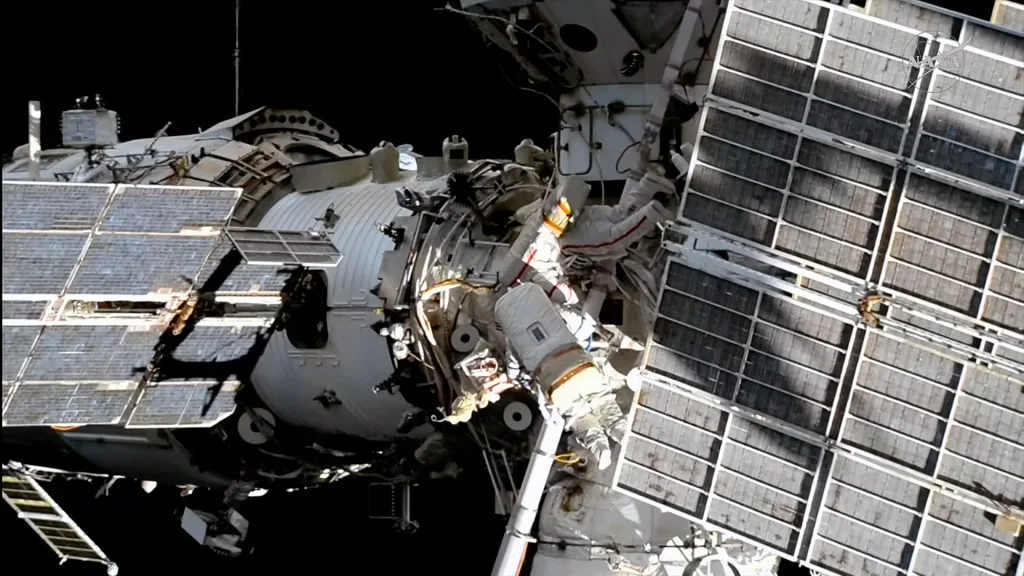
The current ISS Air Leak originates inside a transfer chamber known as PrK. This compartment sits on the aft end of the Zvezda Service Module. It provides access to docking ports used by Russian Progress cargo spacecraft.
Engineers first detected unusual pressure losses several years ago. Since then, teams from NASA and Roscosmos have worked together to track the source.
Investigations pointed toward microscopic structural cracks. Finding those cracks has proven difficult. The affected area remains small, and conditions in orbit complicate inspections.
Years of Monitoring and Repairs
Russian cosmonauts have conducted several repair campaigns. They inspected surfaces, sealed suspected cracks, and monitored pressure changes.
Earlier in 2026, officials reported a period of improved stability. Pressure measurements suggested that previous repairs had reduced leakage.
That optimism did not last long.
In May, Roscosmos confirmed that air losses had returned. The announcement indicated that engineers still had not identified a permanent solution.
Why Small Leaks Matter in Space
The leak rate remains low. It does not threaten station operations.
Even so, engineers pay close attention to any structural issue aboard the station.
A small crack can change over time. Temperature swings, pressure cycles, and long-term material aging may influence its behavior.
Because of those factors, experts treat recurring leaks seriously, even when they pose no immediate risk to crew safety.
Why NASA Ordered a Safe-Haven Procedure
The most notable part of the latest ISS Air Leak event was NASA’s decision to move astronauts into their emergency spacecraft.
Around 9 a.m. Eastern Time, mission controllers instructed the crew to establish a safe haven inside the SpaceX Crew Dragon Freedom capsule.
The spacecraft arrived at the station during the Crew-12 mission and remains attached as an emergency return vehicle.
Which Astronauts Moved Into Crew Dragon?
NASA astronauts Jessica Meir and Jack Hathaway entered the spacecraft.
French astronaut Sophie Adenot also joined them.
Russian cosmonaut Andrey Fedyaev moved into the capsule as well.
NASA astronaut Chris Williams, who arrived aboard a Russian Soyuz spacecraft, joined the group.
For roughly 90 minutes, five crew members remained inside Crew Dragon while operations continued elsewhere on the station.
A Precaution Rather Than an Emergency
NASA emphasized that the action was precautionary.
The station maintained normal pressure levels.
Life-support systems functioned normally.
No evacuation occurred.
The astronauts did not prepare for an immediate departure from orbit.
Instead, NASA adopted a conservative safety posture while Russian specialists worked near the affected area.
Space agencies routinely use this approach when uncertainty exists. Protecting the crew remains the highest priority.
What Russian Cosmonauts Found During Inspections
While the astronauts sheltered inside Crew Dragon, two Russian cosmonauts conducted work near the leak site.
The operation focused on the PrK transfer chamber.
According to Roscosmos, engineers first pressurized the compartment to allow access.
During inspections, specialists identified two possible leak locations.
Two Suspected Leak Sites
Roscosmos reported that one suspected leak location received an initial application of a two-component sealant known as Germetall-1.
The second location appeared on a conical section of the chamber.
Teams prepared additional repair work for that area.
The discovery suggests that engineers may be dealing with more than a single crack.
That possibility could explain why the issue has persisted despite multiple repair attempts.
Repairs Paused for Additional Measurements
An unexpected development occurred later in the day.
NASA informed the crew that Russian specialists had decided to collect measurements instead of continuing with major repair activities.
As a result, NASA ended the safe-haven procedure and allowed astronauts to return to normal station operations.
Roscosmos later confirmed that engineers paused structural repair efforts while they reviewed new data.
The agency plans to evaluate the measurements before determining future actions.
What the ISS Air Leak Reveals About an Aging Space Station
The International Space Station remains one of humanity’s greatest engineering achievements.
Yet the platform is aging.
Some modules have spent more than two decades in orbit.
Long-term exposure to the harsh space environment gradually affects materials and systems.
The ISS Air Leak serves as a reminder of those realities.
The Age of the Zvezda Module
The Zvezda Service Module launched in 2000.
It has supported station operations for more than 25 years.
Throughout that time, the module has experienced countless thermal cycles and pressure changes.
Such conditions create stress on structures over long periods.
Most systems continue to perform remarkably well. However, aging hardware inevitably requires more maintenance.
Different Views From NASA and Roscosmos
The leak has occasionally produced different assessments from American and Russian engineers.
NASA officials have previously expressed concern about the long-term implications of recurring structural cracks.
Roscosmos has generally maintained that the station remains safe and stable.
Despite those differences, both agencies continue working together to understand the problem.
The June 2026 operation demonstrated that cooperation remains essential for station safety.
Lessons for Future Space Stations
The ISS Air Leak may also provide valuable lessons for future orbital outposts.
Commercial space stations are expected to replace the ISS during the 2030s.
Engineers designing those platforms can study decades of station maintenance data.
Understanding how structures age in orbit will help improve future designs.
Every repair effort on the ISS contributes to that knowledge base.
Looking Ahead
The latest ISS Air Leak event did not become a crisis. No crew member faced danger. Station systems remained stable throughout the operation.
Nevertheless, the incident offered a rare glimpse into the challenges of maintaining a complex orbital laboratory after decades in space.
Engineers still face unanswered questions. The source of the recurring leak remains difficult to isolate. New measurements may reveal additional clues. Future inspections could also uncover previously hidden structural issues.
For now, the International Space Station continues operating normally. Research activities remain underway. Crews continue living and working aboard the orbiting laboratory.
The ISS Air Leak, however, remains one of the station’s most persistent engineering puzzles. Until a permanent solution emerges, NASA and Roscosmos will continue monitoring the situation closely as the station moves toward the final years of its operational life.
Main Sources:
- Ars Technica (Stephen Clark)
https://arstechnica.com/space/2026/06/work-on-russias-leaky-space-station-module-causes-astronauts-to-take-shelter/ - NASA ISS Updates
https://www.nasa.gov/international-space-station/ - Roscosmos Official Telegram Updates
https://t.me/roscosmos_gk - NASA Commercial Crew Program
https://www.nasa.gov/commercialcrew - International Space Station Program Overview
https://www.nasa.gov/mission_pages/station/main/index.html