
BY:SpaceEyeNews.
Interstellar Objects and Dark Matter: A New Cosmic Puzzle
The discovery of 3I/ATLAS has sparked an unexpected discussion among astronomers. For decades, scientists have attributed most of the Milky Way’s missing mass to dark matter. However, a new study suggests that some of that hidden mass may come from an overlooked source: interstellar objects.
This idea does not eliminate dark matter. Instead, it raises a new possibility. What if billions of unseen objects drift through the galaxy and contribute more mass than anyone expected?
Researchers at the University of Hamburg explored that question after the detection of 3I/ATLAS. Their calculations suggest that interstellar objects could account for a meaningful fraction of the mass currently assigned to dark matter. While the claim remains highly speculative, it has opened a fascinating new debate about the Milky Way’s mass budget.
The connection between Interstellar Objects and Dark Matter may now become an important area of research as astronomers prepare for a new generation of sky surveys.
Why 3I/ATLAS Changed the Discussion
The Third Known Interstellar Visitor
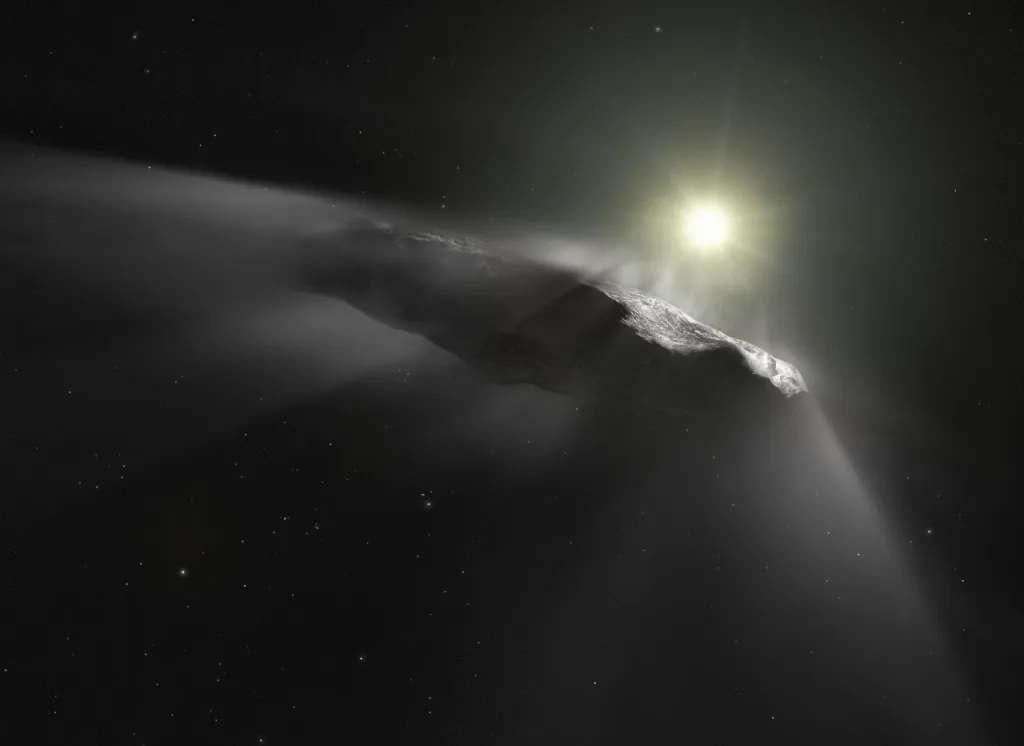
Astronomers first identified an interstellar visitor in 2017 when 1I/’Oumuamua passed through the Solar System. Two years later, 2I/Borisov provided another example of an object arriving from outside our planetary neighborhood.
Then came 3I/ATLAS.
While each discovery attracted significant attention, 3I/ATLAS arrived at a time when researchers had accumulated enough data to begin examining the broader population of interstellar wanderers.
That shift changed the conversation. Instead of studying individual objects, scientists began asking how many similar bodies might exist across the galaxy.
A Hidden Population Across the Milky Way
Most interstellar objects remain invisible.
Telescopes can only detect those that pass close enough to the Sun or Earth. The vast majority stay far beyond current detection limits. As a result, astronomers may only be seeing a tiny fraction of the total population.
If billions of these objects exist, they could collectively contain a surprising amount of mass.
That possibility inspired researchers to investigate whether these hidden travelers contribute to the galaxy’s unseen matter.
Why Size Matters
Mass depends on both size and abundance.
A single interstellar object contributes very little to the Milky Way’s total mass. However, the picture changes dramatically if enormous numbers of similar bodies fill interstellar space.
Researchers used estimates based on the known interstellar visitors to calculate how much mass such a population could contain.
The results surprised many astronomers.
Interstellar Objects and Dark Matter: The New Calculation
Estimating the Galaxy’s Hidden Inventory
The University of Hamburg team used statistical models to estimate how many interstellar objects may exist throughout the Milky Way.
Their approach relied on a simple idea. If telescopes have already detected three interstellar visitors within a relatively short period, then many more likely remain undetected.
Using detection rates and population models, the researchers extrapolated the possible number of similar objects scattered across the galaxy.
The Surprising Result
The study concluded that interstellar objects similar to 3I/ATLAS could account for between 13% and 45% of the mass currently attributed to dark matter.
That range represents a significant amount of material.
If correct, it would mean that part of the Milky Way’s invisible mass consists of ordinary matter rather than exotic dark matter particles.
The findings do not challenge gravity. They also do not eliminate dark matter. Instead, they suggest that astronomers may have underestimated the amount of hidden conventional matter between the stars.
Ordinary Matter Hiding in Plain Sight
One reason the idea attracts attention is that interstellar objects are made of ordinary matter.
Unlike dark matter, these bodies contain familiar materials such as rock, ice, and dust. They simply remain too distant and too faint for current instruments to detect.
That distinction matters.
Scientists have spent decades searching for dark matter particles. If some missing mass comes from ordinary objects instead, future measurements may require adjustments.
The debate surrounding Interstellar Objects and Dark Matter now centers on how large that contribution could be.
Why Many Astronomers Remain Skeptical
A Sample Size of Only Three Objects
The biggest limitation is obvious.
The entire study depends on only three confirmed interstellar objects:
- 1I/’Oumuamua
- 2I/Borisov
- 3I/ATLAS
Three examples cannot accurately represent an entire galaxy.
Small samples often produce large uncertainties. A few unusual objects can dramatically affect statistical estimates.
Because of this limitation, many researchers view the findings as an intriguing possibility rather than a firm conclusion.
The Optimistic Upper Estimate
The study’s highest estimate also relies on favorable assumptions.
To reach the upper value of 45%, planetary systems across the galaxy must eject vast quantities of material into interstellar space.
Even the authors acknowledge that this scenario may be overly optimistic.
The lower estimates remain plausible, but the upper limit should be treated with caution until more observational evidence becomes available.
Dark Matter Still Explains Most Observations
Another important point often gets lost in headlines.
This study does not replace dark matter.
Dark matter remains the leading explanation for galaxy rotation curves, galaxy cluster dynamics, and large-scale cosmic structure.
Even if interstellar objects account for a meaningful portion of the missing mass, a large amount of unexplained gravitational influence would still remain.
For now, dark matter continues to occupy a central role in modern cosmology.
A New Piece of the Puzzle
Instead of replacing existing theories, the new research may add another piece to the puzzle.
Astronomers already know that galaxies contain hidden matter. The question is how much of that matter consists of dark matter and how much consists of unseen ordinary objects.
That balance remains uncertain.
Future observations will help determine whether Interstellar Objects and Dark Matter are more closely linked than scientists currently believe.
The Vera Rubin Observatory Could Provide the Answer
A New Era of Discovery
The upcoming Vera C. Rubin Observatory could transform this field.
Its advanced survey capabilities will repeatedly scan the night sky with unprecedented sensitivity. Scientists expect it to discover many more interstellar visitors than previous observatories.
That increase could happen quickly.
Instead of working with three objects, researchers may soon have dozens or even hundreds.
Better Statistics, Better Answers
A larger sample will dramatically improve confidence levels.
Astronomers will gain a clearer understanding of:
- How common interstellar objects really are
- Their typical sizes
- Their total mass contribution
- Their distribution throughout the galaxy
These measurements will allow researchers to test the Hamburg study directly.
If the population proves smaller than expected, the idea may fade. If the population proves larger, the implications could be profound.
Revisiting the Milky Way’s Mass Budget
Every improvement in observational data helps refine our understanding of the galaxy.
For decades, astronomers have worked to determine exactly where the Milky Way’s mass resides. Future discoveries may reveal that some of that hidden mass comes from countless wandering objects drifting between the stars.
Whether that contribution is small or significant remains unknown.
The answer may arrive within the next few years.
Interstellar Objects and Dark Matter: A Mystery Worth Watching
The discovery of 3I/ATLAS has done more than add another interstellar visitor to the record books. It has inspired scientists to revisit one of astronomy’s most enduring mysteries.
New calculations suggest that unseen interstellar objects may account for part of the Milky Way’s hidden mass. The idea remains speculative, and the evidence remains limited. Yet the mathematics show that the possibility deserves serious investigation.
Most importantly, the study does not eliminate dark matter. Instead, it highlights a potential blind spot in our understanding of the galaxy.
As new observatories begin surveying the sky, astronomers will finally obtain the data needed to test these claims. Until then, the relationship between Interstellar Objects and Dark Matter remains one of the most intriguing questions in modern astronomy.
Main Sources:
https://universemagazine.com/en/proportion-of-dark-matter-in-the-galaxy-may-be-overestimated
https://arxiv.org/abs/2605.04801
https://phys.org/news/2026-06-milky-mass-swarm-interstellar-comets.html