BY:SpaceEyeNews.
Introduction: The Question That Changes How We See the Universe
The phrase Big Bang happened everywhere sounds strange at first. Most people imagine the universe beginning with a giant explosion from a single location. That picture feels intuitive because explosions in everyday life start at a central point and spread outward.
However, modern cosmology tells a very different story.
According to the standard model of the universe, the Big Bang was not an explosion into empty space. Instead, it was the expansion of space itself. That distinction may seem small, but it changes everything. It explains why astronomers cannot identify a center of the universe and why every galaxy appears to see other galaxies moving away.
This idea also leads to one of the most surprising conclusions in science. If the Big Bang happened everywhere, then the location you occupy today was part of the event from the very beginning. There was no special point where everything started. The early universe existed everywhere at once.
Understanding why requires a closer look at what astronomers actually mean when they talk about cosmic expansion.
Why the Big Bang Happened Everywhere Instead of Exploding From One Point
The Common Misconception
Movies, illustrations, and even some textbooks often present the Big Bang as a giant explosion. In that picture, matter erupts from a central location and travels through empty space.
The problem is that this image does not match modern cosmology.
A conventional explosion has three key features:
- A center
- Material moving outward
- Empty space surrounding the event
The universe does not appear to have any of those characteristics on the largest scales.
What Cosmologists Actually Describe
Modern cosmological models, based on Einstein’s theory of general relativity, describe something very different.
Space itself expands.
Galaxies do not move away from a central blast site. Instead, the distances between large regions of space increase over time. As space stretches, galaxies become more separated.
This means there is no preferred location. Every region participates in the expansion.
As a result, the statement that the Big Bang happened everywhere is not a philosophical idea. It is a direct consequence of the mathematics used to describe the universe.
Space Was Part of the Event
Another important point often gets overlooked.
The Big Bang did not happen inside pre-existing space. Space itself was involved in the process.
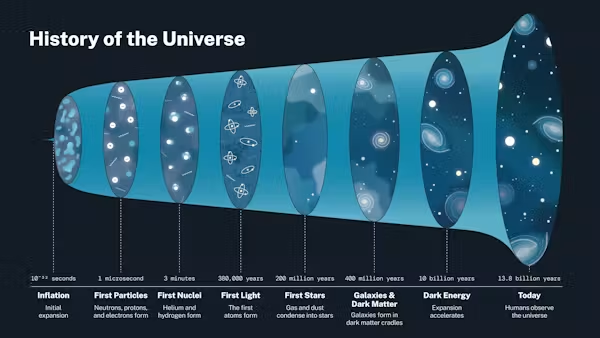
When cosmologists trace the universe backward in time, they find that matter and energy become increasingly concentrated. The universe becomes hotter and denser.
Eventually, every observable region reaches an extremely dense state.
The key detail is that this state existed everywhere. There was no external location where the universe began.
Big Bang Happened Everywhere and Every Galaxy Looks Central
The Discovery That Changed Astronomy
In the 1920s, astronomers made a remarkable discovery.
Distant galaxies appeared to move away from Earth. Even more importantly, the farther away a galaxy was, the faster it seemed to recede.
This relationship became known as the Hubble-Lemaître Law.
At first glance, the observation appears to place Earth near the center of the universe.
If everything is moving away from us, it seems reasonable to assume we occupy a special position.
Fortunately, the actual explanation is far more interesting.
Why Every Observer Sees the Same Thing
Because space expands uniformly on large scales, observers in other galaxies would see the same pattern.
An astronomer living billions of light-years away would observe the Milky Way moving away. They would also see distant galaxies receding faster than nearby ones.
From their perspective, they might conclude that they sit at the center.
Yet we know they do not.
The reason every observer appears central is simple. No location is truly special.
The expansion looks the same from every large-scale vantage point.
The Raisin Bread Analogy
Scientists often use rising raisin bread to illustrate this concept.
Imagine raisins embedded inside dough.
As the dough rises, every raisin moves farther from every other raisin. The raisins themselves do not drive the expansion. The dough between them grows.
Each raisin sees all others moving away.
No raisin occupies a privileged position.
The expanding universe behaves in a similar way.
Where the Analogy Fails
Like all analogies, this one has limits.
A loaf of bread has edges. It sits inside an oven.
The universe may not have either.
Current observations reveal no physical edge. The observable universe has a horizon, but that horizon marks the limit of what light has reached us since the beginning of cosmic expansion.
It is not a wall or boundary.
Evidence That the Big Bang Happened Everywhere
The Cosmic Microwave Background
One of the strongest pieces of evidence comes from the Cosmic Microwave Background, often called the CMB.
Scientists discovered this faint radiation in 1964.
The CMB represents ancient light released when the universe became transparent roughly 380,000 years after the beginning of cosmic expansion.
Today, astronomers detect this radiation across the entire sky.
Why Uniformity Matters
If the universe originated from a localized explosion, scientists would expect to see signs of a preferred direction.
The leftover radiation should appear stronger in one part of the sky.
Observations reveal the opposite.
The Cosmic Microwave Background arrives from virtually every direction with remarkable uniformity.
Tiny fluctuations exist, but the overall signal remains extremely consistent.
This pattern strongly supports the idea that the early universe was hot and dense everywhere.
In other words, the evidence aligns with the conclusion that the Big Bang happened everywhere rather than at a specific location.
What Space Missions Revealed
Several missions transformed our understanding of the early universe.
NASA’s COBE mission first measured the Cosmic Microwave Background with high precision.
WMAP improved those measurements significantly.
Later, the European Space Agency’s Planck spacecraft delivered the most detailed map ever created of this ancient light.
Together, these missions revealed a universe that was remarkably uniform shortly after its formation.
The tiny variations detected in the CMB later grew into galaxies, clusters, and large-scale cosmic structures.
Without those small fluctuations, stars and planets might never have formed.
What Scientists Still Do Not Know
The Earliest Fraction of a Second
Cosmologists can describe the universe extremely well after its earliest moments.
However, important questions remain unanswered.
Scientists still do not know exactly what happened at the very beginning.
General relativity explains gravity on large scales.
Quantum mechanics explains nature on extremely small scales.
Researchers have not yet unified these two frameworks into a complete theory of quantum gravity.
As a result, the exact conditions at time zero remain uncertain.
Is the Universe Infinite?
Another mystery concerns the universe’s total size.
The observable universe spans roughly 93 billion light-years in diameter.
Yet that observable region may represent only a small fraction of the whole.
Scientists do not currently know whether the entire universe is finite or infinite.
Future discoveries may provide better answers.
For now, the question remains open.
What Remains Certain
Despite these uncertainties, several conclusions enjoy strong observational support.
The universe expanded from a much hotter and denser state.
The Cosmic Microwave Background exists and matches theoretical predictions.
Galaxies continue moving apart as space expands.
Most importantly, no evidence points to a central location where the universe began.
Conclusion: The Universe Has No Ordinary Center
The idea that the Big Bang happened everywhere remains one of the most surprising conclusions in modern science.
It challenges the intuitive image of a giant explosion spreading through empty space. Instead, it presents a universe where space itself expands. Every region participates in that expansion. No location holds a privileged status.
That is why astronomers cannot identify a center of the universe. It is also why observers in distant galaxies would see the same large-scale pattern that we observe today.
The question “Where did the Big Bang happen?” sounds simple. Yet modern cosmology offers an answer that is both elegant and profound.
It happened everywhere.
The hot, dense early universe was not confined to a distant point in the sky. The place where Earth exists today was already part of that cosmic beginning. In that sense, every location in the universe can trace its history back to the same event, not because it expanded outward from a center, but because the universe itself expanded everywhere at once.
Main Sources:
NASA – Cosmic Microwave Background:
https://map.gsfc.nasa.gov
ESA Planck Mission:
https://www.esa.int/Science_Exploration/Space_Science/Planck
NASA WMAP Mission:
https://wmap.gsfc.nasa.gov