BY:SpaceEyeNews.
For decades, scientists believed they had a solid explanation for how binary asteroids form. A rapidly spinning asteroid would shed material. Some of that material would remain nearby and eventually gather into a moon. The model appeared simple and effective.
However, recent observations have raised new questions. NASA’s Lucy mission discovered an unusual asteroid system that does not fit neatly into the traditional picture. The asteroid Dinkinesh and its strange companion have encouraged researchers to rethink how small-body systems evolve.
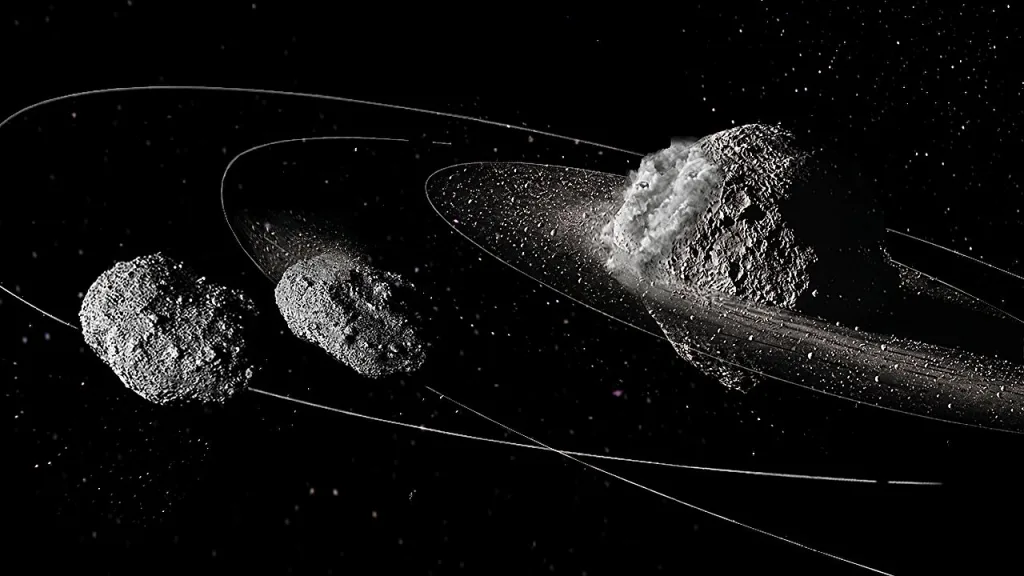
A new Asteroid Formation Theory now suggests that many asteroid systems may form through several repeating stages rather than a single event. If correct, the theory could explain some of the Solar System’s most unusual asteroid families and reshape our understanding of asteroid evolution.
Dinkinesh Revealed a Surprising Asteroid System
NASA’s Lucy spacecraft encountered Dinkinesh in November 2023 during a flyby designed to test mission operations. Scientists expected a relatively ordinary asteroid.
Instead, they found something unexpected.
The Discovery of Selam
Dinkinesh possesses a small companion named Selam. At first glance, Selam appeared to be a typical moon. Further analysis revealed a much more unusual structure.
Selam is a contact binary. It consists of two small lobes connected together. The pair orbit Dinkinesh as a single object.
This discovery immediately attracted attention because such a structure is difficult to explain using conventional asteroid formation models.
Why Scientists Became Interested
The traditional model works well for many binary asteroid systems. However, Selam introduced new complexity.
Researchers began asking several questions:
- How did two small bodies become attached?
- Did they form separately?
- Did they merge later?
- Could multiple formation events be involved?
These questions became the foundation for a new investigation into asteroid evolution.
Traditional Asteroid Formation Theory Faces New Challenges
For many years, planetary scientists relied on a straightforward explanation for binary asteroid formation.
How the Traditional Model Works
Small asteroids can gradually increase their rotation speed. Sunlight can contribute to this process through a phenomenon known as the YORP effect.
As rotation accelerates, the asteroid may begin losing material.
Some of that material escapes completely. Some remains in orbit around the parent body. Over time, the orbiting debris can accumulate and form a moon.
Many known binary asteroids fit this model reasonably well.
The Limits of a Single Ejection Event
The challenge emerges when scientists examine more complex systems.
Dinkinesh is not alone. Other asteroid systems also contain multiple components that appear difficult to explain through one ejection event.
Examples include:
- 2001 SN263
- Balam
- Other multiple-asteroid systems
These objects display structures that suggest a longer and more complicated evolutionary history.
As a result, researchers began exploring whether asteroid systems develop through repeated cycles rather than a single episode.
The New Asteroid Formation Theory
Researchers from China recently proposed a new Asteroid Formation Theory to explain these unusual systems.
The theory introduces a more dynamic picture of asteroid evolution.
Repeated Material Ejections
Instead of a single event, the parent asteroid may lose material several times during its lifetime.
Each episode creates new fragments.
Some fragments leave the system. Others remain nearby and enter orbit.
Over long periods, these repeated events can create multiple generations of orbiting bodies.
Continuous System Evolution
The new model treats asteroid systems as evolving environments.
Conditions do not remain fixed.
Orbits shift over time. Small objects interact with one another. New fragments appear after later mass-loss events.
This ongoing activity creates opportunities for increasingly complex structures to emerge.
Building More Than One Moon
Repeated ejections allow several satellites to form.
These satellites may occupy different orbits.
They can influence each other through gravity. Over time, those interactions can significantly alter the architecture of the system.
This process provides a possible pathway for creating multiple asteroid companions around a single parent body.
Orbital Evolution Plays a Critical Role
The new Asteroid Formation Theory does not stop with repeated material loss.
Researchers argue that orbital evolution is equally important.
Satellite Orbits Change Over Time
Once satellites form, they do not necessarily remain in the same locations.
Gravity continuously affects their motion.
Small changes accumulate over thousands or millions of years.
Eventually, satellites can move closer together or farther apart.
Interactions Between Small Bodies
Multiple satellites create a complex environment.
Each object influences the others.
These interactions can alter orbital paths and rotation rates.
Scientists believe such effects may help explain the unusual arrangements observed in several asteroid systems.
Slow Encounters Create New Possibilities
One of the most interesting parts of the theory involves slow-speed encounters.
Not every meeting between two orbiting bodies ends in destruction or separation.
Under the right conditions, two objects can approach gently enough to remain together.
This process creates a potential pathway for forming contact binaries.
How Contact-Binary Moons May Form
Contact binaries are among the most intriguing structures in the Solar System.
They appear as two connected bodies that touch one another.
A Gentle Merger Scenario
According to the new model, two small moonlets may form independently.
Over time, orbital evolution brings them closer together.
If their relative speed remains low, they can merge gently.
The result is a contact binary similar to Selam.
This mechanism offers a logical explanation for what Lucy observed around Dinkinesh.
Why Selam Matters
Selam may represent more than a curiosity.
It may provide direct evidence that asteroid systems evolve through multiple stages.
The object appears consistent with the idea that asteroid moons can grow, interact, migrate, and merge over long timescales.
That possibility makes Dinkinesh an important natural laboratory for planetary science.
Computer Simulations Support the Asteroid Formation Theory
A scientific theory must match observations.
To test their idea, researchers created advanced computer simulations.
Reconstructing Asteroid Histories
The simulations included:
- Repeated mass-loss events
- Satellite formation
- Orbital evolution
- Gravitational interactions
- Contact-binary formation
Scientists then compared the results with real asteroid systems.
Matching Known Asteroid Systems
The findings were significant.
Researchers reported that approximately 44% of known multiple asteroid systems could be explained by the new framework.
That result does not prove the theory is correct in every case.
However, it provides strong evidence that the model captures important aspects of asteroid evolution.
More Questions Remain
Scientists still need additional observations.
Many asteroid systems remain poorly understood.
Future spacecraft missions and telescope observations will help test the theory further.
As new data arrive, researchers can refine their models and improve their understanding of these small worlds.
Why the Asteroid Formation Theory Matters
The importance of this research extends beyond a single asteroid.
Small Asteroids Have Complex Histories
Scientists once viewed many asteroids as relatively simple objects.
New discoveries suggest otherwise.
Some asteroids may experience repeated cycles of material loss, satellite formation, migration, and merging.
Their histories may span millions of years and involve multiple stages of development.
Lucy Could Provide More Answers
NASA’s Lucy mission continues its journey toward additional targets.
Future flybys may reveal whether systems like Dinkinesh are rare or common.
Each encounter offers an opportunity to test the new Asteroid Formation Theory.
A New View of Solar System Evolution
Asteroids preserve clues from the Solar System’s distant past.
Understanding how they evolve helps scientists reconstruct broader planetary history.
If the new theory proves accurate, researchers may need to revise how they interpret many binary and multiple asteroid systems.
That would represent an important step forward in planetary science.
Conclusion
The discovery of Dinkinesh and its unusual companion has sparked renewed interest in asteroid evolution. A new Asteroid Formation Theory suggests that complex asteroid systems may form through repeated material ejections, orbital migration, and gentle mergers rather than a single event. Computer simulations already show promising results. As NASA’s Lucy mission continues exploring the Solar System, scientists may soon learn whether this Asteroid Formation Theory represents a major breakthrough in understanding how asteroid systems develop and change over time.
Main Sources:
- Universe Magazine
https://universemagazine.com/en/unusual-binary-asteroids-have-led-scientists-to-propose-an-intriguing-theory-about-their-formation/ - Nature Communications (Original Research Paper)
https://www.nature.com/articles/ - NASA Lucy Mission
https://www.nasa.gov/mission/lucy/ - Southwest Research Institute – Lucy Mission Updates
https://www.swri.org/missions/lucy - NASA Solar System Exploration – Dinkinesh and Selam
https://solarsystem.nasa.gov/asteroids-comets-and-meteors/asteroids/