BY:SpaceEyeNews.
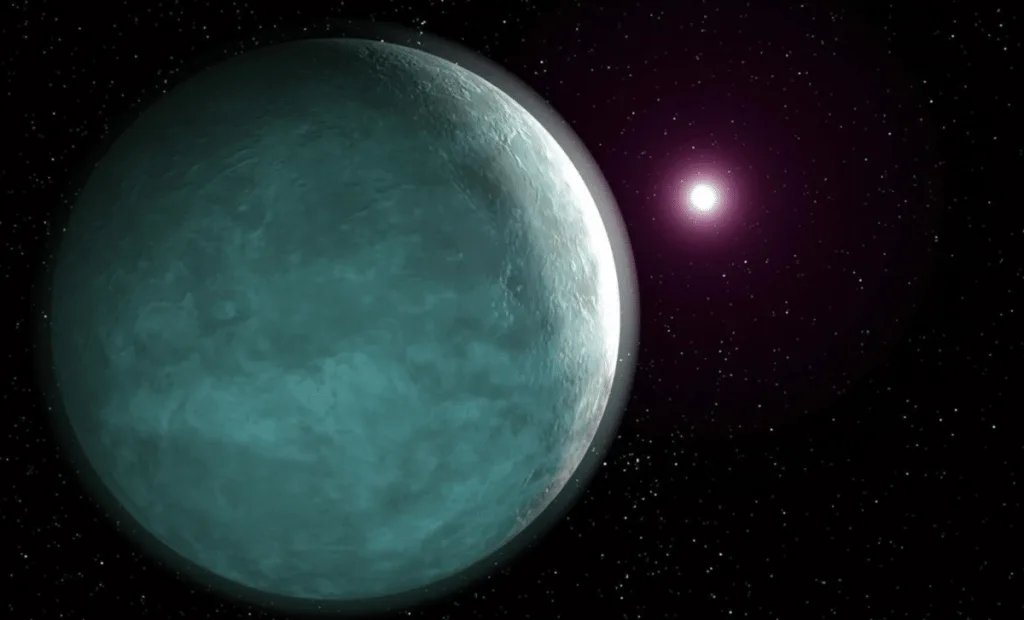
A giant exoplanet located 383 light-years from Earth is giving astronomers a rare opportunity to study one of the strangest regions in planetary science. Known as TOI-1883 b, this unusual world combines a large size, low mass, and extremely low density. Those characteristics make it one of the puffiest planets ever discovered around a red dwarf star.
The planet circles its host star every 4.5 days. That alone would make it interesting. However, recent observations revealed something even more surprising. TOI-1883 b has a density of only about 0.4 grams per cubic centimeter. That is lower than water and far lower than astronomers expected for a planet of its size.
The discovery places TOI-1883 b among a rare group of inflated worlds that challenge current theories of planetary formation and evolution. More importantly, the planet sits inside a mysterious region known as the Neptunian Desert, where planets of similar size are surprisingly uncommon.
As researchers continue to investigate this remarkable world, TOI-1883 b may help answer long-standing questions about planetary migration, atmospheric loss, and the forces that shape planetary systems throughout the galaxy.
TOI-1883 b Changed After Scientists Measured Its Mass
A Large Planet With A Missing Piece Of The Puzzle
Astronomers first identified TOI-1883 b through observations from NASA’s Transiting Exoplanet Survey Satellite. Early measurements showed that the planet possessed a radius more than five times larger than Earth’s. Yet one critical value remained unknown.
Scientists did not know its mass.
Without a mass measurement, researchers could not determine whether TOI-1883 b was a dense rocky world, an ice-rich planet, or a gas-dominated object with an extended atmosphere.
That uncertainty remained until a team led by researchers from the University of Tokyo performed follow-up observations using the InfraRed Doppler instrument mounted on the Subaru Telescope.
Subaru Telescope Revealed The True Nature Of TOI-1883 b
The team combined radial velocity measurements with additional transit observations collected through the MuSCAT instrument series.
The results transformed the planet from an interesting discovery into a major scientific target.
Researchers determined that TOI-1883 b possesses:
- Mass: 13.7 Earth masses
- Radius: 5.65 Earth radii
- Density: 0.4 g/cm³
Those numbers immediately attracted attention.
For comparison, Neptune has a density of roughly 1.64 g/cm³. TOI-1883 b is significantly less dense despite being larger.
Why Such A Low Density Matters
The measurements indicate that TOI-1883 b contains a massive gaseous envelope surrounding a relatively small core.
Astronomers often describe planets like this as “puffy planets” or “cotton candy planets.”
Their atmospheres appear greatly inflated relative to their mass.
This inflation creates valuable opportunities for scientists because extended atmospheres are easier to study. Light passing through the atmosphere can reveal chemical signatures and provide clues about planetary history.
That characteristic alone makes TOI-1883 b an attractive target for future observations.
TOI-1883 b Lives Inside The Neptunian Desert
Understanding The Neptunian Desert
One of the most fascinating aspects of TOI-1883 b is its location.
The planet resides inside a region astronomers call the Neptunian Desert.
This area contains surprisingly few planets with sizes between super-Earths and gas giants that orbit very close to their stars.
The shortage has puzzled scientists for years.
Detection bias does not explain the absence. These planets should be relatively easy to find.
Instead, something in the evolutionary process appears to remove them or prevent them from forming.
Why The Neptunian Desert Exists
Several theories attempt to explain the phenomenon.
One possibility involves atmospheric escape. Intense radiation from a nearby star can gradually strip away a planet’s atmosphere.
Another theory suggests that migration processes influence which planets survive in short-period orbits.
Some researchers believe that both mechanisms work together.
Planets may move inward and then lose large portions of their atmospheres over billions of years.
TOI-1883 b Occupies A Rare Position
TOI-1883 b sits within a subsection known as the Neptunian Ridge.
This region includes planets with orbital periods between roughly 3 and 6 days.
The planet’s orbital period of 4.506 days places it directly inside that category.
Because so few planets occupy this region, every discovery provides valuable information.
TOI-1883 b becomes even more important because it combines a short orbit with an extremely low density.
That unusual combination challenges current models and offers a rare test case for future research.
The Evolutionary History Of TOI-1883 b May Explain Its Survival
Evidence For Planetary Migration
Scientists do not believe TOI-1883 b formed where it currently resides.
Instead, the research suggests that the planet likely formed farther away from its star.
During the early stages of planetary system formation, large planets often interact with surrounding gas disks.
Those interactions can gradually alter their orbits.
Over time, planets may migrate inward toward their stars.
Researchers believe TOI-1883 b followed this path.
Surviving Extreme Stellar Radiation
After migrating inward, the planet entered a much harsher environment.
Close proximity to the host star exposes the atmosphere to high-energy radiation.
That radiation can drive photoevaporation.
Photoevaporation occurs when energetic stellar light removes atmospheric particles from a planet over long periods.
Many scientists believe this process plays a major role in shaping the Neptunian Desert.
Yet TOI-1883 b still retains an enormous atmosphere.
That survival raises an important question.
Why did this planet avoid losing most of its gas while others apparently did not?
A Metal-Rich Star May Hold The Answer
Researchers identified another clue in the host star itself.
The star exhibits metallicity levels higher than those found in the Sun.
In astronomy, metallicity refers to elements heavier than hydrogen and helium.
Higher metallicity can influence how planets form and evolve.
The team suggests that this environment may have limited runaway gas accretion during the planet’s early growth.
As a result, TOI-1883 b never became a Jupiter-sized giant.
Instead, it remained in a transitional state.
The planet accumulated enough gas to become highly inflated but not enough to trigger full gas giant formation.
That scenario may explain its unique characteristics today.
Why TOI-1883 b Could Become A Benchmark Exoplanet
An Ideal Atmosphere For Future Observations
The enormous atmosphere surrounding TOI-1883 b creates a major advantage for astronomers.
Larger atmospheres produce stronger observational signals.
That allows researchers to study atmospheric chemistry with greater precision.
Future instruments may detect:
- Water vapor
- Methane
- Carbon-bearing molecules
- Atmospheric escape signatures
Those observations could reveal how the planet evolved over time.
Searching For Additional Planets
Scientists also want to investigate the possibility of additional planets in the system.
Subtle gravitational interactions can influence orbital behavior.
Future radial velocity measurements may reveal hidden companions.
Finding additional planets could improve our understanding of how the entire system formed and evolved.
A Valuable Laboratory For Planetary Science
Few planets combine all of the characteristics seen in TOI-1883 b.
It possesses:
- A short orbital period
- Extremely low density
- A large atmosphere
- A location inside the Neptunian Desert
- An orbit around an M-dwarf star
Together, these features make the planet an exceptional laboratory for testing theories of planetary evolution.
Researchers may eventually use TOI-1883 b as a benchmark object for studying inflated planets across the galaxy.
Conclusion: TOI-1883 b Could Help Solve A Cosmic Mystery
TOI-1883 b is far more than another exoplanet discovery.
Its unusually low density places it among the puffiest worlds ever observed around a red dwarf star. Its position inside the Neptunian Desert makes it even more valuable.
The planet appears to preserve clues about migration, atmospheric loss, and planetary survival in extreme environments.
Astronomers still have many questions. Future observations will refine the planet’s mass, probe its atmosphere, and search for additional worlds in the system.
If those investigations confirm current theories, TOI-1883 b may become one of the most important exoplanets for understanding how planets evolve. It offers a rare window into processes that shape planetary systems throughout the Milky Way and could help explain one of the biggest mysteries in modern exoplanet science.
Main Sources:
https://subarutelescope.org/en
https://science.nasa.gov/exoplanets