
BY:SpaceEyeNews.
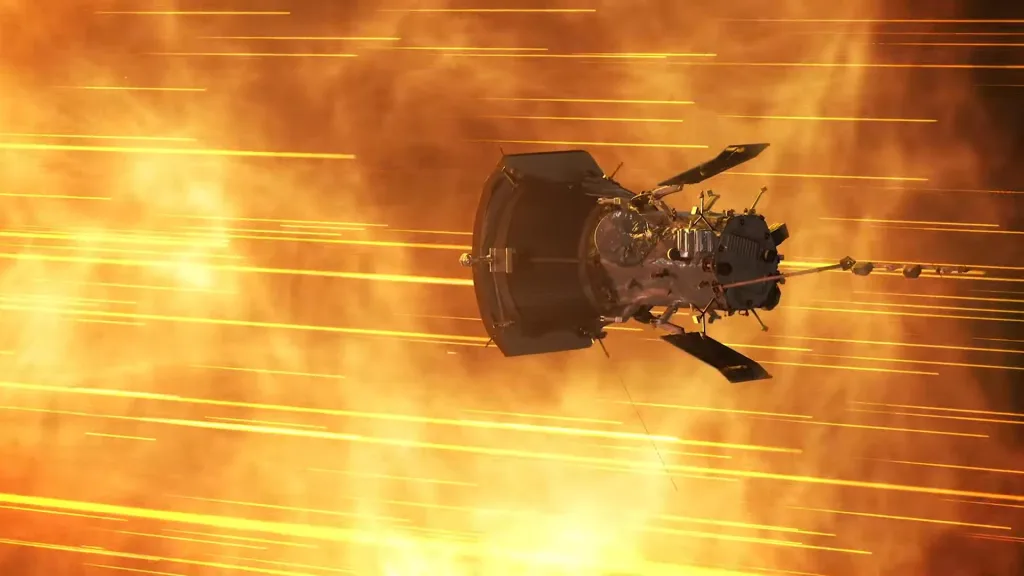
NASA’s Parker Solar Probe has delivered another major surprise from the Sun. During several close approaches through the solar corona, the spacecraft detected energetic particles that were far more powerful than scientists expected. The discovery points to what researchers now describe as a Parker Solar Probe particle accelerator operating near the Sun.
The finding emerged from observations made while Parker crossed the heliospheric current sheet, a region where the Sun’s magnetic field changes direction. Scientists have studied magnetic reconnection in this area for years. However, the proton energies measured by Parker were roughly 1,000 times higher than theoretical models predicted.
That gap between prediction and observation is forcing researchers to rethink how particles gain energy near the Sun. The discovery may also improve our understanding of solar energetic particles and the long-standing mystery of coronal heating.
Parker Solar Probe Particle Accelerator Detected Near the Sun
The discovery occurred during Parker Solar Probe’s closest passes to the Sun. These encounters allowed the spacecraft to travel through regions that no previous mission had explored directly.
As Parker crossed the heliospheric current sheet, its instruments detected energetic protons reaching energies of approximately 400 keV. Such measurements immediately attracted attention because existing models suggested much lower energy levels.
Scientists quickly realized that a previously underestimated acceleration process might be operating in this region.
Why the Discovery Matters
The heliospheric current sheet stretches throughout the solar system. It forms where magnetic fields of opposite polarity meet and interact.
Researchers already knew that magnetic reconnection occurs within this structure. During reconnection, magnetic field lines break apart and reconnect. This process releases stored magnetic energy into surrounding plasma.
What surprised researchers was the efficiency of the process. The energetic particles measured by Parker exceeded theoretical expectations by a remarkable margin.
As a result, scientists began searching for a mechanism capable of producing such extreme particle acceleration.
Inside the Reconnection Region
The observations revealed that energetic particles were trapped inside structures known as magnetic islands.
These islands form naturally during magnetic reconnection events. As magnetic field lines reconnect, they create closed-loop structures that can trap charged particles.
Parker’s data showed that many of these islands merged together. During that process, particles gained substantial amounts of energy.
Researchers now believe that island merging played a major role in creating the newly identified Parker Solar Probe particle accelerator.
How Magnetic Island Merging Accelerates Particles
The new study points toward magnetic island merging as the key driver behind the observed particle energies.
Scientists have discussed this mechanism before. However, they never expected it to produce particles at the levels recorded by Parker Solar Probe.
Magnetic Islands as Natural Accelerators
Magnetic islands behave like moving magnetic containers.
When particles become trapped inside them, they repeatedly interact with changing magnetic fields. Each interaction can increase particle energy.
As islands merge, the process becomes even more efficient. Particles bounce between converging magnetic structures and gain additional energy.
The result resembles a natural particle accelerator operating within the Sun’s atmosphere.
A Thousand-Fold Surprise
One of the most striking results involves the difference between prediction and observation.
The measured proton energies were approximately one thousand times greater than the available magnetic energy per particle predicted by earlier models.
This discrepancy cannot be ignored.
Scientists now face an important challenge. They must determine whether current reconnection theories are incomplete or whether entirely new processes contribute to particle acceleration near the Sun.
Either possibility could reshape solar physics research in the coming years.
What the Parker Solar Probe Particle Accelerator Means for Solar Energetic Particles
Solar energetic particles can travel throughout the solar system. These particles influence space weather and can affect spacecraft systems.
For decades, scientists believed that the strongest particle populations mainly originated from large-scale shock waves.
Those shock waves often form during coronal mass ejections or other major solar disturbances.
The Parker findings suggest another source may play a larger role than previously recognized.
Rethinking Traditional Models
Most solar energetic particle models focus on shock acceleration.
According to those models, particles gain energy as they repeatedly cross moving shock fronts.
That mechanism remains important. However, Parker’s observations indicate that magnetic reconnection may contribute much more than expected.
If reconnection can generate highly energetic particles near the Sun, some space weather events may begin much closer to their source than current models assume.
Implications for Future Research
Researchers now want to know how many energetic particles originate from reconnection regions.
They also want to determine whether these particles can travel outward and contribute to events observed near Earth.
Answering those questions will require additional observations.
Fortunately, Parker Solar Probe continues to collect data during repeated close encounters with the Sun.
Each new pass provides another opportunity to test the newly proposed acceleration mechanism.
Could This Discovery Help Solve the Coronal Heating Mystery?
The discovery also connects to one of the biggest unsolved problems in solar science.
The solar corona reaches temperatures of several million degrees Celsius. Yet the visible surface of the Sun remains much cooler at roughly 5,500 degrees Celsius.
Scientists have spent decades trying to explain this temperature difference.
The Search for Missing Energy
Researchers know that energy must flow from the Sun’s magnetic field into the corona.
The challenge has always been identifying the dominant process.
Two leading explanations have emerged over the years.
The first involves wave heating. The second involves magnetic reconnection.
Both mechanisms likely contribute. However, the relative importance of each remains uncertain.
A New Piece of the Puzzle
The Parker Solar Probe particle accelerator suggests that magnetic reconnection may transfer more energy than previously estimated.
The observed energetic particles require a substantial energy source.
That energy comes directly from magnetic fields undergoing reconnection.
As a result, researchers now have stronger evidence that reconnection could play a larger role in heating the corona.
The discovery does not solve the coronal heating mystery. However, it changes the energy budget calculations and provides new constraints for future models.
What Comes Next for Parker Solar Probe?
The mission is far from over.
Parker Solar Probe has completed numerous close solar encounters, and additional observations are still ahead.
Scientists plan to search for more examples of magnetic island merging during future current sheet crossings.
Looking for Repeated Events
One observation can be exciting. Multiple observations can establish a pattern.
Researchers want to know whether the recently detected acceleration process occurs regularly.
If Parker repeatedly detects similar particle populations, confidence in the new model will grow significantly.
Future measurements may reveal how common these events are throughout the corona.
Working Together with Solar Orbiter
NASA’s Parker Solar Probe is not working alone.
The European Space Agency’s Solar Orbiter provides complementary observations from greater distances.
Together, the two spacecraft can track particle populations as they move away from the Sun.
This coordinated approach will help scientists identify which particle properties originate near the source and which evolve during their journey through the solar wind.
The combined datasets could provide some of the clearest insights yet into particle acceleration in the inner solar system.
Conclusion
The Parker Solar Probe particle accelerator discovery represents one of the most intriguing solar physics findings in recent years.
By detecting energetic protons far beyond theoretical expectations, Parker Solar Probe revealed a powerful acceleration mechanism operating inside the solar corona. The evidence points toward magnetic reconnection and magnetic island merging as key drivers behind this process.
The discovery challenges existing models of particle acceleration, raises new questions about solar energetic particles, and offers fresh clues about the coronal heating mystery. Most importantly, it shows that the Sun still holds surprises even in regions scientists thought they understood.
As Parker Solar Probe continues its historic mission, future observations may reveal whether this newly identified Parker Solar Probe particle accelerator is a rare phenomenon or a fundamental part of how the Sun transfers energy throughout the solar system.
Main Sources:
- Space Daily
https://www.spacedaily.com - The Astrophysical Journal Letters
https://iopscience.iop.org/journal/2041-8205 - University of Maryland – NASA’s Parker Solar Probe Reveals Key Particle Accelerator Near Sun
https://cmns.umd.edu/news-events/news/nasas-parker-solar-probe-reveals-key-particle-accelerator-near-sun - NASA Parker Solar Probe Mission
https://science.nasa.gov/mission/parker-solar-probe - Southwest Research Institute (SwRI)
https://www.swri.org/newsroom/news-releases/nasas-parker-solar-probe-reveals-key-particle-accelerator-near-sun