
BY:SpaceEyeNews.
Humanity is preparing for a new era of exploration. Space agencies are developing missions that could return samples from Mars and other distant worlds. Those missions may help answer one of science’s biggest questions: has life ever existed beyond Earth?
Yet some researchers believe another question deserves attention before those samples arrive. What happens if future missions bring back something unexpected?
A recent scientific proposal suggests building a Lunar Biocontainment Facility on the Moon. The idea may sound like science fiction. However, the researchers behind the proposal argue that it could become an important layer of protection as sample-return missions grow more ambitious.
The concept is simple. Instead of bringing extraterrestrial material directly to Earth, spacecraft would first deliver it to a secure facility on the Moon. Scientists could then study the samples in isolation before approving their transfer to Earth.
The proposal does not claim alien life exists. Instead, it focuses on preparation. The researchers believe that planning ahead is far safer than reacting after a discovery.
Why Sample Return Missions Are Raising New Questions
The Next Generation of Space Exploration
For decades, spacecraft have collected data from other worlds. The next major step involves bringing physical samples back to laboratories for detailed study.
Future missions could return material from Mars, asteroids, and other destinations. Scientists hope these samples will reveal clues about planetary history and the possibility of life beyond Earth.
As exploration advances, planetary protection policies are receiving greater attention. Those policies aim to prevent contamination between Earth and other worlds.
The challenge becomes more complex when samples travel in the opposite direction and return home.
Why Scientists Are Discussing Biological Risks
Researchers describe the risk of extraterrestrial contamination as extremely low. Even so, they argue that the consequences could be significant if an unknown organism entered Earth’s environment.
Current containment facilities were designed to handle known biological threats. Scientists understand how bacteria, viruses, and other Earth organisms behave.
Extraterrestrial life, if it exists, could operate differently. Researchers cannot fully predict how an unfamiliar organism might interact with Earth’s ecosystems.
That uncertainty is driving discussions about stronger protective measures.
A Precautionary Approach
Scientists often prepare for unlikely events when the consequences could be substantial.
Planetary defense programs provide a useful example. Large asteroid impacts are rare. Yet agencies still monitor near-Earth objects because the stakes are high.
Supporters of a Lunar Biocontainment Facility apply similar reasoning. They argue that preparation should happen before a potential discovery rather than after one.
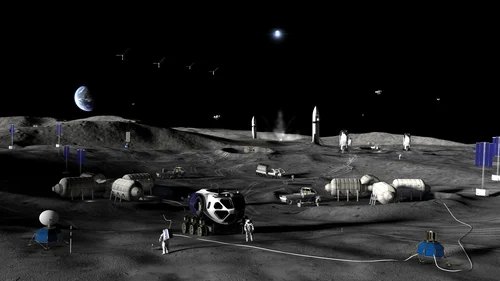
How a Lunar Biocontainment Facility Would Work
A Quarantine Station Beyond Earth
The proposed Lunar Biocontainment Facility would operate as a checkpoint between deep space and Earth.
Instead of landing directly on Earth, returning spacecraft would deliver samples to the Moon. Researchers would then examine the material inside a highly secure environment.
Only samples that pass extensive testing would continue to Earth.
This approach creates an additional safety barrier while allowing scientific investigation to continue.
Robotic Systems Would Handle Samples
The proposal relies heavily on automation.
Advanced robotic systems would perform most handling and analysis tasks. This reduces human exposure and limits opportunities for accidental contamination.
Scientists could operate equipment remotely while maintaining strict containment procedures.
As robotics continue to improve, researchers believe such systems could become increasingly practical.
Why the Moon Is the Preferred Location
The Moon offers several advantages.
First, it has no known biosphere. Any contamination event would remain isolated from Earth’s ecosystems.
Second, the Moon is relatively close. Communication delays are minimal compared with Mars.
Third, future lunar infrastructure may already support scientific operations. Planned lunar bases could provide technology and logistics that help support a Lunar Biocontainment Facility.
Together, these factors make the Moon an attractive location for a quarantine system.
Why Researchers Call the Moon a Biological Firewall
Creating Distance From Earth’s Ecosystem
The Moon sits nearly 240,000 miles from Earth. That distance provides a natural layer of protection.
Researchers describe the proposed facility as a biological firewall. In computer security, a firewall separates networks and blocks harmful activity.
The same principle applies here.
The Moon would create a protective boundary between Earth and any potentially hazardous material from space.
Time Becomes a Valuable Resource
Distance offers another benefit.
If scientists discovered an unexpected biological signature, they would have time to evaluate the situation carefully.
Researchers could conduct additional studies without placing Earth’s ecosystems at risk.
The Moon would serve as a controlled environment where decisions could be made without immediate pressure.
Supporting Future Exploration
A Lunar Biocontainment Facility could also support long-term exploration goals.
As missions become more ambitious, the volume of returned material may increase.
Scientists may eventually study samples from multiple worlds. A dedicated lunar quarantine center could become part of the broader infrastructure needed for deep-space exploration.
What Invasive Species Teach Us About Unknown Organisms
Lessons From Earth’s Ecosystems
One of the strongest arguments behind the proposal comes from ecology.
Researchers point to invasive species as examples of how organisms can transform environments after introduction.
History contains many cases where species entered new ecosystems and produced unexpected consequences.
In some situations, those changes persisted for decades.
Scientists argue that these examples demonstrate the importance of caution when dealing with unfamiliar life forms.
Why Prediction Is Difficult
A major challenge involves uncertainty.
Researchers cannot predict the characteristics of a hypothetical extraterrestrial organism because no such organism has been discovered.
Without data, assumptions become risky.
Some experts believe alien microbes would struggle to survive on Earth. Others argue that scientists should avoid making conclusions before evidence exists.
The proposal reflects this uncertainty rather than confidence in any specific threat.
The Rebound Contamination Scenario
Researchers also discuss another possibility.
Future missions may carry small amounts of Earth material to other worlds despite strict procedures.
Over long periods, biological material could change through environmental exposure.
If future missions later returned that material to Earth, scientists would want to understand any changes before release.
While highly speculative, the scenario highlights the complexity of planetary protection.
The Historical Connection to Apollo
Quarantine Was Not a New Idea
The concept of quarantine in space exploration has historical roots.
During the Apollo era, NASA took precautions when astronauts returned from the Moon.
Crew members entered quarantine after splashdown. Lunar samples also underwent careful examination.
At the time, scientists wanted to eliminate even remote biological concerns.
Why Mars Changes the Discussion
The Moon and Mars present different scientific questions.
Apollo missions focused primarily on lunar geology. Mars missions increasingly search for evidence related to past habitability and possible microbial life.
As a result, sample-return discussions now involve different levels of scrutiny.
The possibility of discovering biological signatures makes planetary protection more important than ever.
Are Existing Facilities Enough?
Some experts believe advanced Earth-based laboratories can safely handle returned samples.
Others support additional layers of protection.
The Lunar Biocontainment Facility proposal enters this debate by offering a location beyond Earth itself.
Whether such a system becomes necessary remains an open question.
Can a Lunar Biocontainment Facility Become Reality?
Lunar Infrastructure Is Expanding
Several space programs are working toward a sustained presence on the Moon.
NASA’s Artemis program aims to establish long-term lunar operations. Other nations are pursuing their own lunar initiatives.
As infrastructure grows, concepts that once seemed unrealistic become easier to evaluate.
A Lunar Biocontainment Facility could eventually benefit from technologies developed for lunar habitats and research stations.
Major Challenges Remain
Despite its appeal, the proposal faces obstacles.
Building and operating a secure facility on the Moon would require substantial investment.
Engineers would need reliable power systems, robotics, communications networks, and containment technologies.
Transportation logistics would add additional complexity.
These challenges do not make the concept impossible, but they do make it ambitious.
A Debate That May Grow Stronger
Today, the proposal remains a scientific recommendation rather than an official program.
However, the conversation is likely to continue.
The more capable sample-return missions become, the more attention planetary protection will receive.
Scientists, policymakers, and engineers may eventually need to decide whether Earth alone should host returned samples.
Conclusion
The Lunar Biocontainment Facility proposal is not based on evidence that alien organisms exist. Instead, it reflects a precautionary strategy for the future of exploration.
Researchers believe that as humanity returns more material from other worlds, additional safeguards may become necessary. The Moon offers a unique combination of isolation, accessibility, and scientific potential.
Whether the concept becomes reality remains uncertain. Yet the discussion highlights a larger shift in space exploration. Scientists are no longer asking only how to reach other worlds. They are also considering how to safely bring pieces of those worlds back home.
If humanity eventually discovers evidence of life beyond Earth, the first place we study it may not be on Earth at all. It could be inside a Lunar Biocontainment Facility on the Moon.
Main Sources:
- Daily Galaxy
https://dailygalaxy.com/2026/06/scientists-nasa-security-facility-the-moon/ - Phys.org – NASA should build a biocontainment facility on the Moon to protect Earth from extraterrestrial contamination
https://phys.org/news/2026-06-nasa-biocontainment-facility-moon-earth.html - Ambio (Original Scientific Paper)
https://link.springer.com/journal/13280 - Astrobiology.com – Protecting Earth from Extraterrestrial Contamination
https://astrobiology.com/2026/06/protecting-earth-from-extraterrestrial-contamination-the-case-for-a-lunar-biocontainment-facility.html - NASA Planetary Protection Overview
https://sma.nasa.gov/sma-disciplines/planetary-protection - NASA Artemis Program
https://www.nasa.gov/artemis - Space.com – Should We Store Mars Samples on the Moon?
https://www.space.com/astronomy/moon/should-we-store-mars-samples-on-the-moon-to-keep-alien-germs-away-from-earth