
BY:SpaceEyeNews.
For years, astronomers believed one type of observation simply could not be made. The dense hydrogen fog that filled the young universe should have hidden ionizing ultraviolet light from even the brightest early galaxies. Yet a remarkable new discovery has overturned that assumption. Hubble detects impossible galaxy MXDFz4.4, capturing light that researchers once believed would never escape.
The finding offers one of the strongest pieces of evidence yet for how the early universe became transparent. Rather than pointing toward supermassive black holes as the main drivers of cosmic reionization, the observations highlight the importance of compact clusters of hot, massive stars. Combined observations from the Hubble Space Telescope, the James Webb Space Telescope, and the European Southern Observatory’s Very Large Telescope now provide a detailed look at how one small galaxy may represent a much larger cosmic process.
Why Hubble Detects Impossible Galaxy Surprised Astronomers
The galaxy known as MXDFz4.4 existed roughly 1.4 billion years after the Big Bang. At that time, much of the universe still contained large amounts of neutral hydrogen gas. This gas absorbed energetic ultraviolet radiation, making it extremely difficult for astronomers to observe ionizing photons escaping from distant galaxies.
For decades, researchers expected this hydrogen fog to block almost all direct observations of ionizing ultraviolet light from galaxies living so early in cosmic history. That assumption made galaxies like MXDFz4.4 appear almost impossible to study using ultraviolet observations.
Instead, Hubble detected exactly what scientists expected to remain hidden.
According to the research team, the ultraviolet light could only have reached Earth if the hydrogen surrounding the galaxy had already become ionized. That means astronomers are seeing direct evidence of radiation escaping into intergalactic space during one of the universe’s most important transitions.
Lead researcher Ilias Goovaerts described the result as something researchers previously thought would be impossible to observe.
Why Escaping Ultraviolet Light Matters
The discovery goes far beyond finding another ancient galaxy.
The escaping ultraviolet photons reveal the physical process that helped transform the universe.
Astronomers have debated this question for decades. Two main candidates have dominated the discussion.
One possibility involved active supermassive black holes producing enough energetic radiation to ionize the surrounding hydrogen.
The second proposed that countless young, massive stars inside early galaxies generated the required ultraviolet radiation.
Direct evidence remained difficult to obtain because neutral hydrogen naturally absorbs these energetic photons.
MXDFz4.4 changes that picture.
Instead of relying only on theoretical models, astronomers can now study one galaxy where ionizing radiation clearly escaped into space.
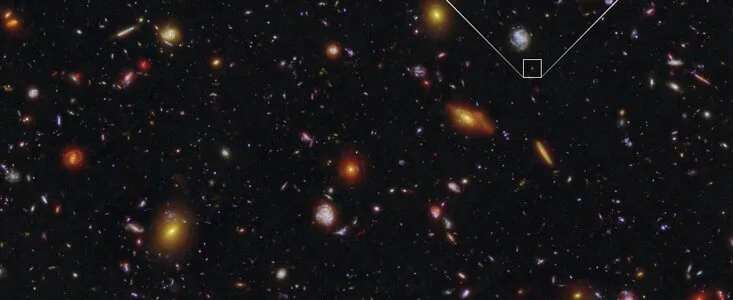
Hubble Detects Impossible Galaxy With an Extraordinary Stellar Nursery
MXDFz4.4 is remarkably small.
The galaxy measures roughly one hundred times smaller than the Milky Way. However, its star formation activity is extraordinary. Researchers estimate it creates new stars around ten times faster than our galaxy.
A Compact Cluster Makes the Difference
Inside the galaxy lies an exceptionally dense cluster of young, hot, massive stars.
Rather than spreading across the entire galaxy, these stars occupy a compact region. Their close concentration allows enormous amounts of ultraviolet radiation to build within a relatively small volume.
That concentrated energy appears powerful enough to gradually clear pathways through surrounding gas.
The observation supports earlier theoretical predictions suggesting that compact star clusters may contribute far more to cosmic reionization than previously recognized.
Star Formation Happened in Bursts
Data from the James Webb Space Telescope revealed another important clue.
Instead of forming stars continuously, MXDFz4.4 experienced repeated bursts of star formation.
Each burst produced fresh generations of hot, luminous stars capable of emitting large quantities of ionizing ultraviolet light.
Between these bursts, earlier generations of massive stars reached the ends of their short lives.
Many exploded as supernovae.
Those explosions pushed surrounding gas outward and created expanding cavities around the stellar cluster.
As more openings formed, ultraviolet radiation escaped more easily into intergalactic space.
The process repeated over millions of years.
Rather than one dramatic event, the surrounding hydrogen gradually became transparent through multiple cycles of star formation and stellar evolution.
How Three Observatories Solved the Mystery
This breakthrough did not rely on one telescope alone.
Instead, astronomers combined observations from three world-class observatories, with each contributing a unique piece of the puzzle.
Hubble Measured the Escaping Radiation
The Hubble Space Telescope directly detected the escaping ultraviolet photons.
This observation provided the strongest evidence that ionizing radiation successfully left the galaxy.
Without this measurement, researchers could only estimate how much radiation escaped.
James Webb Reconstructed the Galaxy’s History
The James Webb Space Telescope observed cooler and older stars inside MXDFz4.4.
Those observations allowed astronomers to reconstruct the galaxy’s star formation history.
The data showed repeated bursts instead of continuous star formation, strengthening the explanation for how the surrounding gas gradually cleared.
The Very Large Telescope Confirmed Its Distance
The galaxy was originally identified through observations from the Multi Unit Spectroscopic Explorer, or MUSE, mounted on the European Southern Observatory’s Very Large Telescope in Chile.
MUSE measured the galaxy’s redshift of approximately 4.4.
That confirms astronomers are observing the galaxy as it appeared roughly 12.4 billion years ago.
Together, these three observatories produced one of the clearest pictures yet of how an early galaxy evolved.
What Hubble Detects Impossible Galaxy Means for Cosmic Reionization
The discovery strengthens one of the leading explanations for the end of the Epoch of Reionization.
Instead of relying mainly on supermassive black holes, the evidence increasingly supports massive stars inside numerous small galaxies as the dominant source of ionizing radiation.
MXDFz4.4 demonstrates that even relatively small galaxies can generate tremendous amounts of ultraviolet energy when their stars form rapidly and remain tightly clustered.
This finding also suggests that similar galaxies throughout the young universe may have worked together to transform cosmic conditions.
Each galaxy likely cleared only a small region around itself.
Collectively, however, thousands or millions of these systems may have ionized nearly all the hydrogen between galaxies.
That gradual process ultimately made the universe transparent to ultraviolet light.
Why This Discovery Is Only the Beginning
The importance of MXDFz4.4 extends well beyond a single observation.
Astronomers now have a valuable template for identifying similar galaxies.
Finding additional examples will allow researchers to compare different stages of cosmic reionization and determine whether MXDFz4.4 represents a typical early galaxy or an unusually efficient one.
Future observations using both Hubble and the James Webb Space Telescope could reveal many more galaxies with escaping ionizing radiation.
Larger samples would help scientists answer several remaining questions.
They hope to determine how quickly cosmic reionization spread across the universe.
Researchers also want to measure how much different galaxy populations contributed compared with active supermassive black holes.
Perhaps most importantly, astronomers aim to understand how the first generations of galaxies reshaped the universe during its earliest billion years.
Conclusion
The discovery of MXDFz4.4 marks one of the strongest observational breakthroughs yet in the study of the early universe. Hubble detects impossible galaxy not simply because the object is distant, but because its escaping ultraviolet light was once considered impossible to observe through the dense hydrogen that filled the young cosmos.
By combining Hubble’s ultraviolet observations with the James Webb Space Telescope’s stellar analysis and precise measurements from the Very Large Telescope, astronomers have assembled compelling evidence that compact clusters of massive young stars played a major role in ending the Epoch of Reionization. As more galaxies like MXDFz4.4 are discovered, researchers may finally uncover the full story of how countless small galaxies transformed the opaque early universe into the transparent cosmos we observe today.
Main Sources:
NASA Hubble Space Telescope: https://science.nasa.gov/mission/hubble/
ESA Hubble News: https://esahubble.org/
Space Telescope Science Institute (STScI): https://www.stsci.edu/