
BY:SpaceEyeNews.
Introduction
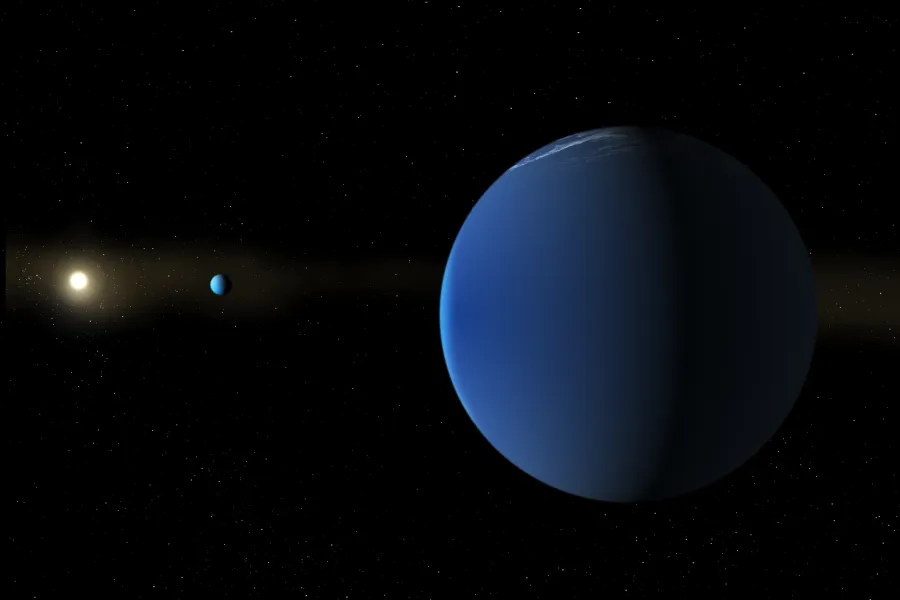
Super-Puff Planets have become one of the biggest surprises in exoplanet research. Astronomers have discovered two giant worlds that are nearly as large as Jupiter but have densities lower than cotton candy. The newly identified planets, TOI-791 b and TOI-791 c, are now the largest super-puff planets ever found. Their unusual properties challenge current ideas about how giant planets form and evolve. The discovery also provides scientists with a rare opportunity to study one of the most extreme types of planets known beyond our Solar System.
Meet the Largest Super-Puff Planets Ever Found
The newly discovered Super-Puff Planets orbit the Sun-like star TOI-791, located about 1,110 light-years away in the constellation Volans. NASA’s Transiting Exoplanet Survey Satellite (TESS) first detected them by observing tiny decreases in the brightness of their host star. Astronomers later combined those observations with years of measurements from ground-based telescopes to determine the planets’ masses and densities.
Although both planets are almost as large as Jupiter, their masses are dramatically smaller.
TOI-791 b contains only about 3 percent of Jupiter’s mass, while TOI-791 c contains roughly 6 percent. Despite their enormous sizes, they are among the lightest giant planets ever measured.
Just How Light Are They?
The measured densities highlight how extraordinary these planets really are.
TOI-791 b has a density of only about 0.038 grams per cubic centimeter. TOI-791 c is only slightly denser at approximately 0.047 grams per cubic centimeter.
For comparison, Jupiter’s average density is about 1.33 grams per cubic centimeter. That makes Jupiter roughly 30 to 35 times denser than these newly discovered worlds.
Lead researcher George Dransfield compared their densities to fresh shaving foam. News reports have also described them as being lighter than cotton candy because their average density is lower than the fluffy confection itself.
These values officially make TOI-791 b and TOI-791 c the least dense Jupiter-sized planets currently known.
Why Size Alone Doesn’t Tell the Story
At first glance, these planets appear similar to Jupiter because of their enormous radii. However, size alone does not determine what a planet is like.
Scientists calculate density by combining a planet’s radius with its mass. That calculation revealed that these worlds contain surprisingly little material for their size.
Instead of being filled with dense matter, they appear to consist mostly of extremely extended atmospheres made largely of hydrogen and helium.
That combination creates giant planets that resemble inflated balloons more than compact gas giants.
Why Super-Puff Planets Challenge Planet Formation Models
The discovery of these Super-Puff Planets is exciting because it raises difficult questions for planetary scientists.
Current models suggest that giant planets begin by building a solid core inside a young protoplanetary disk. Once the core becomes massive enough, it rapidly attracts surrounding hydrogen and helium gas.
Eventually, the planet becomes both large and relatively massive.
TOI-791 b and TOI-791 c do not follow that expected pattern.
A Planet Almost as Large as Jupiter
One of the biggest puzzles is the enormous size of these planets despite their tiny masses.
A world that measures nearly the size of Jupiter would normally contain much more material. Instead, these planets appear unusually inflated.
Astronomers believe they may have formed farther away from their star, where cold temperatures allowed large amounts of gas to accumulate. Later, they may have migrated inward to their current orbits.
Even so, that explanation does not fully account for their extremely low densities.
Atmospheres That Refuse to Shrink
Researchers also believe both planets are dominated by hydrogen and helium.
Normally, giant planets lose part of their outer atmospheres over billions of years through interactions with their host stars.
These two worlds somehow retained enormous atmospheres while remaining exceptionally light.
That combination makes them difficult to reproduce using current computer models of planet formation.
As a result, scientists now have another important test case for improving theories about how planetary systems develop.
A Rare Planetary System Gives Scientists New Clues
Super-puff planets are already uncommon.
Finding two of them orbiting the same star is even more remarkable.
Among nearly 6,300 confirmed exoplanets, fewer than 40 belong to the super-puff category. Only a handful of planetary systems contain multiple examples.
That rarity makes TOI-791 an especially valuable laboratory for planetary science.
Two Worlds Formed Together
Because both planets orbit the same star, astronomers believe they formed from the same protoplanetary disk.
Studying two similar planets that developed under nearly identical conditions allows researchers to compare how giant planets evolve over time.
The planets also occupy a near 5:3 orbital resonance. Their gravitational interactions helped astronomers measure their masses more precisely than would otherwise be possible.
Years of Observations Confirmed the Discovery
This discovery did not happen overnight.
NASA’s TESS spacecraft first identified the planets during its long-term survey of nearby stars.
Astronomers then collected additional observations using several ground-based telescopes over multiple years.
The Antarctic Search for Transiting ExoPlanets (ASTEP) telescope also contributed valuable measurements.
Citizen scientists participating through Planet Hunters helped identify the original transit signals as well.
The combination of space observations, professional observatories, and public participation produced one of the most reliable measurements yet for this unusual class of planets.
James Webb Could Reveal the Next Chapter
Although astronomers now know these planets are incredibly light, many important questions remain unanswered.
The James Webb Space Telescope could soon provide those answers.
Looking Inside Their Atmospheres
Webb can analyze starlight that passes through planetary atmospheres during transits.
That technique allows scientists to identify gases such as water vapor, methane, carbon dioxide, carbon monoxide, and other molecules.
Those measurements will help determine exactly what these planets are made of.
Researchers also hope to learn whether clouds cover the planets and how their atmospheres became so extended.
Testing Planet Formation Theories
Atmospheric measurements could reveal where these planets originally formed before moving closer to their star.
Scientists may also determine whether these planets represent a short-lived stage of planetary evolution or an entirely separate class of giant planets.
Either outcome would improve current models of how giant planets grow and change over billions of years.
Future observations could therefore transform this discovery from an unusual curiosity into a major milestone in exoplanet science.
Why These Super-Puff Planets Matter
The discovery of these Super-Puff Planets shows that the universe continues to produce planetary systems unlike anything found in our own Solar System.
TOI-791 b and TOI-791 c are not simply record-breaking worlds because they are lighter than cotton candy. They expose important gaps in scientists’ understanding of giant planet formation, atmospheric evolution, and planetary migration.
Every unusual exoplanet adds another piece to the puzzle of how planetary systems develop. These two planets may become some of the most important examples yet. As future observations from the James Webb Space Telescope reveal more details, astronomers may finally understand how a planet can grow to nearly Jupiter’s size while remaining one of the lightest giant worlds ever discovered.
Main Sources:
- Associated Press – Astronomers find biggest super-puff planets yet that are lighter than cotton candy
https://apnews.com/article/super-puffs-cotton-candy-giant-light-planets-db1ebf1cb946e1c0bba67a5040bfc8a9 - Monthly Notices of the Royal Astronomical Society – Original research paper
https://academic.oup.com/mnras - NASA TESS Mission
https://science.nasa.gov/mission/tess/ - University of Birmingham – Researchers help discover candy floss planets among the lightest ever found
https://www.birmingham.ac.uk/news - University of Oxford Department of Physics
https://www.physics.ox.ac.uk/