
BY:SpaceEyeNews.
Big Wheel galaxy changes the early-universe story
The Big Wheel galaxy is forcing astronomers to look again at how quickly the early universe could build giant, organized galaxies. The James Webb Space Telescope has revealed a huge spiral disk galaxy from a time when the universe was only about two billion years old. That alone is exciting. But the real surprise is its scale.
This object is not a small, messy young galaxy. It is a massive rotating disk with visible spiral structure. It also appears far larger and more developed than many models expected for that cosmic era.
Astronomers nicknamed it the Big Wheel, and the name fits. It looks like a giant cosmic disk from a period when galaxies should have been growing fast, changing often, and facing constant pressure from their surroundings.
This does not mean galaxy science has failed. It means JWST has found a rare object that gives scientists a sharper test. The Big Wheel galaxy may reveal how some early cosmic neighborhoods built huge structures much faster than expected.
What is the Big Wheel galaxy?
The Big Wheel galaxy is a giant disk galaxy seen at a redshift of about 3.245. That means its light comes from a time roughly two billion years after the Big Bang. In cosmic history, that is still very early.
The galaxy has a stellar mass of about 3.7 × 10¹¹ solar masses. In simpler terms, it contains hundreds of billions of suns’ worth of stars. That places it among the most massive known star-forming disk galaxies from that period.
Its size is just as important. The study reports a half-light radius of 9.6 kiloparsecs. That is much larger than typical disk galaxies seen at similar redshifts and similar mass ranges.
The simple headline version says the Big Wheel is about five times more massive than the Milky Way. The careful version is that it is an unusually massive disk system from an early time. Either way, the message is clear. This galaxy is huge for its age.
Even more striking, it does not look like a random cloud of stars. JWST revealed a disk with spiral features. Spectroscopy also showed motion consistent with rotation. That makes the discovery much stronger than a simple image-based claim.
Why this JWST discovery is so surprising
The early universe was not empty or quiet. Galaxies were forming, gas was flowing, stars were being born, and cosmic structures were growing fast. But fast growth often brings disorder.
Many early galaxies appear clumpy, compact, and unsettled. That makes sense. Young galaxies often experience strong gas inflows and frequent interactions with nearby systems. These events can reshape a galaxy and disturb its disk.
A spiral galaxy needs more than mass. It needs a rotating disk. It needs structure. It needs enough stability for arms and patterns to appear. It also needs conditions that do not completely scramble its shape.
That is where the Big Wheel galaxy becomes important. It appears large, massive, rotating, and structured at a very early time. Current models can produce early disks. Yet a disk this large and well developed is harder to explain.
The discovery does not say a giant early disk is impossible. It says this object sits near the edge of what models naturally expect. That is exactly why it matters.
Big Wheel galaxy and the survival problem
The biggest question is not only how the Big Wheel formed. It is also how it stayed so ordered.
In a busy early environment, galaxies often interact. Some interactions help galaxies grow. Others can disturb disks and erase spiral patterns. A large disk can become thicker, clumpier, or more chaotic after major encounters.
So how did the Big Wheel galaxy remain recognizable as a rotating disk?
One answer may involve gas-rich growth. If early galaxies contained large amounts of gas, some interactions may have been less destructive. A disk might survive, or rebuild, after a merger. Another possibility involves smooth gas accretion. If gas entered the galaxy with coherent angular momentum, it could help build a large rotating disk instead of disrupting it.
The galaxy may also have formed in a very special region. Its environment seems unusually dense. That means it had access to more material. But it also faced more interactions. This creates a fascinating tension.
The same environment that could have disturbed the Big Wheel may also have helped it grow quickly.
How JWST saw what Hubble could miss
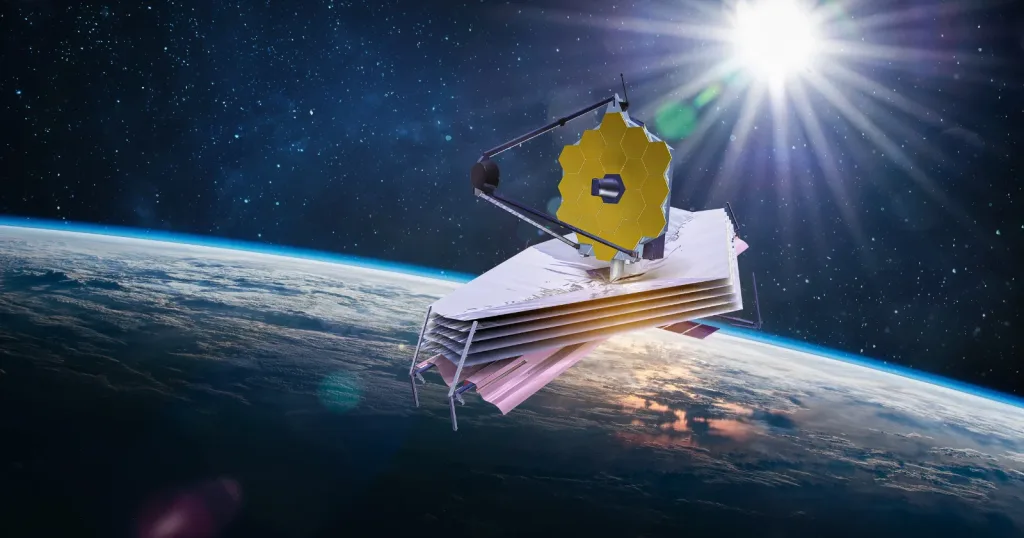
The Big Wheel galaxy shows why JWST has changed the study of the early universe.
Hubble transformed astronomy. But for galaxies at this distance, Hubble often sees rest-frame ultraviolet light. That light usually highlights young, bright stars. It can show clumps and star-forming regions, but it may miss the older stellar structure beneath them.
JWST works in infrared wavelengths. That matters because light from very distant galaxies stretches as the universe expands. By the time that light reaches us, it shifts toward infrared.
This allows Webb to see deeper structure in ancient galaxies. In the Big Wheel’s case, JWST revealed a red central region and a large disk. Spiral features became visible in Webb’s near-infrared view.
This is not just a prettier image. It is a different kind of information. JWST can trace older stars and reveal the shape of a galaxy more clearly than ultraviolet observations alone.
That is why the Big Wheel galaxy became visible as a major scientific problem. Without Webb, it may have looked less ordered and less complete.
Spectroscopy confirmed a rotating disk
A spiral-looking galaxy is not always a true spiral disk. Distant objects can fool the eye. Clumps, overlapping galaxies, or mergers can create shapes that look organized from far away.
That is why spectroscopy matters.
The research team used JWST’s Near Infrared Spectrograph to study emission lines across the galaxy. These measurements allowed them to map motion. The result matched the pattern expected from disk rotation.
The team also used data from Hubble, ALMA, and other observations. This multiwavelength approach helped measure the galaxy’s structure, mass, rotation, and environment.
The Big Wheel galaxy also appears consistent with the local Tully-Fisher relation. This relation links a disk galaxy’s rotation speed with its stellar mass. That detail adds another layer to the puzzle.
This object is not only large. It behaves, in key ways, like a massive disk galaxy. That makes it much harder to dismiss as a visual trick.
A dense cosmic neighborhood may explain the mystery
The Big Wheel galaxy was not found in an average patch of sky. It sits in an exceptionally dense region. The study reports a galaxy number density more than ten times higher than the cosmic average.
That context may be essential.
Dense regions can speed up galaxy growth. They can supply more gas. They can bring more interactions. They can also help build massive structures earlier than quieter regions.
But there is a catch. Dense regions can also be disruptive. More neighbors can mean more gravitational encounters. More encounters can disturb disks.
This makes the Big Wheel galaxy especially interesting. Its environment may be both the problem and the solution. It could have helped the galaxy assemble quickly. At the same time, it should have made survival harder.
The answer may lie in the type of growth. If the galaxy gained material through aligned gas flows, it could build a large disk. If it experienced gas-rich interactions instead of destructive dry mergers, it may have kept or rebuilt its structure.
For now, scientists do not have a final answer. But they now have a clear target for future models.
How rare is the Big Wheel galaxy?
The Big Wheel galaxy appears rare. That is part of its value.
The study suggests it is larger and more massive than other kinematically confirmed disk galaxies known at similar redshifts. It is also far bigger than expected for star-forming disk galaxies of its mass and time.
This does not mean early giant disks were common. Most early galaxies were not like this. The importance of the Big Wheel comes from its unusual nature.
Rare objects can reveal hidden pathways. They show where ordinary assumptions stop working. They also help scientists identify special conditions that may not appear in average survey fields.
The Big Wheel was found in a field originally chosen because of a bright quasar. That detail matters. If dense environments play a key role, then future targeted searches may find more galaxies like it.
JWST is still building the statistical picture. Each new object adds another piece. Some early claims become less surprising with better data. Others become stronger. The Big Wheel galaxy belongs to the second group because the evidence includes size, mass, rotation, and environment.
What this discovery does not mean
The Big Wheel galaxy does not mean every early galaxy was a giant spiral. It also does not mean the Milky Way had an identical twin only two billion years after the Big Bang.
This galaxy is more massive than the Milky Way in the headline comparison. It also sits in a different environment. Its future path may have been very different from our galaxy’s story.
The discovery also does not erase modern galaxy formation models. A single galaxy cannot do that. Instead, it gives theorists a demanding test case.
Good models grow stronger when strange objects expose their limits. The Big Wheel galaxy does exactly that. It asks how a giant disk formed so early. It asks how spiral structure stayed visible. It asks whether dense cosmic regions produced growth channels that normal surveys underrepresent.
That is a model problem worth having.
Why the Big Wheel galaxy matters
The Big Wheel galaxy matters because it changes the question from “Can early disks exist?” to “How large and mature could early disks become?”
JWST has already shown that the early universe was more complex than expected. It has found galaxies that appear brighter, dustier, more massive, or more structured than many astronomers anticipated. The Big Wheel adds another major example.
This galaxy shows that some regions of the young universe may have built organized systems very quickly. It also suggests that environment may have played a powerful role.
A dense region may have supplied the gas and interactions needed for rapid growth. Under the right conditions, that growth may have built a large disk instead of destroying it.
That makes the Big Wheel more than a beautiful galaxy. It is a test of how matter, motion, gas, and environment worked together in the early universe.
What comes next for JWST and ALMA
Future observations will decide how unusual the Big Wheel galaxy really is.
JWST can continue to study similar early-universe regions. Deeper spectroscopy may refine the galaxy’s rotation, star formation, metallicity, and internal structure. ALMA can trace cold gas, which is vital for understanding how the disk formed and how it kept growing.
Simulations will also play a major role. Scientists can test whether gas-rich mergers, aligned gas inflows, or calm recent growth can create a galaxy like this.
The biggest question remains open. Is the Big Wheel galaxy a rare exception, or is it the first clear sign of a hidden population of giant early disks?
JWST may soon tell us.
Conclusion: Big Wheel galaxy is a serious cosmic test
The Big Wheel galaxy is one of those discoveries that turns a distant object into a major scientific challenge. JWST did not simply find a pretty spiral. It revealed a huge rotating disk from a time when such structure should have been difficult to build and harder to preserve.
That is why this discovery matters. It shows that the early universe was not simple. Some regions may have created massive, ordered galaxies faster than expected.
The Big Wheel galaxy may be rare. But rare objects often teach us the most. They reveal the edges of current models. They push scientists to ask sharper questions. And in this case, they show that the young universe may have been far more capable than we imagined.
Main Sources:
Nature Astronomy — A giant disk galaxy two billion years after the Big Bang
https://www.nature.com/articles/s41550-025-02500-2
NASA Science — How Can Webb Study the Early Universe?
https://science.nasa.gov/mission/webb/science-overview/science-explainers/how-can-webb-study-the-early-universe
NASA Science — Webb Early Universe Overview
https://science.nasa.gov/mission/webb/early-universe
arXiv — A Giant Disk Galaxy Two Billion Years After The Big Bang
https://arxiv.org/abs/2409.17956
SpaceDaily article provided by user — JWST found a spiral galaxy nicknamed the Big Wheel
https://spacedaily.com/t-the-james-webb-space-telescope-found-a-spiral-galaxy-nicknamed-the-big-wheel-that-existed-just-two-billion-years-after-the-big-bang-five-times-more-massive-than-the-milky-way-with-a-spira/