BY:SpaceEyeNews.
Primordial Black Hole Mystery Takes a New Turn
A possible primordial black hole discovery may have just lost its strongest support.
For a brief moment, the event nicknamed Phoebe looked like one of the most exciting signals in modern astronomy. A star in the Large Magellanic Cloud changed brightness for about an hour. The first interpretation suggested that an invisible compact object passed in front of the star and bent its light.
That sounded like microlensing. Even more exciting, the estimated object was tiny by black hole standards. It appeared to have a mass close to three lunar masses. A normal black hole cannot form at that size through the collapse of a massive star. So, the original team suggested a bold possibility: Phoebe might be a primordial black hole in the Milky Way’s dark matter halo.
Now the story has changed.
A new reanalysis by astronomers Andrzej Udalski and Przemek Mróz argues that Phoebe was not a one-time cosmic lens. Instead, the same star appears to have changed brightness more than once. That points toward a simpler explanation. Phoebe may be an ordinary variable star, not a tiny black hole hiding in the dark.
This does not end the search for a primordial black hole. But it does show how difficult that search really is.
Why Phoebe Looked Like a Primordial Black Hole
The original Phoebe claim came from the AMPM survey. The team used the Dark Energy Camera, known as DECam, to monitor stars toward the Large Magellanic Cloud. DECam is a wide-field imager on the Víctor M. Blanco 4-meter telescope at Cerro Tololo Inter-American Observatory in Chile. The instrument can capture large areas of the sky with high sensitivity, which makes it useful for time-domain surveys.
The AMPM team reported a short event lasting roughly 60 minutes. In their interpretation, an unseen object crossed the line of sight between Earth and a distant star. Its gravity magnified the star’s light for a short time. That is the basic signature of gravitational microlensing.
The estimated mass made the claim unusual. The original paper interpreted Phoebe as a lensing object with a mass of about 0.032 Earth masses, or roughly three lunar masses. The authors described it as one of the fastest and lowest-mass microlensing signals ever detected. They also argued that the object was more likely to sit in the Milky Way’s dark matter halo than in normal stellar populations.
That made Phoebe exciting. A black hole with lunar-scale mass would not fit the normal stellar black hole story. It would need a different origin. This is why the phrase primordial black hole entered the discussion.
A primordial black hole would not form from a dying star. Instead, it would come from extreme density fluctuations in the early universe. If such objects exist, they could help explain some of the missing mass that astronomers call dark matter.
Why a Tiny Black Hole Would Matter
Phoebe mattered because it touched a very large question.
Dark matter shapes galaxies, galaxy clusters, and cosmic structure. Astronomers can measure its gravity, but they still do not know what it is. Many ideas involve unknown particles. Another idea suggests that some dark matter could exist as compact objects, including primordial black holes.
That does not mean every strange dimming event points to dark matter. It also does not mean Phoebe proved anything. The original claim was a candidate, not a final discovery.
Still, a confirmed lunar-mass primordial black hole would have been remarkable. It would show that black holes can exist in mass ranges that normal stellar evolution cannot explain. It would also give researchers a direct target in the long search for dark matter.
This is why the story spread so quickly. Phoebe was not just another flickering star in a nearby galaxy. It looked like a possible window into the early universe.
But strong claims need strong tests. Phoebe now faces one.
The New Reanalysis Changes the Story
Udalski and Mróz revisited the publicly available DECam observations. They also included extra data from 2020 and 2021. Their conclusion was very different from the first interpretation.
They found that Phoebe did not show only one clean brightening. The object showed at least three distinct low-amplitude brightenings. It also showed longer-term changes in its average brightness. According to their paper, those features fit an ordinary variable star better than a microlensing event.
This is the central point.
Microlensing should look like a rare alignment. A compact object passes in front of a background star. The star brightens, then returns to normal. The event should not repeat from the same source in the same way.
A variable star behaves differently. Its brightness can rise and fall because of processes inside the star or around it. Some variable stars pulse. Others show surface activity, eclipses, dust effects, or complex changes linked to stellar systems.
Phoebe now appears to fit that second category better.
The new study does not need to explain the exact physical cause of the star’s variability. It only needs to show that the star itself changes brightness. Once that happens, the black hole interpretation becomes much weaker.
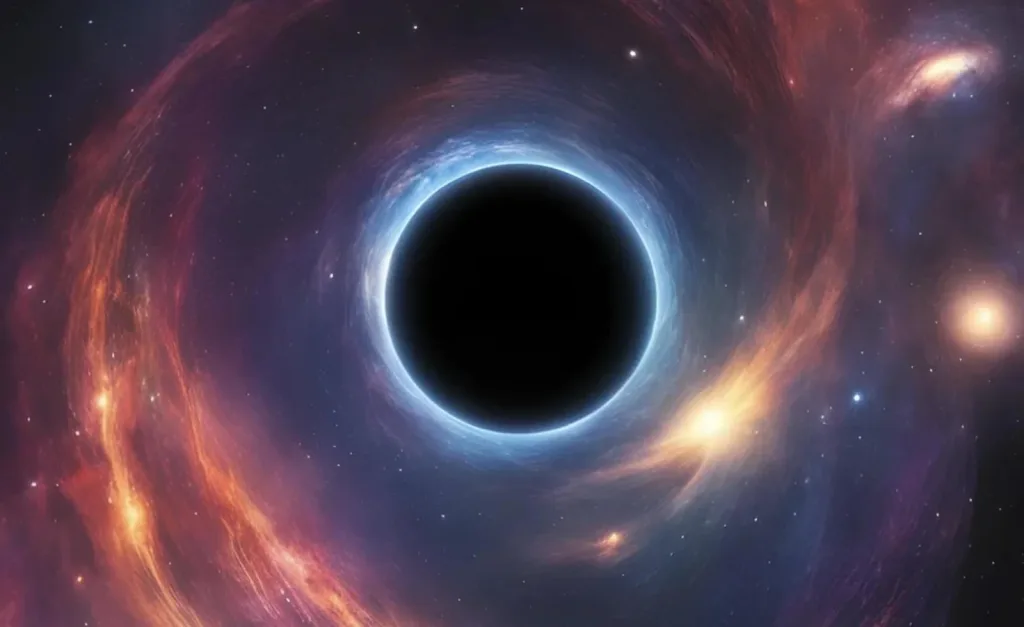
Primordial Black Holes: Could Dark Matter Hold a Deadly Secret?!
A One-Time Cosmic Lens or a Flickering Star?
The difference may sound small, but it changes everything.
A microlensing event comes from an object between Earth and a background star. The lens does not need to shine. It only needs gravity. That makes microlensing one of the best tools for finding dark objects.
A variable star is not the same. In that case, the light changes because the source star changes. The invisible lens disappears from the explanation.
This is why repeated brightness changes matter so much. If Phoebe brightened once, the microlensing idea could stay alive. If it brightened several times, the simpler answer becomes stronger.
In science, the simpler explanation does not always win. But it becomes harder to ignore when it explains more of the data.
That is what happened here. The newer paper argues that the original signal was one brightening among several. One of those changes looked like a microlensing event. But the broader light curve tells a different story.
For a general audience, the difference is easy to picture.
Microlensing is like a cosmic magnifying glass crossing a lamp once. A variable star is the lamp itself flickering.
Phoebe now looks more like the flickering lamp.
Why OGLE Makes the Claim Harder to Defend
The Phoebe debate also connects to another major survey: OGLE, the Optical Gravitational Lensing Experiment.
OGLE has monitored dense star fields for many years. Its data matter because microlensing surveys depend on statistics. One strange event can look exciting. But astronomers also need to ask a larger question: should similar events appear elsewhere?
A 2024 OGLE high-cadence survey observed almost 35 million source stars in the Magellanic Clouds. It found no short-timescale microlensing events, despite sensitivity to them. The authors concluded that primordial black holes and other compact objects in a certain planetary-mass range can make up at most about 1% of dark matter.
That creates pressure on the Phoebe claim.
If lunar- or planetary-mass primordial black holes were common enough, surveys should see more short events. Phoebe alone would be difficult to place inside the larger picture. The new reanalysis helps resolve that tension by removing Phoebe as a strong black hole candidate.
In other words, the variable-star explanation makes Phoebe less spectacular. But it also makes the data more consistent.
What This Means for Primordial Black Holes
This result does not prove that primordial black holes do not exist.
It only weakens one candidate.
That distinction matters. Astronomy often advances by removing wrong answers. Every false alarm teaches researchers how to improve their methods. Phoebe may help scientists build better tests for future short-timescale events.
The search for a primordial black hole will continue. Researchers will keep using microlensing, gravitational-wave data, and wide-field sky surveys. Future observatories may also catch short events with better cadence and longer follow-up.
The lesson is not that the idea failed. The lesson is that the evidence must survive deeper checks.
Phoebe looked exciting because it matched one part of the microlensing story. But the larger data set appears to favor stellar variability. That is exactly why long-term monitoring matters.
A real primordial black hole signal must stand out from ordinary stellar behavior. It must also fit the wider survey record.
Science Did Not Fail Here
Some readers may see the Phoebe story as a failed discovery. That misses the point.
This is how science works.
A team finds a strange signal. They publish an interpretation. Another team checks the data. The new analysis challenges the claim. The community then weighs both explanations.
That process can feel slow. It can also feel frustrating. But it protects astronomy from false certainty.
Phoebe may not be the first detected lunar-mass primordial black hole. Yet the case still matters. It shows how hard it is to separate rare cosmic events from ordinary stellar activity. It also shows why dramatic claims need independent review.
The universe gives astronomers messy data. Stars vary. Instruments have limits. Short events can mislead even careful observers. That does not weaken astronomy. It makes the method more important.
In this case, the better explanation may be less exotic. But the investigation itself remains valuable.
Why the Phoebe Case Still Matters
Phoebe is still useful, even if it is not a black hole.
It highlights the danger of short observing windows. A star can look stable over a few nights but reveal variability over months or years. That is exactly why long-baseline surveys are important.
It also shows why microlensing searches need careful follow-up. A one-hour event can look clean in isolation. But one hour cannot tell the whole story.
For future surveys, Phoebe may become a warning sign. Researchers will need to compare new candidates against older data. They will also need to watch the same source again. If the star keeps changing, the lensing claim becomes weaker.
That does not make future discoveries impossible. It makes them stronger.
A confirmed primordial black hole would need to pass the Phoebe test. It would need a clean light curve, no repeated source variability, and consistency with broader survey limits.
Conclusion: The Primordial Black Hole Search Continues
The Phoebe event first looked like a rare clue to a hidden primordial black hole. It may have pointed to a lunar-mass object in the Milky Way’s dark matter halo. That would have been a major discovery.
But the new reanalysis points in another direction. Phoebe seems to have brightened more than once. It also changed over longer timescales. Those signs make it look more like a variable star than a one-time microlensing event.
So the mystery has changed. It is no longer simply about a tiny black hole. It is about how astronomers separate extraordinary signals from ordinary stars.
The search for primordial black holes remains open. Phoebe may not be the breakthrough. But it gives scientists a sharper rule for the next candidate: the best cosmic discoveries must survive being questioned.
Main Sources:
- AMPM II. A Lunar-Mass Primordial Black Hole Microlensing Candidate in the Milky Way Halo — https://arxiv.org/abs/2605.19375
- Eppur non si trovano Vol. 3: Phoebe — a Mirage of a Primordial Black Hole — https://arxiv.org/abs/2606.19442
- Limits on planetary-mass primordial black holes from the OGLE high-cadence survey of the Magellanic Clouds — https://arxiv.org/abs/2410.06251
- Dark Energy Camera, CTIO / NOIRLab official instrument page — https://www.ctio.noirlab.edu/noao/content/dark-energy-camera-decam
- Phys.org report: Reanalysis suggests “Phoebe” is a variable star, not a primordial black hole — https://phys.org/news/2026-06-reanalysis-phoebe-variable-star-primordial.html