
BY:SpaceEyeNews.
Could the Sun collide with another star one day? The question sounds like pure science fiction. Yet it comes from real astronomy. The Sun is not fixed in space. It moves around the center of the Milky Way, along with hundreds of billions of other stars. From time to time, stars pass near one another. That raises a dramatic question for our Solar System. Could one of those stars ever come too close?
A recent article from The Universe Space Tech explored this idea and asked whether the Sun could collide with another star. The answer is both simple and surprising. A direct collision can happen in physics. But for our Sun, the odds are so tiny that it is not a real concern on human, planetary, or even solar-lifetime timescales.
The more interesting issue is different. Another star does not need to hit the Sun to matter. A close stellar flyby could disturb distant icy objects far beyond Neptune. That would not immediately affect Earth. Still, it could change the flow of comets over very long periods.
So the real story is not fear. It is scale.
Sun collide with another star: Is it physically possible?
Yes, stars can collide. Gravity allows it. If two stars move along paths that bring them close enough, they can merge or strongly interact. Astronomers have studied such events in dense star clusters, where stars live much closer together than they do near the Sun. The NASA/ESA Hubble Space Telescope has found evidence that some unusual stars in globular clusters may form through stellar collisions or close stellar partnerships.
But the Sun does not live inside a crowded globular cluster. It lives in a much more open part of the Milky Way. That changes everything.
The night sky may look crowded from Earth. In reality, stars are separated by huge distances. NASA says the Sun is about 1.4 million kilometers wide. That sounds enormous. Yet the nearest star system, Alpha Centauri, sits more than four light-years away. NASA lists Proxima Centauri at about 4.24 light-years from the Sun.
That gap is the key. Stars are big, but space is far bigger. A direct hit would require an incredibly exact path. The Universe Space Tech article notes that such a direct encounter outside dense clusters would be extraordinarily rare, far beyond the Sun’s lifetime.
Why the Sun is almost certainly safe
The Sun has been shining for about 4.5 billion years. It will not last forever, but its remaining future is still measured in billions of years. A direct collision with another star is not expected during that time.
The numbers explain why. The Sun’s diameter is about 1.4 million kilometers. The nearest stellar neighbor sits trillions of kilometers away. So even when stars move through the galaxy, they usually pass at vast distances from one another.
Think of it this way. The Milky Way contains a huge number of stars, but most of the galaxy is empty space. The Sun and nearby stars move like distant ships crossing an enormous ocean. Their routes may bring them nearer over time. Yet a direct impact remains extremely unlikely.
That does not mean stars never pass near the Solar System. They do. But “near” in astronomy can still mean thousands of times farther than Neptune.
The real risk is a stellar flyby
The real question is not only, could the Sun collide with another star? A better question is this: could another star pass close enough to disturb the Solar System?
That scenario is more realistic. It still does not mean instant danger. The planets are held tightly by the Sun’s gravity compared with objects in the far outer Solar System. Earth, Mars, Jupiter, and Neptune sit deep inside the Sun’s gravitational influence.
The distant Oort Cloud is different. NASA describes the Oort Cloud as a huge, distant shell of icy objects that may stretch from thousands to as far as 100,000 astronomical units from the Sun. One astronomical unit, or AU, equals the average distance between Earth and the Sun.
At those distances, the Sun’s grip becomes weaker. A passing star could tug on some icy bodies there. Over time, some of those objects could shift into new paths. A few may become long-period comets that move inward.
That is the real scientific concern. Not a star hitting the Sun. Not Earth suddenly leaving its orbit. Instead, the concern is a slow reshaping of the Solar System’s outer edge.
Scholz’s Star already passed near us
This has happened before.
About 70,000 years ago, Scholz’s Star passed close to the Solar System. NASA says astronomers calculated that this red dwarf and its companion moved within roughly one light-year of the Sun. At closest approach, NASA gives the distance as about 55,000 AU.
That is extremely close by galactic standards. Yet nothing dramatic happened to the planets. Earth stayed on its path. The Moon stayed with Earth. The Solar System continued normally.
Scholz’s Star likely passed near the outer Oort Cloud. But it was small, faint, and fast-moving. NASA notes that it would probably have been too dim for early humans to see with the naked eye, unless it produced a bright flare.
This example matters because it gives us a real test case. A star came close in the recent astronomical past. It did not create a planetary crisis. That supports the main point of this article. Close stellar flybys are real, but most do not threaten the inner Solar System.
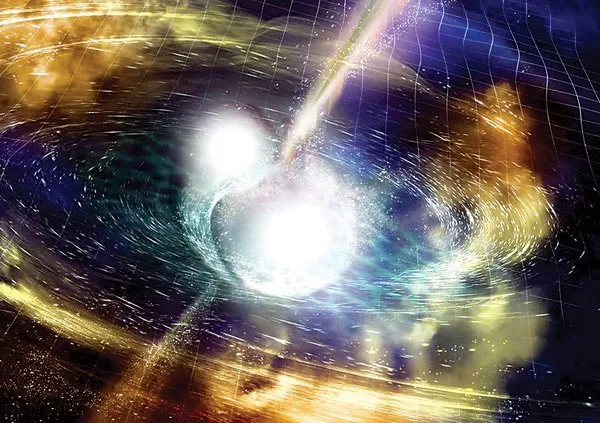
What happens if the Sun gets close to another star?!
Could a flyby send comets inward?
A close stellar flyby could disturb comets in the Oort Cloud. ESA’s Gaia team has studied this exact issue. ESA explains that rare close encounters with the Sun may disturb the distant comet cloud and send some comets toward the inner Solar System in the distant future.
This does not mean a sudden wave of comets would appear overnight. Space works on long timescales. If a passing star changed the orbit of a distant icy body, that object could take a very long time to move inward.
NASA explains that Oort Cloud comets can take thousands or even millions of years to complete one trip around the Sun. Some long-period comets come from that distant region.
So the effect would be delayed. It would also be spread out. A passing star could increase comet activity over time, but it would not act like a switch.
This is why scientists care about stellar flybys. They help explain how the outer Solar System evolves. They may also help explain how some comets begin their journeys toward the Sun.
Gliese 710 is the future flyby to watch
One future encounter stands out. ESA’s Gaia data shows that Gliese 710 will pass near the Solar System in about 1.3 million years. ESA says it may pass within about 2.3 trillion kilometers, or around 16,000 Earth-Sun distances. That places it within the Oort Cloud region.
NASA also notes that GJ 710 is expected to make a close pass in about 1.3 million years.
Gliese 710 will not collide with the Sun. It will not pass through the inner Solar System. Still, it may strongly affect parts of the Oort Cloud because it will pass relatively close and move more slowly than many other stars. ESA says that slower motion gives it more time to exert gravitational influence on distant icy bodies.
That makes Gliese 710 important. It is not a doomsday object. It is a natural experiment in galactic motion. It shows that the Solar System does not live in isolation.
How scientists predict close stellar encounters
Astronomers do not guess these encounters. They track stars with measurements.
To predict a stellar flyby, scientists need several pieces of data. They measure a star’s position. They measure its proper motion across the sky. They measure radial velocity, which tells whether the star moves toward or away from us. Then they model its path through the Milky Way.
ESA’s Gaia mission has transformed this work. Gaia has measured the positions and motions of huge numbers of stars. ESA says Gaia data helped identify rare close encounters that may affect the Solar System’s distant comet reservoir.
This does not make every prediction perfect. Small uncertainties grow over long times. But the data keeps improving. Each Gaia release helps astronomers refine the map of past and future stellar visitors.
That is why stories like Scholz’s Star and Gliese 710 matter. They are not random curiosities. They show how scientists reconstruct the Solar System’s galactic environment.
Sun collide with another star: What would actually happen?
If the Sun collide with another star scenario somehow happened, the results would be extreme. The Sun’s structure would change. Planetary orbits could shift heavily. The Solar System as we know it would not remain stable.
But this is not the scenario scientists expect.
A closer, more realistic event involves a passing star at thousands or tens of thousands of AU. At that range, the planets would likely remain stable. The outer comet cloud would feel the strongest effect.
Distance matters. Mass matters too. A massive star would create a stronger gravitational pull. Speed also matters. A slower star has more time to influence distant objects. Direction matters as well, because the geometry of the encounter shapes the outcome.
So a stellar flyby is not one single type of event. Some flybys barely matter. Others may reshape the Oort Cloud over long times. The dangerous cases are rare.
Should we be worried?
No. There is no reason to worry that the Sun will collide with another star.
The direct collision scenario is far too unlikely. The close flyby scenario is more realistic, but it is still rare and slow. Even the important future encounter with Gliese 710 lies about 1.3 million years ahead.
That said, this topic remains scientifically valuable. It reminds us that the Solar System is not sealed away from the galaxy. The Sun moves. Other stars move. Their paths sometimes bring them near our cosmic neighborhood.
Most of the time, nothing dramatic happens. But over millions of years, these encounters may help stir the outer Solar System. They may send some comets inward. They may help shape the long-term story of our planetary system.
Conclusion: The Sun is safe, but the galaxy is moving
So, could the Sun collide with another star? In theory, yes. In reality, it is so unlikely that it should not be treated as a real threat.
The more realistic story is a close stellar flyby. Scholz’s Star already passed near the Solar System about 70,000 years ago. Gliese 710 will make a closer future approach in about 1.3 million years. Neither case means the Sun will be hit. But both show that our Solar System travels through a living, moving galaxy.
The real lesson is not panic. It is perspective. The Sun is safe from a direct stellar collision, but the outer Solar System can still feel the distant pull of passing stars. Space may look still from Earth, yet the Milky Way is always in motion.
Main Sources:
The Universe Space Tech — Could the Sun collide with another star?
https://universemagazine.com/en/could-the-sun-collide-with-another-star/
NASA Science — A passing star: our Sun’s near miss
https://science.nasa.gov/universe/exoplanets/a-passing-star-our-suns-near-miss/
ESA — Close encounters of the stellar kind
https://www.esa.int/Science_Exploration/Space_Science/Gaia/Close_encounters_of_the_stellar_kind
ESA Science & Technology — Waiting for a stellar encounter
https://sci.esa.int/web/gaia/-/59439-waiting-for-a-stellar-encounter
NASA Science — Oort Cloud Facts
https://science.nasa.gov/solar-system/oort-cloud/facts/
NASA Science — Sun Facts
https://science.nasa.gov/sun/facts/