
BY:SpaceEyeNews.
Introduction: The Milky Way Gamma-Ray Glow Is Back in the Dark Matter Debate
The Milky Way gamma-ray glow has returned to the center of one of astronomy’s biggest debates. For years, scientists have studied a strange high-energy signal near the heart of our galaxy. Many researchers argued that the glow might come from hidden millisecond pulsars. These are fast-spinning neutron stars that can produce powerful radiation.
Now, a new machine-learning study has changed the picture. Researchers from the University of Vienna and Lawrence Berkeley National Laboratory used AI to recheck the signal in a deeper way. Their results do not prove dark matter is behind the glow. But they show that dark matter cannot be ruled out yet.
That matters because the Galactic Center Excess has puzzled scientists for more than a decade. It may be a hidden population of faint stars. Or it may be something far stranger. The Milky Way gamma-ray glow could still be one of the most important clues in the search for dark matter.
What Makes the Milky Way Gamma-Ray Glow So Mysterious?
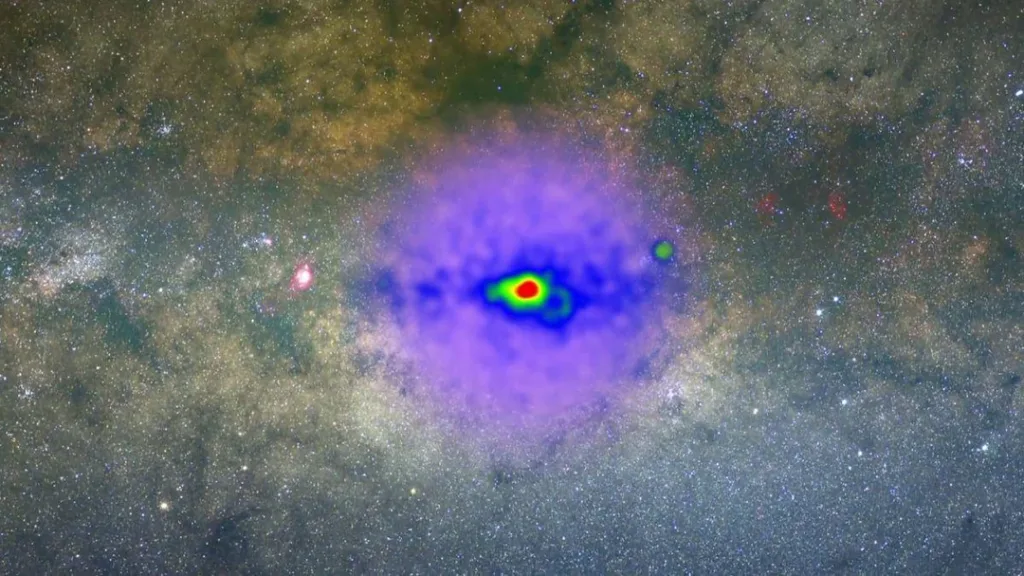
The strange signal is known as the Galactic Center Excess, or GCE. It is a broad glow of gamma rays around the center of the Milky Way. Gamma rays are the most energetic form of light. They often come from extreme cosmic processes.
This glow extends across thousands of light-years around the galaxy’s core. It appears roughly spherical. That shape is one reason scientists have taken it so seriously. A smooth, rounded signal can match some expectations for dark matter activity near the Galactic Center.
Yet the center of the Milky Way is not a clean laboratory. It is crowded, bright, and complex. Many objects and processes overlap there. Stars, compact objects, gas, cosmic rays, and powerful structures can all affect the gamma-ray sky.
That is why the signal has remained so difficult to explain. Scientists can see the excess. The hard part is proving what creates it.
The Two Main Explanations
For years, the debate has focused on two leading ideas.
The first idea is dark matter. In some models, dark matter particles could interact with each other near the dense center of the galaxy. This process could produce gamma rays. If true, the signal would be a major indirect clue about one of the universe’s greatest mysteries.
The second idea is millisecond pulsars. These are rapidly spinning neutron stars. They can emit high-energy radiation. If thousands of them remain hidden near the Galactic Center, their combined light could create the glow.
Both ideas are serious. Both have support. And both face challenges.
The new study does not end the debate. Instead, it reopens a question that many thought had moved away from dark matter.
Why Pulsars Became the Favorite Explanation
Earlier studies often favored the pulsar explanation. The reason was not simple guesswork. Some statistical analyses suggested the signal looked less like a smooth glow and more like the combined light of many unresolved point sources.
A point source is a compact source of light. If a telescope cannot resolve many faint objects one by one, their combined emission may appear as a broader glow. In this case, those point sources could be millisecond pulsars.
That argument became powerful. It made the dark matter explanation seem less likely to some researchers. If the glow came from many small astrophysical objects, there would be no need to invoke dark matter.
Still, there was a weakness. Earlier methods focused mainly on where photons appeared in the sky. They did not fully use another important clue: the energy of each photon.
That missing piece is where the new AI study enters the story.
How AI Changed the Milky Way Gamma-Ray Glow Debate
The new research used a machine-learning method trained on more than one million simulated gamma-ray observations. This allowed the team to test the Galactic Center Excess in a more detailed way.
The key change was simple but powerful. The AI did not only analyze the spatial pattern of the signal. It also included photon energy data.
That matters because different sources can produce different energy patterns. A population of faint pulsars may not look exactly like dark matter when both position and energy are studied together. By combining both types of information, the researchers tested the signal from a new angle.
The result was striking. When energy data entered the analysis, the inferred point sources became much fainter. In fact, they became so faint that they were almost indistinguishable from the smooth emission expected from dark matter.
This does not mean dark matter has been found. It means one of the strongest arguments against dark matter has become weaker.
The 35,000 Pulsar Problem
One of the most important parts of the study is the number of sources needed under the pulsar explanation.
If point sources are behind the glow, the study suggests there must be at least 35,000 of them near the center of the Milky Way. That is far more than the few hundred to few thousand sources assumed in some earlier studies.
This creates a serious challenge.
The issue is not only the large number. It is also how faint these objects would need to be. If the sources are extremely faint, they become very hard to separate from a smooth dark matter-like signal. In other words, the pulsar explanation starts to look less clean than before.
For general readers, this is the core point: the new AI study does not remove pulsars from the debate. But it makes the pulsar answer more demanding. It suggests that the Milky Way’s center would need to hide a much larger population of faint sources than many previous models expected.
That is why the Milky Way gamma-ray glow remains so exciting. The answer is still not obvious.
Does This Study Prove Dark Matter?
No. This study does not prove that dark matter is responsible for the Galactic Center Excess.
That point is important. The researchers themselves are clear about it. Their work shows that dark matter remains a plausible explanation. It does not claim a direct detection.
This is the right way to frame the discovery. The study reopens the dark matter possibility. It weakens one argument against it. It also shows that earlier confidence in the pulsar explanation may have been too strong.
So the headline is not “dark matter discovered.” The better headline is: dark matter is still in the race.
That makes the finding exciting without overstating it. Science often moves this way. A mystery narrows. A model gets tested. A new method changes the result. Then the debate becomes sharper.
Why the Galactic Center Is So Hard to Decode
The center of the Milky Way is one of the most difficult regions in the sky to study. It is bright in many wavelengths. It contains many types of sources. It also has complex background emission.
That makes any claim about dark matter very difficult. Scientists must separate the possible signal from normal astrophysical activity. They must also test how sensitive their results are to background models.
Small changes in modeling can affect the interpretation. That is why the Galactic Center Excess has remained controversial for so long.
The new AI method helps because it can handle a huge number of simulated possibilities. It can compare different signal patterns in a more advanced way. But even AI cannot magically solve every uncertainty. Better data and stronger models are still needed.
This is why caution matters. The result is important, but the mystery is not finished.
Why This Matters for Dark Matter Searches
Dark matter has never been directly detected. Yet scientists believe it makes up a large part of the universe’s matter. Its gravity helps explain how galaxies move and how large cosmic structures form.
The challenge is that dark matter does not shine like normal matter. It does not emit ordinary light. Researchers must look for indirect clues. Gamma rays from the Galactic Center are one possible clue.
If the Milky Way gamma-ray glow comes from dark matter activity, it would be a major step for physics and astronomy. It could help scientists understand what dark matter is made of. It could also guide future searches.
If pulsars are responsible instead, that would still be important. It would reveal a huge hidden population of compact stars near the heart of our galaxy. That would change what scientists know about the Milky Way’s central region.
Either way, the result matters.
AI Is Becoming a New Tool for Cosmic Mysteries
This study also shows how machine learning is changing astrophysics. Modern telescopes collect huge amounts of data. Some signals are too complex for older methods to separate clearly.
AI can help researchers explore large simulations. It can test patterns that are difficult to capture with traditional analysis alone. In this case, machine learning allowed the team to include photon energy information in a new way.
That does not mean AI replaces scientists. It gives them a stronger tool. Human researchers still design the models, test the assumptions, and judge the meaning of the results.
For the Galactic Center Excess, AI helped reopen a case many thought was becoming clearer. That is why the study is getting attention.
What Scientists Need to Do Next
The next step is not one single observation. Scientists need several lines of evidence.
They need better gamma-ray data. They also need stronger models of the Galactic Center. Future work may search for more direct signs of faint pulsars in radio or X-ray observations. Researchers will also keep testing whether the glow behaves more like point sources or smooth emission.
New methods will matter too. More advanced simulations may help separate dark matter-like signals from complex astrophysical backgrounds. Better instruments could also improve the picture.
The key question remains simple: is the glow made of many hidden sources, or is it something more fundamental?
For now, the answer remains unknown.
Conclusion: The Milky Way Gamma-Ray Glow Mystery Continues
The Milky Way gamma-ray glow remains one of the most fascinating mysteries in modern astrophysics. For years, many studies pushed the debate toward hidden millisecond pulsars. But the new AI-powered analysis has brought dark matter back into serious discussion.
The result is not proof of dark matter. It is not the final answer. But it shows that the dark matter explanation cannot yet be dismissed.
If the glow comes from pulsars, the Milky Way’s center may hide tens of thousands of faint neutron stars. If it comes from dark matter, scientists may be looking at one of the most important indirect clues ever found.
Either way, the heart of our galaxy is still hiding something extraordinary. And the Milky Way gamma-ray glow may be the signal that finally helps reveal it.
Main Sources:
University of Vienna — Dark Matter in the Center of the Milky Way Not Ruled Out
https://www.univie.ac.at/en/news/detail/dark-matter-in-the-center-of-the-milky-way-not-ruled-out
Lawrence Berkeley National Laboratory — Machine Learning Reopens the Case for Dark Matter at the Galactic Center
https://physicalsciences.lbl.gov/2026/06/17/machine-learning-reopens-the-case-for-dark-matter-at-the-galactic-center/
Physical Review Letters — Energy Distribution of the Galactic Center Excess’s Sources
https://journals.aps.org/prl/abstract/10.1103/dkcq-6y4f
ScienceDaily — The Milky Way’s weird gamma-ray glow may be dark matter after all
https://www.sciencedaily.com/releases/2026/06/260619101334.htm