
BY:SpaceEyeNews.
Titan Human Mission Enters a New Phase
A Titan human mission is no longer just a wild idea from science fiction. Scientists are now starting to discuss it as a serious long-term goal after the Moon and Mars. That does not mean a crew is packing for Saturn tomorrow. It means the conversation has changed.
At the Humans to Titan Summit 2026, experts gathered to examine what it would take to send people to Titan, Saturn’s largest moon. The summit focused on the real challenges. These include travel time, power, habitats, spacesuits, surface movement, and crew safety. It also looked at why Titan may be worth the effort.
The key message is clear. Human exploration of Titan is not blocked by physics alone. It depends on technology, time, and commitment. That makes Titan one of the most exciting future targets in deep-space exploration.
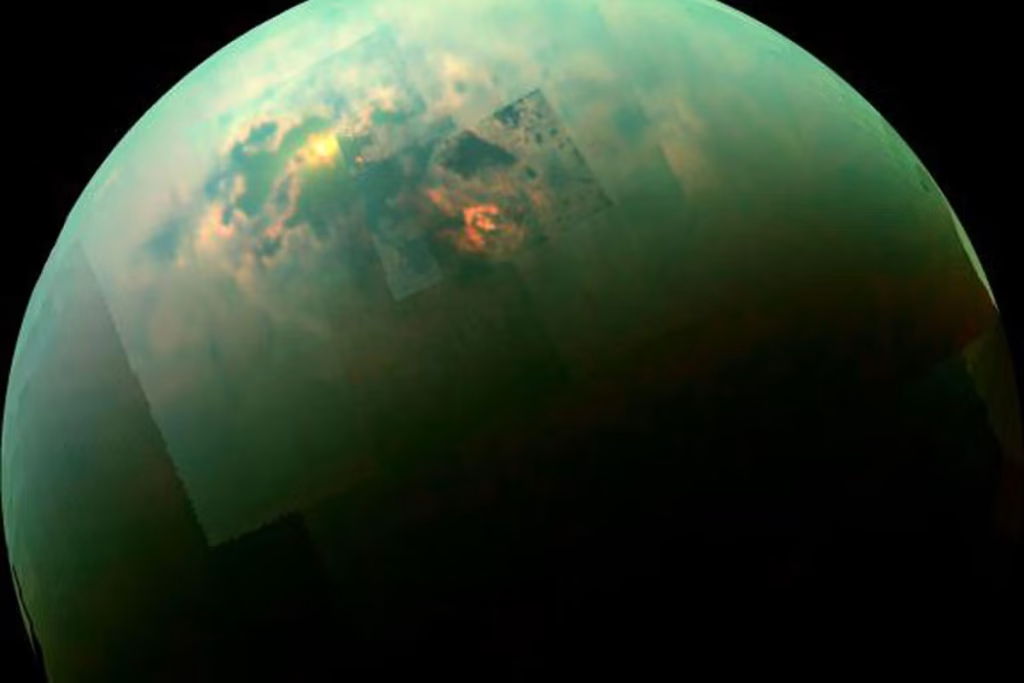
NASA already describes Titan as a unique world. It has a thick atmosphere, rivers, lakes, seas, clouds, rain, and surface liquids. These liquids are not water. They are methane and ethane. Still, Titan is the only world beyond Earth known to have stable liquids on its surface.
Why Titan Is Different From Other Moons
Titan stands out because it feels familiar and alien at the same time. It has weather. It has dunes. It has lakes and seas. It has a dense atmosphere. Yet its surface is extremely cold, and its liquid cycle uses hydrocarbons instead of water.
This strange mix makes Titan a powerful science target. It can help scientists study chemistry that may resemble early steps before life. It can also reveal how complex organic molecules behave in a cold outer solar system environment.
For a future Titan human mission, the atmosphere matters most. Titan’s air is mainly nitrogen, like Earth’s atmosphere. NASA confirms it also contains methane. That methane helps drive Titan’s clouds, rain, and surface liquid cycle.
Titan is not Earth-like in a comfortable way. It is far colder than any place humans could survive without advanced systems. But its thick atmosphere gives it a major advantage. It can help shield the surface from several forms of radiation. That makes Titan different from the Moon and Mars, where radiation remains a serious long-term challenge.
The Humans to Titan Summit Was Not a Mission Announcement
The Humans to Titan Summit 2026 did not announce an approved mission. It did something different. It treated Titan as a real destination worth planning for.
Explore Titan describes the summit goal as bringing science, robotic, and human exploration communities together. The purpose was to explore Titan as a possible next human destination after Mars. It also asked what would need to happen now to make that future possible.
That distinction is important. A Titan human mission is still a long-term concept. No space agency has approved a crewed flight there. No launch date exists. No spacecraft is being built for astronauts.
Even so, early planning matters. Big exploration goals rarely begin with hardware. They begin with questions. How would astronauts travel that far? How would they live there? What resources could they use? What risks would they face? What science would justify the journey?
The summit began organizing those questions into a serious roadmap.
Why Titan’s Atmosphere Could Change the Equation
The strongest reason to discuss a Titan human mission is Titan’s atmosphere. It is thick, nitrogen-rich, and far denser than the thin atmosphere of Mars. That gives mission planners more options.
A dense atmosphere could help with landing. It could also support aerial vehicles, balloons, rotorcraft, or floating platforms. On Mars, flying is hard because the air is thin. On Titan, flight could be easier in some ways because the atmosphere is dense and gravity is low.
That does not make Titan easy. The cold is extreme. Sunlight is weak. Communication with Earth would be delayed. A crew would need reliable nuclear power, strong thermal protection, and very high levels of autonomy.
Still, Titan’s atmosphere gives it something rare. It offers an environment where flying machines, surface vehicles, and habitats may work together in creative ways. This is why scientists are taking the idea seriously.
The Biggest Barrier Is the Journey
The hardest part of a Titan human mission may not be walking on Titan. It may be getting there.
Titan orbits Saturn, far from Earth. A crewed mission would require a long trip through deep space. That raises major concerns. Astronauts would need protection from radiation during the journey. They would need closed-loop life support. They would need medical systems, spare parts, food, power, and psychological support.
Propulsion is another major challenge. Faster travel would reduce risk. But faster travel needs major advances in spacecraft systems. Nuclear electric propulsion, advanced nuclear thermal concepts, or other deep-space propulsion methods may become important.
The mission would also need a strong communication plan. Earth and Saturn are separated by huge distances. Real-time control would not be possible. A Titan crew would need to solve many problems locally, with help arriving only after long signal delays.
This is why the summit’s message matters. Titan may be reachable one day, but only after decades of technology growth.
Dragonfly Is the Robotic Step Before Any Crew
NASA’s Dragonfly mission is the next major step in Titan exploration. It is not a human mission. It is a robotic rotorcraft designed to fly across Titan and study different surface locations.
NASA lists Dragonfly’s launch target as no earlier than July 2028, with arrival at Titan in late 2034. The mission is planned to operate for about 3.3 years on Titan. Its rotors will let it travel miles across the surface and study areas such as dunes and Selk Crater.
Dragonfly matters because any future Titan human mission will need better ground truth. Orbiters and flybys can reveal a lot. But landing and moving across Titan can reveal much more.
Dragonfly can help scientists understand the surface, atmosphere, chemistry, and local hazards. It can test how flight works in Titan’s environment. It can also help shape future mission designs.
In simple terms, Dragonfly is not sending humans to Titan. But it may give future planners the most important Titan data since Cassini-Huygens.
Huygens Proved Titan Can Be Reached
Titan is not an untouched dream. Humanity has already landed there.
ESA’s Huygens probe reached Titan on January 14, 2005. It descended through the atmosphere by parachute and landed on the surface. ESA described it as a major moment in outer solar system exploration.
That landing changed how scientists viewed Titan. It showed a world with complex surface features and an active environment. It also proved that a spacecraft could enter Titan’s atmosphere and survive long enough to send data.
For a future Titan human mission, Huygens is a foundation. Dragonfly will build on it. Future orbiters may build on Dragonfly. Human exploration would come only after many more steps.
Titan Could Become a Saturn System Hub
One idea discussed in the article is especially powerful. Titan could become more than a destination. It could become a hub for exploring the Saturn system.
This matters because Saturn has several fascinating moons. Enceladus is one of the most interesting. It has icy plumes and strong astrobiology interest. A future Titan base could support sample-return missions or robotic exploration around Saturn.
That idea is still very early. It depends on power, fuel production, launch systems, and local manufacturing. But Titan has resources that make scientists pay attention.
Its atmosphere contains nitrogen and methane. Its crust contains water ice. Oxygen could, in theory, come from water ice processing. Methane could support fuel production. Nitrogen could support habitat systems and industrial uses.
None of this is ready today. But it gives the Titan human mission concept a bigger purpose. Titan may not only be a place to visit. It could become a stepping stone for deeper outer solar system science.
Local Resources Could Shape the Mission
A crewed Titan plan would need to use local resources. Carrying everything from Earth would make the mission far harder.
Titan offers several possible resources. Methane is abundant. Nitrogen dominates the atmosphere. Water ice is expected on and below the surface. These materials could support fuel, breathing systems, manufacturing, and radiation-shielded habitats.
But using these resources is not simple. Engineers would need machines that work in deep cold. They would need reliable mining, processing, storage, and repair systems. They would also need power sources that can run for years.
Solar power would be weak at Saturn. Nuclear power would likely play a major role. NASA’s Dragonfly already uses a nuclear power system because sunlight on Titan is limited.
This is why Titan planning connects to broader space technology. A Titan human mission could drive progress in power systems, robotics, autonomous operations, and closed-loop life support.
The Science Case Is Bigger Than Exploration
Titan is not only interesting because humans might go there. It is interesting because it can answer deep scientific questions.
How does organic chemistry evolve on a cold world? How do methane clouds, rain, rivers, and lakes shape a surface? What can Titan teach us about prebiotic chemistry? How common are complex chemical environments in the universe?
NASA describes Titan as a world with clouds, rain, rivers, lakes, and seas of liquid hydrocarbons. That makes it one of the most Earth-like bodies in structure, even though its chemistry and temperature are completely different.
A human presence could expand the science greatly. Astronauts can make decisions in real time. They can repair equipment. They can collect complex samples. They can respond to surprises faster than distant operators on Earth.
Still, robotic missions must come first. Titan is too far and too challenging for shortcuts.
Why the Titan Human Mission Idea Matters Now
Some people may ask why we should discuss Titan now if humans may not go for generations. The answer is simple. Long-term goals shape near-term technology.
Planning for Titan could improve spacecraft propulsion. It could improve nuclear power. It could advance life support, robotics, remote medicine, and deep-space habitats. It could also push new designs for aerial exploration on other worlds.
The destination may be Titan. But the benefits would reach far beyond Titan.
This is the same pattern seen in many areas of space exploration. Ambitious targets force engineers and scientists to solve hard problems. Those solutions then help many other missions.
A Titan human mission is not a near-term schedule. It is a long-term direction. That makes it valuable.
Conclusion: Titan Is Becoming a Serious Future Destination
Titan is still far away in every sense. It is distant, cold, complex, and difficult. A crewed journey there would require huge advances in propulsion, power, life support, automation, and surface systems.
Yet the idea is no longer only a fantasy. The Humans to Titan Summit 2026 showed that scientists are ready to discuss Titan as a real future destination after Mars. NASA’s Dragonfly mission will add crucial data. ESA’s Huygens landing already proved that Titan can be reached.
A Titan human mission may not happen soon. It may take decades, or even longer. But the first serious conversations are now happening. That matters.
Titan is not just another moon. It is a world with weather, chemistry, resources, and mystery. If humans ever reach it, the journey will mark one of the boldest steps in solar system exploration.
Main Sources:
NASA Titan Facts
https://science.nasa.gov/saturn/moons/titan/facts/
Official NASA page confirming Titan’s thick atmosphere, methane/ethane lakes, rivers, clouds, rain, and surface liquids.
NASA Dragonfly Mission
https://science.nasa.gov/mission/dragonfly/
Official NASA mission page for Dragonfly, including its Titan target, launch NET July 2028, arrival in late 2034, and planned 3.3-year surface mission.
NASA Dragonfly Mission Confirmed
https://science.nasa.gov/missions/dragonfly/nasas-dragonfly-rotorcraft-mission-to-saturns-moon-titan-confirmed/
Official NASA update confirming Dragonfly’s mission approval, budget, and July 2028 launch date.
NASA Dragonfly Integration and Testing Update
https://science.nasa.gov/blogs/dragonfly/2026/03/10/nasas-dragonfly-mission-begins-rotorcraft-integration-testing-stage/
Official NASA update confirming Dragonfly has entered rotorcraft integration and testing.
ESA Huygens Landing on Titan
https://www.esa.int/Science_Exploration/Space_Science/Cassini-Huygens/The_Huygens_landing_br_one_year_on
Official ESA source on the Huygens probe landing on Titan on January 14, 2005.
Explore Titan — Humans to Titan Summit 2026
https://exploretitan.org/humans-to-titan-summit-1
Official summit page about studying Titan as a possible future human destination after Mars.
Space.com Original Article
https://www.space.com/astronomy/saturn/titan-is-actually-a-very-reasonable-destination-for-humans-scientists-start-mapping-out-crewed-mission-to-huge-saturn-moon
Original article by Leonard David about the Humans to Titan Summit 2026 and the long-term concept of a crewed Titan mission.