
BY:SpaceEyeNews.
NASA’s NASA TESS microlensing planet discovery has surprised astronomers and expanded the scientific potential of one of the world’s most successful planet-hunting missions. The Transiting Exoplanet Survey Satellite (TESS) was designed to detect planets passing in front of their host stars. Yet researchers have now confirmed that the spacecraft helped discover a distant giant planet through an entirely different technique known as gravitational microlensing.
The newly confirmed world, Gaia23bra b, sits nearly 40,000 light-years from Earth. That is far beyond TESS’s usual search region. Even more remarkable, scientists did not realize TESS had recorded the event until they searched through archived observations after another space mission detected something unusual.
The discovery shows that years of TESS observations may contain hidden planetary systems waiting to be identified. It also demonstrates how combining data from multiple space telescopes can unlock discoveries that neither mission could achieve alone.
NASA TESS Microlensing Planet Discovery Changes Expectations
For years, astronomers viewed TESS as a mission specialized in finding planets that repeatedly cross in front of their stars. Those transits create tiny, regular drops in brightness that reveal the presence of an orbiting planet.
Gaia23bra b does not fit that pattern.
Instead, the newly discovered planet follows a wide orbit around an orange dwarf star that contains roughly 80 percent of the Sun’s mass. The planet itself has approximately 1.6 times Jupiter’s mass and orbits at a distance similar to Jupiter’s orbit around our Sun.
That combination made the discovery highly unexpected.
Unlike the close-in planets that dominate TESS discoveries, Gaia23bra b lies far from its host star and much farther away from Earth than the mission normally studies. TESS typically focuses on stars within roughly 150 light-years. Gaia23bra b is almost 40,000 light-years away.
Scientists involved in the research noted that nobody originally expected TESS to identify planets using microlensing.
The result immediately raises an important question. Could similar planets already exist inside years of archived TESS observations?
Archived Data Became the Real Treasure
One reason this discovery stands out is that no new observations were required.
Researchers simply looked back through existing TESS data after another spacecraft pointed them toward an unusual event.
That means valuable discoveries may already exist inside observations collected years ago. Scientists simply needed a different way of searching through them.
This approach highlights an important trend in modern astronomy. As telescopes continue collecting enormous amounts of information, archived datasets become increasingly valuable. New analysis methods often reveal discoveries that previous searches overlooked.
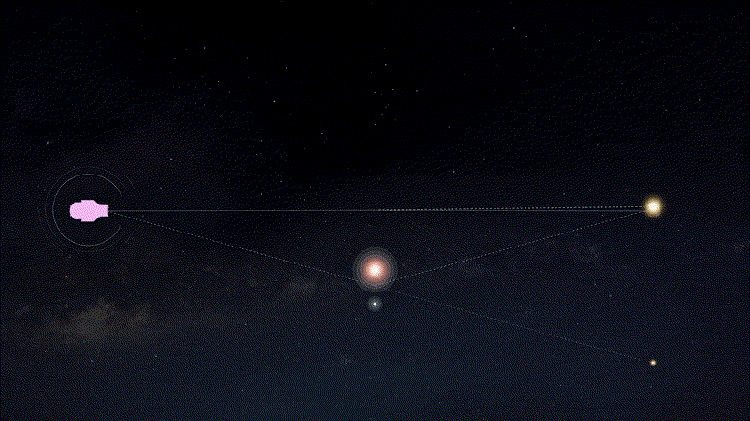
NASA’s TESS Mission Finds Planetary System In New Way.
NASA TESS Microlensing Planet Discovery Started with Gaia
The discovery began in 2023 when the European Space Agency’s Gaia spacecraft detected an unusual increase in the brightness of a distant star.
Gaia’s alert system recognized that the event resembled gravitational microlensing.
However, Gaia’s observation schedule was too sparse to determine whether a planet had influenced the event.
Researchers then turned to archived TESS observations.
Fortunately, TESS happened to observe the same region of the sky during exactly the right period.
Because TESS measures brightness much more frequently, its data revealed small additional changes that Gaia alone could not resolve.
Those tiny variations exposed the presence of Gaia23bra b.
Two Space Missions Solved the Puzzle Together
Neither spacecraft completed the discovery independently.
Gaia detected the unusual brightening first.
TESS supplied the missing measurements that confirmed a planetary companion.
This collaboration demonstrates the growing importance of combining observations from different space missions rather than relying on a single telescope.
Future discoveries may increasingly depend on this approach.
As astronomy missions continue producing enormous archives, researchers can compare observations collected by different spacecraft across many years.
That strategy allows scientists to revisit earlier events with fresh ideas and more advanced analysis techniques.
Why Microlensing Reveals Different Kinds of Planets
The NASA TESS microlensing planet discovery also highlights why gravitational microlensing remains such an important detection technique.
Unlike the transit method, microlensing does not require a planet to pass directly in front of its host star.
Instead, astronomers observe what happens when one star passes almost directly in front of another from Earth’s perspective.
The gravity of the foreground star bends and magnifies the background star’s light.
If planets orbit the foreground star, they create small additional distortions in the magnified light.
Those brief signals reveal the planet’s presence.
Finding Solar System-Like Worlds
Each planet detection method has different strengths.
Transit observations excel at discovering planets orbiting close to their stars.
Microlensing fills an important gap.
It can reveal planets that orbit much farther away from their stars, including giant planets that resemble Jupiter’s position within our own Solar System.
That makes microlensing especially valuable for understanding how complete planetary systems form and evolve.
Scientists are not simply counting planets.
They are comparing different planetary architectures throughout the Milky Way.
The more diverse those discoveries become, the better astronomers can understand where our Solar System fits among billions of planetary systems.
NASA TESS Microlensing Planet Discovery Supports Future Exploration
This discovery arrives at an ideal time for NASA’s upcoming Nancy Grace Roman Space Telescope.
Roman will conduct one of the largest microlensing surveys ever attempted after its planned launch.
Scientists expect the mission to discover around 1,000 planets through microlensing while also identifying approximately 100,000 transiting planets.
Those observations will focus mainly on the crowded central region of the Milky Way, where microlensing events occur more frequently.
TESS Adds a Different View of the Galaxy
Although Roman will concentrate on the galactic center, TESS observes much larger portions of the sky.
That difference creates an exciting opportunity.
TESS can identify microlensing events occurring in regions outside the galaxy’s crowded core.
Researchers can then compare planetary systems formed under different environmental conditions.
Those comparisons may help answer long-standing questions about planet formation across the Milky Way.
Some regions experience more stellar interactions and higher radiation levels than others.
Studying planets across different galactic environments could reveal whether those conditions influence the types of planetary systems that emerge.
Instead of viewing TESS and Roman as competing missions, astronomers now see them as complementary tools that strengthen one another.
Why This Discovery Matters
The NASA TESS microlensing planet discovery is significant for more than the confirmation of one distant giant planet.
It demonstrates that TESS can contribute to discoveries outside its original mission design.
It proves that archived observations remain scientifically valuable years after they were collected.
It highlights the growing role of combining datasets from multiple observatories.
Perhaps most importantly, it suggests that additional hidden planetary systems may already exist inside the vast TESS archive.
As researchers continue developing new analysis techniques, previously overlooked observations may become tomorrow’s biggest discoveries.
Gaia23bra b could therefore represent the beginning of a much larger scientific story rather than a single unexpected result.
With the Nancy Grace Roman Space Telescope preparing for its own extensive microlensing survey, this breakthrough provides an exciting preview of the discoveries that may soon reshape our understanding of planetary systems throughout the Milky Way.
Conclusion
The NASA TESS microlensing planet discovery marks an important milestone in modern exoplanet science. By confirming Gaia23bra b through gravitational microlensing, researchers showed that TESS can contribute to discoveries well beyond its original mission goals. The finding also proves that archived observations remain rich scientific resources. As astronomers continue reanalyzing existing datasets and prepare for the Nancy Grace Roman Space Telescope, they may uncover many more hidden worlds scattered across our galaxy. Sometimes the next major discovery does not require a new telescope. It simply requires looking at familiar data from a completely new perspective.
Main Sources:
- NASA Science – NASA’s TESS Mission Finds Planetary System in New Way
https://science.nasa.gov/missions/tess/nasas-tess-mission-finds-planetary-system-in-new-way/ - The Astrophysical Journal Letters – Original Scientific Paper (July 2026)
https://iopscience.iop.org/journal/2041-8205 - NASA TESS Mission
https://science.nasa.gov/mission/tess/ - NASA Nancy Grace Roman Space Telescope
https://science.nasa.gov/mission/roman-space-telescope/ - European Space Agency – Gaia Mission
https://www.esa.int/Science_Exploration/Space_Science/Gaia