
BY:SpaceEyeNews.
Introduction: Hubble LH 95 Stellar Nursery Opens A Rare Window Into Star Birth
The Hubble LH 95 stellar nursery is not just another beautiful space image. It is a live record of star formation in progress. NASA’s Hubble Space Telescope has revealed a glowing region filled with blue and white young stars, crimson hydrogen gas, and dark lanes of dust. Inside that scene, thousands of stars are still growing.
LH 95 sits inside the Large Magellanic Cloud, a dwarf galaxy that orbits the Milky Way. That location makes it a valuable target. It is distant enough to show a different galactic environment, yet close enough for Hubble to study young stars in detail.
The new Hubble view matters because it shows more than a colorful nebula. It shows how stars gather mass, how stellar nurseries evolve, and how multiple generations of stars can share the same region. It also gives scientists clues about the early environments where planets may one day form.
For astronomers, LH 95 is a natural laboratory. For the general public, it is a rare look at how the universe keeps building itself.
Why Hubble LH 95 Stellar Nursery Matters
The Hubble LH 95 stellar nursery gives scientists a clear view of young stars at different stages of growth. In one region, low-mass infant stars exist beside much larger blue giant stars. This mix helps researchers study how stars of different sizes develop inside the same cosmic environment.
That detail matters. Many star-forming regions in the Milky Way contain thick dust that blocks visible light. LH 95 has less obscuring dust than many similar regions. Because of that, Hubble can separate individual stars with high precision.
NASA’s archive notes that earlier ground-based observations mainly revealed the bright blue giants in such regions. Hubble’s resolution changed that. It allowed astronomers to analyze the lower-mass stars as well. That creates a fuller picture of the stellar population.
This is important because low-mass stars are common. They may not dominate the image visually, but they dominate the numbers. By studying them, astronomers can better estimate stellar ages, masses, and growth patterns.
LH 95 also sits about 160,000 light-years away in the Large Magellanic Cloud. That distance places it outside the Milky Way, but still within our cosmic neighborhood. As a result, Hubble can use it to compare star formation in a nearby dwarf galaxy with star formation in our own galaxy.
A Region Filled With Young Stars And Glowing Gas
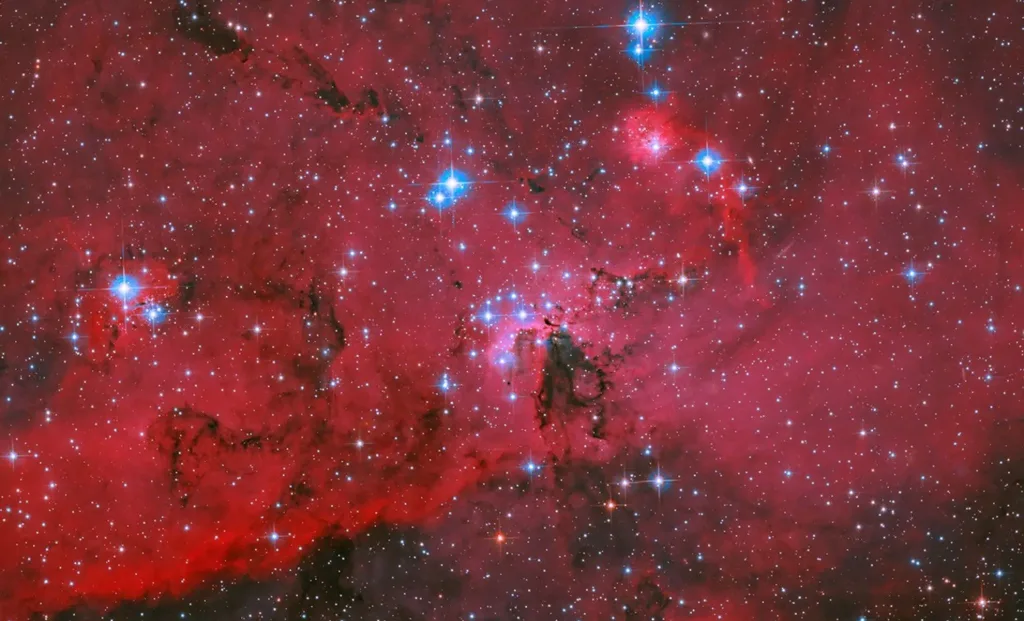
The image of LH 95 immediately stands out because of its colors. Blue and white stars shine across the field. Crimson gas spreads around them. Dark dust lanes cut through the glowing material.
These colors are not just visual decoration. They carry scientific meaning.
The red glow comes from hydrogen-alpha emission. This emission appears when hydrogen gas responds to energy from nearby young stars. Astronomers use hydrogen-alpha light as a strong marker of active star formation.
In LH 95, the most massive stars shape the gas around them. They release intense ultraviolet radiation and stellar winds. These forces heat the surrounding hydrogen and push nearby material into new structures.
Dust lanes add another layer to the story. Some dense regions resist erosion from nearby stars. These areas appear as dark filaments against the glowing gas. They show where thick material still survives inside the nursery.
This makes the Hubble image valuable in two ways. It is visually dramatic, but it is also a map of physical processes. Every bright star, red cloud, and dark lane helps scientists trace the life cycle of a stellar nursery.
The 2,500 Young Stars That Have Not Fully Turned On
One of the strongest findings inside the Hubble LH 95 stellar nursery is the presence of about 2,500 pre-main-sequence stars. These are young stars that have gathered most of their final mass. Yet they have not fully started hydrogen fusion in their cores.
In simple terms, these stars are almost complete, but not yet mature. They formed from collapsing clouds of gas. They still contract under gravity. They also continue to pull material from disks of gas and dust around them.
This stage is crucial. A star does not become stable all at once. It must build mass first. Then its core must become hot and dense enough to begin sustained hydrogen fusion.
Hubble helps astronomers study this phase in detail. By looking at many developing stars together, researchers can compare young objects at different ages. They can also measure how fast those stars continue to gather material.
NASA notes that the accretion rate decreases with age. That matches what scientists expect. Younger stars tend to feed more quickly. Older young stars feed more slowly.
Yet LH 95 adds an important detail. Accretion can continue for several million years. That is longer than some earlier assumptions suggested. This means young stars may keep interacting with their disks for a longer period than expected.
That detail matters for planet formation. The same disks that feed young stars can also become the raw material for future planets. If those disks last longer, then planet-building environments may also have more time to evolve.
Why Accretion Changes The Story
Accretion may sound technical, but it is central to the story of LH 95. It describes how young stars collect material from nearby gas and dust. Without this process, stars cannot reach their final mass.
In the Hubble LH 95 stellar nursery, scientists can study accretion across a large group of young stars. This is valuable because one star only gives a limited view. Thousands of stars create a stronger pattern.
The results show that star growth is not a single quick event. It is a process that stretches across time. A young star may gather most of its mass early, but its disk can continue feeding it for millions of years.
This longer timeline affects how scientists think about early stellar systems. A disk is not just leftover material. It is an active part of the young system. It can feed the star, shape its rotation, and provide the material that may later gather into planets.
That makes LH 95 more than a star-birth region. It also becomes a window into the first chapters of planetary systems.
Our own solar system began in a disk around the young Sun. LH 95 does not show the birth of our system, of course. But it helps scientists study the same general processes that once shaped the early Sun and its surroundings.
Multiple Generations Inside One Stellar Nursery
LH 95 also shows that star formation can happen in waves. NASA reports that distinct generations of stars exist side by side in the region. This means LH 95 did not form all its stars in one single event.
Many stars in the region appear to be around 4 million years old. The most massive star in LH 95 is different. It has about 60 to 70 times the mass of the Sun and appears roughly one million years younger than many nearby stars.
That age difference is important. It suggests that star formation continued over time. One group formed first. Later, another group followed. The nursery did not simply switch on and stop.
This layered history helps astronomers reconstruct the region’s past. Massive stars can affect their surroundings through radiation and stellar winds. Those forces can push, heat, and reshape nearby gas. In some cases, they may influence where the next generation of stars begins to form.
So LH 95 acts like a timeline. It shows young stars at different stages and different ages. Instead of a single snapshot, Hubble gives scientists a scene with history built into it.
That makes the region especially useful. It helps answer a key question in astronomy: does star formation happen all at once, or can it continue across generations inside the same cloud?
In LH 95, the answer appears clear. Star birth can unfold over an extended period.
What LH 95 Reveals About Planet-Forming Environments
The Hubble LH 95 stellar nursery also matters because stars and planets begin from connected material. Young stars grow from disks of gas and dust. Those same disks can later support planet formation.
This connection makes LH 95 important beyond stellar science. It helps astronomers understand how early solar systems may develop.
When Hubble observes young stars still gathering material, it also observes the environments around them. Those disks may contain the early ingredients of planets. Over time, dust grains can collect, grow, and form larger bodies.
Not every disk will produce planets. Not every young system will become like our solar system. Still, studying many young stars in one nursery gives scientists a stronger sample. It helps them see how common long-lasting disks may be.
The finding that accretion can continue for millions of years gives researchers more to consider. If a disk keeps feeding a star for a long time, it may also keep changing chemically and structurally. That can affect the conditions for planet formation.
This is why LH 95 is not only a beautiful Hubble target. It is part of a larger question: how do stars and planetary systems form across different galactic environments?
Why The Large Magellanic Cloud Makes LH 95 Special
The Large Magellanic Cloud adds more value to this discovery. It is a nearby dwarf galaxy that orbits the Milky Way. Its environment differs from our galaxy in important ways.
NASA’s older LH 95 archive notes that the Large Magellanic Cloud contains relatively small amounts of elements heavier than hydrogen. In astronomy, those heavier elements affect how gas cools, how dust forms, and how stars develop.
That makes LH 95 useful for comparison. Scientists can study star formation in a setting that is not identical to the Milky Way. This helps them test whether star formation follows the same patterns in different environments.
The result is a broader view of cosmic star birth. Astronomers do not want to understand only one region or one galaxy. They want to understand how star formation works across the universe.
LH 95 helps with that goal. It offers a rich sample of young stars in a nearby galaxy. It also gives Hubble a chance to observe low-mass stars that would be much harder to study in more distant galaxies.
Why Hubble Still Matters In The Webb Era
The James Webb Space Telescope has transformed infrared astronomy. Yet Hubble still plays a major role. The LH 95 image proves why.
Hubble remains powerful because it sees the universe in visible and ultraviolet wavelengths with sharp resolution. That makes it excellent for studying glowing gas, young stars, and detailed structures in nebulae.
Webb can look deeper into dusty regions with infrared vision. Hubble can show different wavelengths with a different kind of detail. Together, the two observatories give scientists a fuller view.
NASA also points to the upcoming Nancy Grace Roman Space Telescope as part of this wider future. Roman will bring wide-field survey power. Hubble, Webb, and Roman will not simply replace one another. They will work as complementary tools.
In the case of LH 95, Hubble’s long life is part of the story. More than three decades after launch, it continues to deliver valuable science. It still reveals new details about star-forming regions, galaxies, and the structure of the universe.
That is why this image matters beyond its beauty. It shows Hubble still doing what it does best: turning distant cosmic scenes into scientific evidence.
Conclusion: Hubble LH 95 Stellar Nursery Shows Star Birth In Motion
The Hubble LH 95 stellar nursery reveals a region that is still building itself. Inside the Large Magellanic Cloud, thousands of young stars continue to grow within glowing gas and dust.
NASA’s Hubble image shows about 2,500 pre-main-sequence stars. These stars have not yet fully started hydrogen fusion. Many still gather material from surrounding disks. That growth can continue for several million years.
The image also reveals multiple generations of stars sharing the same nursery. Some stars are older. One huge star is younger and far more massive than the Sun. Together, they show that star formation can happen in waves.
For astronomers, LH 95 is a natural laboratory. It helps explain how stars grow, how disks evolve, and how future planet-forming environments may begin. For the rest of us, it offers a clear reminder that the universe is not frozen in place. It is still creating new stars, new systems, and new stories across cosmic time.
Main Sources:
NASA — NASA’s Hubble Captures Crimson Cloud Sparkling with White, Blue Stars
https://science.nasa.gov/missions/hubble/nasas-hubble-captures-crimson-cloud-sparkling-with-white-blue-stars/
NASA — Star-Forming Region LH 95 in the Large Magellanic Cloud
https://science.nasa.gov/asset/hubble/star-forming-region-lh-95-in-the-large-magellanic-cloud/
ESA — Star-forming Region in the Large Magellanic Cloud
https://sci.esa.int/web/hubble/-/39807-star-forming-region-in-the-large-magellanic-cloud
arXiv — Discovery of the Pre-Main Sequence Population of the Stellar Association LH 95
https://arxiv.org/abs/0706.4377
arXiv — Photometric Determination of the Mass Accretion Rates of Pre-main Sequence Stars: LH 95
https://arxiv.org/abs/1903.07610