
BY:SpaceEyeNews.
Introduction: Two Asteroid Encounters, One Big Signal
Two asteroid encounters happened almost back-to-back this weekend, and together they tell a much bigger story. Japan’s Hayabusa2 spacecraft flew past asteroid Torifune during its extended mission. Hours later, China released images from Tianwen-2 after it reached Kamoʻoalewa, a small object often called Earth’s quasi-moon.
These events were not simple photo opportunities. They showed how asteroid exploration is changing. Space agencies are now targeting smaller, harder, and more unusual objects near Earth. These tiny worlds can reveal how the Solar System formed. They can also help scientists understand how small bodies move, spin, and change over time.
For Japan, the Torifune flyby proved that an older spacecraft can still deliver useful science after its main mission. For China, Tianwen-2 opened the next phase of an ambitious sample-return mission. Together, these two asteroid encounters highlight a new era in deep-space exploration.
Hayabusa2’s Torifune Flyby: A Mission That Refused to End
Hayabusa2 already had a historic career before it reached Torifune. The Japanese spacecraft launched in December 2014. It arrived at asteroid Ryugu in June 2018, studied the surface, collected samples, and sent a capsule back to Earth in December 2020.
That alone made the mission a major success. Yet Hayabusa2 still had enough fuel and healthy systems to keep going. Instead of ending the spacecraft’s journey, Japanese engineers created an extended mission.
Torifune became the first major target in that extended plan. The asteroid, officially known as 98943 Torifune, is a small near-Earth object. It is not famous like Ryugu or Bennu. Yet that is exactly why it matters. Small asteroids are difficult to observe from Earth in detail. A close spacecraft flyby can reveal shapes, surface features, and motion patterns that telescopes cannot capture clearly.
JAXA planned the Torifune flyby for July 5, 2026. The spacecraft passed the asteroid at very high speed, close to 5 kilometers per second. That means Hayabusa2 had only a short window to collect useful data.
This kind of operation is not easy. A spacecraft must point its instruments correctly while moving past a small target at extreme speed. The navigation must be accurate. The timing must be precise. Even a small error can reduce the quality of the images and measurements.
That is why this flyby matters beyond one asteroid. It tested deep-space navigation, long-duration spacecraft health, and high-speed observation techniques. These skills could support future missions that need to study or redirect small objects near Earth.
Torifune’s Peanut Shape Makes It More Than a Rock
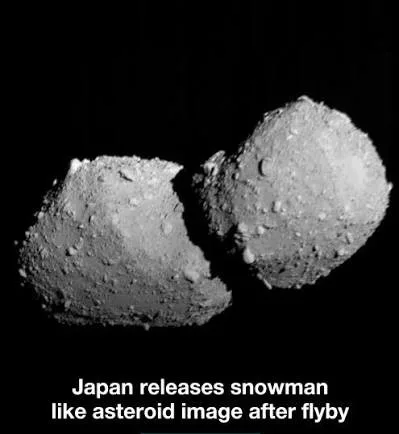
The first images of Torifune offered an instant visual surprise. The asteroid appears to have a peanut-like shape. That may sound like a fun detail, but it carries scientific value.
Small asteroids often have strange shapes because their gravity is weak. They do not always form smooth spheres. Instead, they may look stretched, lumpy, or divided into two connected parts. A peanut-like body can point to several possible histories.
One possibility is that Torifune formed as a contact binary. In that case, two smaller bodies may have slowly come together and stayed attached. Another possibility is that rotation, impacts, and loose surface material shaped the asteroid over time.
Scientists need more data before drawing firm conclusions. JAXA said only part of the flyby data had reached Earth soon after the encounter. More information should come down during later operations.
Even so, Torifune is already useful. It adds one more strange object to the growing catalog of small asteroid shapes. That catalog matters because small bodies do not all behave the same way. Some may be solid rock. Others may be loose piles of material. Some rotate slowly. Others spin quickly.
Each detail helps scientists understand how near-Earth objects evolve. It also helps mission planners prepare for future spacecraft visits.
Tianwen-2 Reaches Kamoʻoalewa
While Japan was celebrating Hayabusa2’s extended success, China reached a major milestone of its own. The China National Space Administration announced that Tianwen-2 had reached close range near asteroid Kamoʻoalewa, also known as 2016 HO3.
The spacecraft came within about 20 kilometers of the asteroid. It had traveled for about 400 days and covered roughly 1 billion kilometers before beginning close scientific operations. China also released an early image of the object.
Kamoʻoalewa is tiny. Estimates place it at only a few tens of meters across. That makes the mission extremely challenging. A small asteroid has very weak gravity. Its surface may be loose, uneven, or difficult to predict. Its rotation can also make sampling harder.
Tianwen-2 is not there only to take pictures. The spacecraft must study the asteroid’s shape, surface, composition, and rotation before attempting sample collection. This careful mapping phase is essential. Engineers need to understand the object before choosing a safe and useful sampling strategy.
If successful, Tianwen-2 will return asteroid material to Earth. The sample capsule is expected late next year, according to current mission plans. That would place China among the small group of nations that have completed asteroid sample-return missions.
Why Kamoʻoalewa Is So Interesting
Kamoʻoalewa is often described as Earth’s quasi-moon. That term can sound confusing, so the distinction matters. It is not a true moon of Earth. It does not orbit Earth in the same way the Moon does. Instead, it orbits the Sun while staying near Earth’s orbital path.
This unusual relationship makes Kamoʻoalewa scientifically valuable. It moves in a way that keeps it close to Earth over long periods. That gives scientists a rare chance to study a nearby small body with an unusual orbital history.
The biggest question is its origin. Some research suggests Kamoʻoalewa may be linked to the Moon. It could be a fragment blasted away by an ancient impact. Other studies explore different possible origins and surface types.
A returned sample could help settle the debate. Telescope data can suggest a composition, but laboratory analysis goes much deeper. Scientists can study minerals, isotopes, grain size, and exposure history. Those clues can show whether the asteroid truly resembles lunar material or came from another source.
This is why Tianwen-2’s mission has global scientific interest. It may answer a question that remote observation alone cannot solve.
Two Asteroid Encounters, Two Different Strategies
These two asteroid encounters matter more when viewed side by side. Japan and China are not doing the same mission. They are showing two different paths in asteroid exploration.
Hayabusa2 represents mission extension. Japan took a spacecraft that had already completed its main goal and used it for new science. That approach saves value. It also shows confidence in long-term spacecraft operations.
Tianwen-2 represents a new sample-return campaign. China designed the mission to visit a small near-Earth asteroid, collect material, return it, and then continue deeper into space.
Both approaches are important. A flyby can deliver fast science and test navigation. A sample return can bring unmatched laboratory data. Together, they show how asteroid exploration is becoming more flexible and more ambitious.
The targets also matter. Torifune and Kamoʻoalewa are small. They are not giant worlds with easy surfaces and strong gravity. They are compact, irregular, and difficult. That is exactly what makes them valuable.
Small asteroids are common near Earth. Yet scientists still need more close-up data about how they behave. These missions help fill that gap.
The Planetary Defense Connection
The phrase “planetary defense” often sounds dramatic. In this case, it simply means understanding near-Earth objects before they become a practical concern. Scientists need to know how small asteroids move, rotate, reflect light, and respond to forces in space.
Hayabusa2’s Torifune flyby directly supports that goal. JAXA has linked the extended mission to techniques useful for planetary defense. A high-speed flyby helps engineers practice precise guidance near a small object. That skill could matter in future missions that need to study or alter an asteroid’s path.
Tianwen-2 also adds value. Its work at Kamoʻoalewa will improve knowledge of small-body surfaces. Sampling a tiny asteroid can reveal how firm, dusty, rocky, or fragile such objects may be.
That matters because not all asteroids respond the same way. A solid rock and a loose rubble pile require different mission designs. Before any future deflection or close-contact mission, scientists need to know what kind of object they are dealing with.
So these two asteroid encounters are not only about discovery. They also build practical knowledge for future space safety.
Sample Return Is Becoming the New Standard
Asteroid sample return has become one of the clearest signs of deep-space capability. Japan achieved it with Hayabusa and Hayabusa2. NASA achieved it with OSIRIS-REx. China is now trying to do it with Tianwen-2.
This does not make asteroid science a race in the simple sense. The science benefits everyone when data becomes available. Still, sample return requires a high level of engineering. A spacecraft must travel far from Earth, approach a tiny object, collect material, return home, and deliver a capsule safely.
That chain of events is difficult. Every step must work. Guidance, communications, thermal control, sampling hardware, and reentry systems all matter.
If Tianwen-2 succeeds, it will mark a major step for China’s deep-space program. It will also add a new sample from a very unusual near-Earth object.
For scientists, the prize is not only national achievement. It is material from a world that may preserve clues from early Solar System history. If Kamoʻoalewa has a lunar connection, the sample could become even more important.
What Scientists Want to Learn Next
The next phase will be data-heavy. For Torifune, scientists will study images and measurements from the flyby. They will look at the asteroid’s shape, brightness, surface texture, and rotation. The peanut-like form will receive special attention.
For Kamoʻoalewa, Tianwen-2 will spend time characterizing the target before sampling. The spacecraft must learn where the safest and most valuable sampling area may be. It must also account for weak gravity and possible surface hazards.
Both missions can improve models of small asteroid behavior. Scientists want to know how these objects hold together. They also want to understand how sunlight, heat, impacts, and rotation reshape them over time.
Surface weathering is another key topic. Space is not empty or gentle. Radiation, micrometeorites, and temperature changes can alter asteroid surfaces. A returned sample can reveal how long material has been exposed and what processes changed it.
These are not basic questions. They are central to understanding small worlds near Earth.
What Comes After This Weekend
Hayabusa2’s journey is not finished. Its final extended mission goal is a rendezvous with asteroid 1998 KY26 in 2031. That object is extremely small and rotates quickly. Studying it up close could become one of the most interesting small-body missions of the next decade.
Tianwen-2 also has a longer plan. After returning samples from Kamoʻoalewa, the spacecraft may continue toward 311P/PanSTARRS. That object is especially intriguing because it has tail-like features. It sits in the asteroid belt but behaves in ways that raise comet-like questions.
This gives Tianwen-2 a two-part identity. First, it is an asteroid sample-return mission. Later, it could become a mission to study an unusual active object in the asteroid belt.
That kind of mission design shows where deep-space exploration is heading. Spacecraft are no longer built only for one moment. More missions now aim for extended science, secondary targets, and flexible long-term operations.
Conclusion: Why These Two Asteroid Encounters Matter
Two asteroid encounters in one weekend may sound like a coincidence. In reality, they reveal a clear shift in space exploration.
Japan’s Hayabusa2 showed that a proven spacecraft can keep producing science long after its main mission. Its Torifune flyby delivered new data from a small, peanut-shaped asteroid and tested high-speed navigation near a challenging target.
China’s Tianwen-2 reached Kamoʻoalewa and began one of the most ambitious asteroid sample-return efforts now underway. Its target is tiny, strange, and scientifically rich. If the mission succeeds, its samples could help explain whether this quasi-moon has a link to the Moon or another source.
Together, these two asteroid encounters show that small worlds are becoming major destinations. They matter for Solar System science. They matter for mission design. They also matter for planetary defense.
These were not just close-up views of distant rocks. They were signs that the next chapter of deep-space exploration may be written around the smallest worlds near Earth.
Main Sources:
JAXA — The timing of the flyby of asteroid Torifune by asteroid explorer Hayabusa2
https://global.jaxa.jp/press/2026/06/20260609-1_e.html
JAXA / ISAS — Hayabusa2 mission information
https://www.isas.jaxa.jp/en/missions/spacecraft/current/hayabusa2.html
CNSA — Tianwen-2 reaches asteroid 2016 HO3 / Kamoʻoalewa and begins scientific exploration
https://www.cnsa.gov.cn/
Ars Technica — There were not one, but two asteroid encounters this weekend
https://arstechnica.com/space/2026/07/there-were-not-one-but-two-asteroid-encounters-this-weekend/
NASA OSIRIS-REx mission overview
https://science.nasa.gov/mission/osiris-rex/