
BY:SpaceEyeNews.
NASA’s Chandra X-ray Observatory has delivered its most detailed X-ray view yet of the M87 black hole jet. The result reveals a far more complex and active structure than earlier X-ray images could show.
This breakthrough did not come from one new observation. Instead, astronomers combined 14 Chandra observations collected between 2012 and 2025. They then used advanced image-processing methods to reduce the blur created by the telescope’s optics.
The reconstructed images separate structures that previously appeared merged. They also allow researchers to follow individual features across 13 years.
Some bright regions remain nearly stationary. Others appear to travel at almost five times the speed of light. Several major features have also faded sharply in X-rays.
Together, these changes offer new clues about particle acceleration, magnetic fields, and energy transport inside one of the most famous cosmic jets ever studied.
Chandra Turns 13 Years of Data Into a Cosmic Timeline
M87 sits about 55 million light-years from Earth in the constellation Virgo. At its center lies a supermassive black hole with roughly 6.5 billion times the mass of the Sun.
That black hole became famous in 2019. The Event Horizon Telescope used a global network of radio observatories to produce the first direct image of a black hole’s shadow.
However, the new Chandra research focuses on a much larger structure.
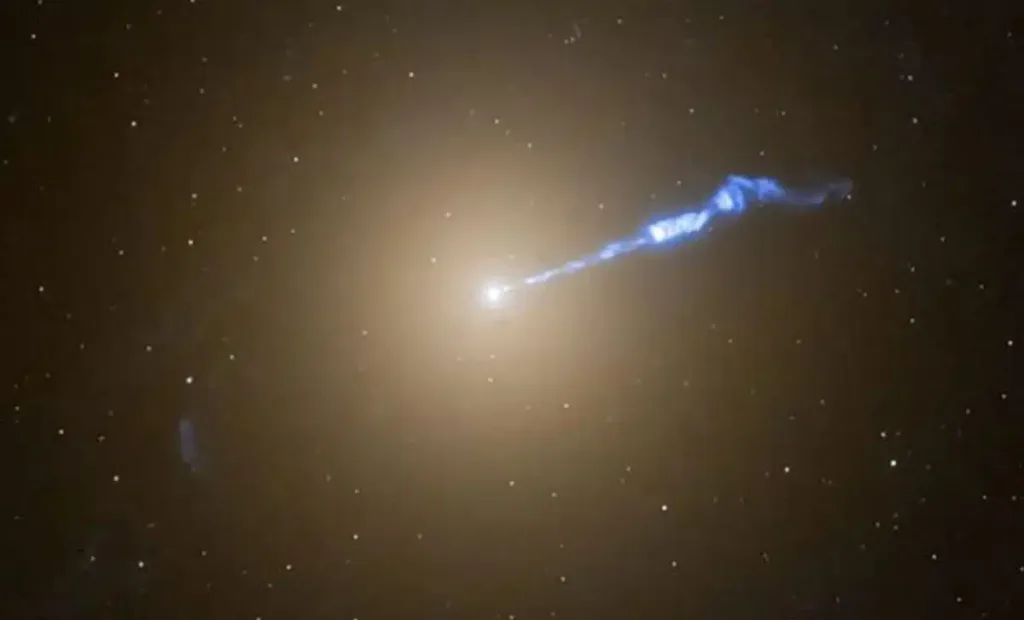
A powerful jet extends thousands of light-years from M87’s center. It carries energetic particles and magnetic fields far beyond the immediate area around the black hole.
Astronomers have studied this jet for decades in radio, infrared, optical, ultraviolet, and X-ray wavelengths. Yet earlier X-ray images could not clearly separate many of its smaller structures.
The new study changes that view.
Researchers analyzed observations taken during four main periods: 2012, 2017, 2023, and 2025. Those datasets came from Chandra’s High Resolution Camera. The combined observing time reached just over 80 hours.
Because the observations span 13 years, the team could do more than sharpen the jet. It could track how the jet changed over time.
The resulting sequence functions like a slow-motion cosmic video. Bright knots shift position, change shape, and lose brightness between each observing period.
How Chandra Sharpened the M87 Black Hole Jet
The team used a technique called point-spread-function deconvolution.
Every telescope spreads light slightly when it forms an image. A point of light therefore appears wider than it truly is. When several bright features sit close together, their light can overlap and create one blurred structure.
Deconvolution estimates how the telescope spreads that light. It then uses mathematical reconstruction to recover more of the original detail.
This process does not add imaginary objects to the image. Instead, it helps researchers separate signals that already exist within the data.
The astronomers also created time-dependent models of Chandra’s imaging response. This step helped them account for small changes between observing periods.
After applying the method, the team achieved X-ray detail below one arcsecond. That resolution brought the Chandra images much closer to views produced at optical and infrared wavelengths.
The comparison matters because astronomers can now identify many of the same features across Chandra, the Hubble Space Telescope, the James Webb Space Telescope, the Atacama Large Millimeter/submillimeter Array, and the Very Large Array.
Chandra’s official image covers an area about 12,000 light-years across. Within that region, the jet appears as a chain of bright knots rather than one smooth beam.
Previously Blended Structures Come Into View
One of the most important targets in the study is a bright feature called HST-1.
HST-1 lies downstream from the black hole and has displayed major brightness changes during previous observing campaigns. Researchers have long considered it a key location for studying particle acceleration.
In raw X-ray images, HST-1 looks like a single feature. The new reconstruction shows a more complicated structure.
From 2023 onward, the team resolved HST-1 into two separate components. Those components also align closely with structures seen by Hubble and Webb.
This discovery changes how astronomers interpret the feature’s motion.
When two objects overlap, researchers may measure the center of their combined brightness. If one component brightens while the other fades, that center can appear to move even when the physical structures behave differently.
The new study shows that this blending can distort speed measurements. Once the researchers separated the components, they gained a more reliable view of their individual movement.
Other regions also revealed complex shapes. Downstream knots contained smaller features, changing edges, and uneven brightness patterns that earlier X-ray images had hidden.
The M87 Black Hole Jet Is Not a Steady Beam
The improved images show that the M87 black hole jet does not move as one uniform flow.
Some features appear nearly fixed for years. Others travel outward. Several structures also display movement across the width of the jet rather than only along its main direction.
These different behaviors suggest that each bright knot may represent a different physical process.
A moving knot could trace plasma traveling through the jet. It could also represent a shock or disturbance passing through the plasma.
Meanwhile, a nearly stationary feature may mark a standing shock. In that case, material flows through a relatively fixed compression zone.
Researchers consider knot A a possible example. It shows little overall motion in the reconstructed images, even though its shape changes. Earlier studies also found magnetic-field patterns consistent with compressed plasma in that region.
The full picture probably includes several effects. Moving shocks, standing shocks, magnetic interactions, and changes in plasma density may all shape the observed jet.
The new data do not prove one final model. However, they provide stronger limits for simulations that attempt to reproduce the jet’s behavior.
Why Some Knots Appear to Exceed Light Speed
Several features display apparent speeds approaching five times the speed of light.
The fastest measurement in the study reaches about 4.8 times light speed in one component of HST-1. This does not mean that matter has broken the cosmic speed limit.
Astronomers call the effect superluminal motion.
It occurs when material travels extremely close to light speed while also moving partly toward Earth. Light released from a later position has a shorter distance to travel than light released earlier.
That difference compresses the observed timeline. From Earth, the feature appears to cross the sky faster than light could travel across the same projected distance.
In reality, the particles remain below light speed.
Previous Chandra research showed that some sections of the M87 jet move at more than 99% of light speed. Radio and optical observations have also detected superluminal motion in the same general region.
The latest analysis adds more detail. It shows that the measured apparent speed can change when multiple unresolved components contribute different amounts of light.
Major Parts of the Jet Are Fading in X-Rays
Motion is only part of the discovery.
The team also measured a broad decline in X-ray emission across much of the jet between 2012 and 2025.
HST-1 showed the largest change. Its X-ray brightness fell by as much as 84% compared with the 2012 observation.
Knot A also faded, although more gradually. The study found a decline of roughly 27% by 2025. Other knots displayed smaller but still measurable changes.
This fading provides direct information about the particles inside the jet.
The X-rays come mainly from extremely energetic electrons traveling through magnetic fields. As those electrons follow curved paths, they release energy as synchrotron radiation.
Over time, the electrons lose energy. Eventually, they can no longer produce strong X-ray emission.
Astronomers call this process synchrotron cooling.
The highest-energy electrons cool faster than lower-energy particles. Therefore, X-ray brightness can change over shorter periods than radio or infrared brightness.
By measuring the fading rate, researchers can estimate the minimum magnetic-field strength needed to produce the observed energy loss. The study calculated ranges for both HST-1 and knot A.
These values remain model-dependent. They represent lower limits rather than direct measurements of the jet’s complete magnetic field.
X-Rays Reveal Where Particles Gain Energy
Multiwavelength observations add another important clue.
The main X-ray knots generally align with structures seen in infrared, optical, radio, and millimeter wavelengths. However, the brightest X-ray emission often appears slightly upstream.
In other words, the X-ray peaks sit closer to the black hole than the matching optical or infrared peaks.
This pattern fits the synchrotron-cooling explanation.
Freshly accelerated electrons carry enough energy to produce X-rays near their acceleration site. As they move downstream, they lose energy.
Those older electrons may stop producing X-rays but continue emitting optical, infrared, or radio radiation. As a result, lower-energy emission can remain visible farther along the jet.
Chandra therefore helps researchers locate areas where particles have recently gained extreme energy.
The study found upstream X-ray offsets in several regions, including knots D-E, E, F, and A. Knot A also showed a sharper X-ray structure than its lower-energy counterparts.
These differences help astronomers reconstruct the sequence of events inside each knot. They reveal where acceleration begins and how particles cool while moving through the jet.
Hubble, Webb, Chandra, and Radio Data Complete the Picture
No single observatory can reveal every part of the M87 black hole jet.
Chandra detects radiation from the most energetic electrons. Hubble observes optical light. Webb follows infrared emission. ALMA and the Very Large Array examine longer wavelengths.
Each telescope therefore traces particles with different energies and cooling histories.
The improved Chandra images now match the jet’s width and major knot locations across those wavelengths more closely than before.
That alignment allows astronomers to compare the same structures instead of studying disconnected images.
They can measure whether an X-ray peak sits ahead of an optical peak. They can check whether an infrared component matches a newly separated X-ray feature. They can also follow how brightness changes across the spectrum.
Such comparisons test models of shocks and magnetic acceleration more effectively than one wavelength alone.
The result shows the value of coordinated astronomy. Webb and Hubble provide sharp lower-energy views, while Chandra reveals the jet’s highest-energy activity. Radio observatories then trace particles that survive much farther downstream.
What the Jet Reveals About Black Hole Feedback
The study does not directly show how the jet launches beside the event horizon.
The Event Horizon Telescope examines scales close to the black hole. Chandra studies material much farther away. Some of that material left the central region hundreds or thousands of years before its light reached the observed location.
Even so, the larger jet plays an important role in its host galaxy.
Supermassive black holes can send energy into surrounding gas through their jets. That energy can heat the environment and change how quickly gas cools.
This process, known as black hole feedback, may influence the long-term development of massive galaxies and galaxy clusters.
By tracking the knots, researchers can examine where the jet loses energy. They can also study how magnetic fields and shocks transfer that energy into the surrounding environment.
The new Chandra timeline gives astronomers a direct way to watch that process evolve rather than relying on one frozen image.
Why Long-Term Chandra Observations Matter
Modern image processing produced the sharper view, but the long observational record made the discovery possible.
A single observation can reveal a jet’s position and brightness. It cannot show whether a knot moves, fades, separates, or changes shape.
The four observing periods allowed the team to compare the same structures over more than a decade.
That timeline exposed the fading of HST-1. It revealed the slower decline in knot A. It also separated moving components from nearly stationary features.
Stable observatories provide this kind of long-term scientific value. Researchers can return to the same target with the same instrument and build a consistent record.
Chandra launched in 1999. Decades later, its archive continues to support new results, especially when teams apply improved analysis methods to earlier data.
The current study remains a preprint submitted to The Astrophysical Journal. Future peer review may refine some measurements or interpretations. However, the official Chandra team has released the images, observational details, and principal results.
Conclusion: The M87 Black Hole Jet Becomes a Changing Laboratory
The sharpest X-ray view yet of the M87 black hole jet reveals much more than extra visual detail.
It shows a dynamic system filled with separate knots, shifting structures, rapid apparent motion, and major brightness changes. Some components remain almost fixed. Others appear to travel at nearly five times light speed because of superluminal motion.
The fading X-rays also show how energetic electrons lose power inside magnetic fields. Meanwhile, comparisons with Hubble, Webb, ALMA, and radio observations identify where particles likely gain energy before cooling downstream.
M87 first entered public history through the first black hole image. Chandra now shows that the activity beyond that famous shadow deserves equal attention.
By turning 13 years of observations into a detailed timeline, astronomers have transformed the jet into a living laboratory for testing how black holes accelerate particles and distribute energy across their galaxies.
Main Sources:
NASA Chandra X-ray Observatory — Chandra Tracks the Evolving Jet from Messier 87’s Black Hole:
https://chandra.harvard.edu/press/26_releases/press_061526_m87.html
NASA Chandra X-ray Observatory — M87 Jet Photo Album and Observation Details:
https://chandra.harvard.edu/photo/2026/m87/
Poitras et al. — Resolving the Temporal Evolution of M87 Jet With Chandra Observations:
https://arxiv.org/abs/2606.13800
Full Research Paper:
https://arxiv.org/html/2606.13800v1
NASA — Famous Black Hole Has Jet Pushing Cosmic Speed Limit:
https://www.nasa.gov/image-article/famous-black-hole-has-jet-pushing-cosmic-speed-limit/
NASA — First Image of a Black Hole:
https://science.nasa.gov/resource/first-image-of-a-black-hole/