
BY:SpaceEyeNews.
ames Webb’s Quintet has exposed a crowded and rapidly changing region of the universe only 800 million years after the Big Bang. The James Webb Space Telescope found at least five physically connected galaxies interacting inside a remarkably compact area. Together, they contain more than 17 galaxy-sized clumps and are producing stars at an exceptional rate.
Yet the galaxies themselves tell only part of the story. Webb also detected a vast halo of oxygen-rich gas surrounding and connecting several members. This material shows that stars had already formed, created heavy elements and spread those elements beyond their host galaxies.
The discovery suggests that some early galaxies did not grow slowly or alone. Instead, they developed through crowded interactions that quickly built stellar mass and enriched the space around them.
James Webb’s Quintet Emerges in a Crowded Deep Field
Researchers led by Weida Hu identified the unusual system in the GOODS-South field. They used observations from the JWST Advanced Deep Extragalactic Survey, better known as JADES.
The team reported the findings in a peer-reviewed study published in Nature Astronomy. The system sits at a redshift of approximately 6.7. Its light began traveling toward us when the universe was around 800 million years old.
Astronomers named the system James Webb’s Quintet, or JWST’s Quintet. The name reflects its five main galaxy members. However, researchers also identified many smaller structures within them.
Webb resolved more than 17 galaxy-sized clumps across the system. Some appear to be intense pockets of star formation. Others may represent smaller components merging into the larger galaxies.
The entire structure occupies an area only about 4.5 arcseconds across. At that distance, this corresponds to roughly 24.6 by 24.6 physical kiloparsecs. That makes it a remarkably compact environment for so many active galaxies.
For comparison, the Milky Way’s stellar disk spans about 30 kiloparsecs. James Webb’s Quintet packs several interacting galaxies into a region of broadly comparable scale.
Five Galaxies, Not a Chance Alignment
Distant galaxies can sometimes appear close together even when they sit at very different distances. The researchers therefore had to determine whether the five objects formed a genuine physical system.
Two members have spectroscopically confirmed redshifts of 6.707 and 6.712. Their projected separation is about 18.6 physical kiloparsecs. Their measured velocity difference is also relatively small.
The remaining three members lack the same level of spectroscopic confirmation. However, their photometric redshifts closely match the confirmed galaxies. Their light profiles and spectral energy distributions also support a shared distance.
In addition, the galaxies show disturbed shapes, connecting gas and extended star-forming features. Together, these clues strongly indicate that all five belong to the same interacting structure.
This is therefore more than a collection of bright objects lined up in the same direction. It appears to be a major multi-galaxy merger caught during an active stage of assembly.
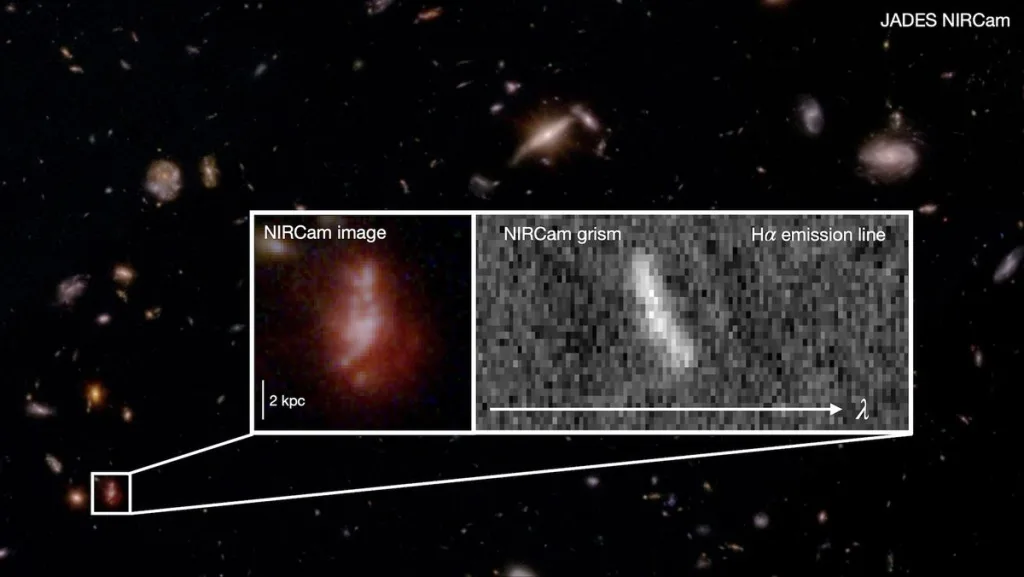
James Webb telescope uncovers a chaotic surprise in the early universe.
James Webb’s Quintet Is Producing Stars at an Extreme Rate
The five galaxies contain a combined stellar mass of around 10 billion times the mass of the Sun. That figure is notable because the system existed before the universe reached its first billion years.
Even more striking is its star formation rate.
The researchers estimate that the system was producing between 240 and 270 solar masses of new stars each year. A central estimate of about 255 solar masses per year captures the scale of this activity.
That rate places James Webb’s Quintet roughly one order of magnitude above the typical star-forming main sequence for galaxies of similar mass at that time.
In simpler terms, the system was creating stars about ten times faster than an ordinary galaxy population with a similar combined mass.
Interactions May Be Driving the Starburst
Galaxy interactions can compress large clouds of gas. This compression can create ideal conditions for rapid star formation.
Webb’s images reveal several disturbed and elongated structures inside the Quintet. One galaxy contains an extended tail that points toward another member. Smaller star-forming clumps appear along that feature.
Another member shows two distinct clumps connected through diffuse emission. These shapes suggest that gravitational interactions have already rearranged the galaxies’ gas and stars.
The system may therefore represent a rapid construction phase. Several smaller galaxies are interacting, forming new stars and building a much larger stellar population.
This offers a very different picture from gradual, isolated growth. In dense early environments, galaxies may have assembled through short and highly productive episodes.
Oxygen-Rich Gas Surrounds James Webb’s Quintet
The most important result may not be the number of galaxies. Instead, it may be the glowing gas found between them.
Webb detected an extended halo of [O III] and hydrogen-beta emission. This gas surrounds and connects four of the five galaxies.
[O III] emission comes from doubly ionized oxygen. Hydrogen-beta traces ionized hydrogen. Together, these emission lines reveal hot gas exposed to strong radiation or other energetic processes.
The halo occupies part of the circumgalactic medium. This region lies beyond the galaxies’ main stellar bodies but remains connected to their evolution.
Webb’s observations show that this surrounding environment was already chemically enriched.
Why Early Oxygen Matters
The Big Bang produced mainly hydrogen and helium, along with tiny amounts of a few lighter elements. Oxygen formed later inside stars.
Finding oxygen around these galaxies means that several stages of cosmic development had already occurred.
Stars first had to form from relatively simple gas. Those stars then had to produce oxygen through nuclear reactions. The enriched material had to leave the stellar interiors. Finally, it had to travel beyond the galaxies and enter their surroundings.
All of this happened within the universe’s first 800 million years.
That timeline makes James Webb’s Quintet an important example of rapid chemical evolution. It shows that some early environments did not remain chemically simple for long.
The system was already massive, active and chemically enriched. It was also moving those heavier elements across a region much larger than any single star-forming clump.
A Galaxy Merger May Have Stripped the Enriched Gas
The researchers examined several ways that oxygen-rich material could have reached the surrounding halo.
Powerful stellar activity can produce large-scale outflows. Active black holes can also drive gas away from a galaxy’s center. However, the team found no clear evidence for an active galactic nucleus in the main Quintet members.
Existing spectra also show no broad emission component strong enough to explain the full amount of enriched gas through a powerful outflow alone.
Instead, the structure of the halo points toward tidal stripping.
As galaxies pass close to one another, their gravity can stretch and remove gas. The material may form bridges, streams and extended tails between the interacting objects.
In James Webb’s Quintet, much of the diffuse emission appears in a bridge between two merging galaxies. The shape closely follows features expected from strong gravitational interaction.
The researchers therefore consider merger-driven tidal stripping the more plausible explanation. Some stellar outflows may still contribute, but the merger likely plays the leading role.
Early Mergers Could Enrich Entire Galactic Environments
This process has implications beyond one unusual system.
Heavy elements influence how gas cools. They also affect later generations of stars and the chemistry of future planetary systems.
When a merger spreads enriched gas into the circumgalactic medium, it changes the material available for future galaxy growth. Some gas may later fall back into the merged galaxy. Other material may circulate through a larger developing group.
James Webb’s Quintet provides direct observational evidence that this environmental enrichment was already happening during the first billion years.
It also shows how quickly galaxies could transform their surroundings. Chemical evolution did not take place only inside compact stellar systems. Interactions could move enriched material across much wider regions.
Was the Early Universe Already “Mature”?
Descriptions of this discovery often call the early universe surprisingly mature. That wording captures the excitement, but it needs careful interpretation.
The galaxies were not mature in the same sense as calm, fully developed galaxies in the nearby universe. They were young, irregular and undergoing rapid change.
However, they were advanced in a narrower chemical and dynamical sense.
They had already built about 10 billion solar masses of stars. They were forming hundreds of solar masses of new stars each year. Their stars had already produced oxygen. Interactions were already moving that oxygen into the surrounding environment.
Therefore, the system had reached a complex stage very quickly.
A better description is that parts of the early universe became dynamically and chemically complex sooner than simple models or popular illustrations often suggest.
James Webb’s Quintet May Explain Early Quiet Galaxies
Webb has also found surprisingly massive galaxies that appear to have reduced or stopped their star formation at later redshifts of around 4 to 5.
Astronomers often call these systems massive quiescent galaxies. Their existence raises a difficult question.
How could a galaxy build so many stars and then become relatively quiet so early in cosmic history?
James Webb’s Quintet may offer one possible route.
The system already contains substantial stellar mass. It is also forming new stars at an extraordinary pace. If that activity continues for a limited period, the galaxies could rapidly build a much larger combined population.
Eventually, the same process could reduce the available fuel.
Rapid Growth Could Lead to Rapid Slowdown
Mergers can push gas toward a galaxy’s central regions. That movement can trigger an intense burst of star formation.
Yet such a burst cannot continue indefinitely. The galaxies may consume their cold gas faster than new material arrives. Interactions can also pull gas outward or heat it, making future star formation more difficult.
Stellar activity may remove additional material. A growing central black hole could also affect the gas at a later stage, although the researchers found no current evidence of strong active black hole activity in the Quintet.
Over time, the five galaxies may combine into one larger system. That remnant could then enter a quieter phase.
The study does not prove that this outcome will occur. Astronomers cannot directly watch hundreds of millions of years of future evolution.
Still, the Quintet’s stellar mass and star formation rate fit a plausible pathway toward the massive quiescent galaxies observed at later times.
What Webb Added to the Discovery
Systems like this were extremely difficult to examine before the James Webb Space Telescope.
The galaxies are distant, faint and tightly packed. Their visible light has also shifted into infrared wavelengths during its journey through the expanding universe.
Webb’s NIRCam instrument can observe those wavelengths with high sensitivity and sharp resolution. JADES combines data from broad and medium infrared filters, covering wavelengths from about 0.8 to 5 microns.
That coverage helped researchers estimate distances, separate closely packed clumps and identify strong emission from ionized gas.
NASA’s wider GOODS-South image contains more than 45,000 visible galaxies. The field has also received extensive observations from Hubble and other major telescopes. That earlier work gave researchers valuable supporting data for removing unrelated foreground objects.
JADES has already revealed hundreds of galaxies from the universe’s first 600 million years. Many show strong emission lines linked to intense star formation. James Webb’s Quintet adds a new dimension by showing several galaxies assembling together inside one enriched environment.
Does James Webb’s Quintet Break Cosmology?
No. The discovery does not disprove the Big Bang or the standard cosmological model.
Galaxy mergers, star formation and chemical enrichment all fit within modern cosmology. The new questions concern their timing, frequency and efficiency.
Models must explain how a system with this mass, star formation rate and enriched gas developed so early. They must also determine whether such multi-galaxy mergers were rare events or common features of dense early environments.
One system cannot settle that issue.
The article’s most dramatic interpretation—that the event occurred earlier than any model predicted—goes beyond what the study proves. The researchers use more measured language. They describe the Quintet as a plausible pathway that may help explain other surprising early galaxies.
However, the discovery joins a wider pattern. Webb has repeatedly found bright and developed galaxies at earlier times than pre-launch observations suggested. ESA has noted that some recent early-galaxy discoveries reveal meaningful tension between observations and older theoretical expectations.
That tension makes the findings important. It does not mean cosmology has collapsed. Instead, it gives astronomers new evidence for improving models of early galaxy formation.
The Next Questions for James Webb’s Quintet
Astronomers now need to determine how common similar systems were.
More spectroscopy could confirm precise redshifts for the remaining three members. It could also measure the motion and chemical composition of the gas in greater detail.
Researchers will want to distinguish between tidal stripping, stellar outflows and heated gas. Specific emission-line ratios could reveal how the halo became ionized.
Future observations may also show whether the Quintet sits inside a wider overdense region. If so, it could form part of an early protocluster that later developed into a much larger galaxy group.
Simulations must then reproduce comparable environments. Scientists will examine whether models create enough compact multi-galaxy mergers during the first billion years.
If Webb discovers many similar systems, astronomers may need to revise the expected pace of early galaxy assembly. Rapid mergers could explain how massive galaxies appeared and became chemically enriched in such a limited period.
Conclusion: James Webb’s Quintet Changes the Early-Universe Picture
James Webb’s Quintet reveals a universe that became crowded and chemically complex at remarkable speed. At least five galaxies were interacting inside a region only about 25 kiloparsecs across. Together, they contained roughly 10 billion solar masses of stars and produced up to 270 solar masses of new stars each year.
More importantly, Webb detected oxygen-rich gas surrounding and connecting several members. The evidence suggests that gravitational interactions stripped this enriched material from the galaxies and spread it through their environment.
The discovery does not overturn cosmology. Instead, it gives scientists a direct example of rapid galaxy assembly during the first billion years.
Some early massive galaxies may not have grown through slow, isolated development. They may have formed inside compact environments where mergers quickly created stars, moved heavy elements and transformed the surrounding gas.
The next major answer will depend on whether James Webb’s Quintet is a rare exception or one example of a much more common chapter in cosmic history.
Main Sources:
Nature Astronomy / Research paper:
https://www.nature.com/articles/s41550-025-02636-1
ArXiv research paper:
https://arxiv.org/abs/2503.04032
Full research paper text:
https://arxiv.org/html/2503.04032
NASA — JWST Advanced Deep Extragalactic Survey in GOODS-South:
https://science.nasa.gov/asset/webb/jwst-advanced-deep-extragalactic-survey-nircam-image/