BY:SpaceEyeNews.
A black hole energy extraction experiment has brought one of astrophysics’ most remarkable predictions into the laboratory. Researchers created a stationary electronic device that amplifies electromagnetic waves as if they were interacting with an object rotating at an extreme speed.
Nothing in the device physically spins. Instead, the researchers rapidly changed its electromagnetic properties across space and time. Those changes created a travelling pattern that acted like synthetic rotation.
Certain waves then extracted energy from the engineered system and emerged stronger than they entered.
The experiment did not create a black hole. Nor did it collect energy from one. However, it reproduced the central physics behind rotational superradiance. This process describes how waves can gain energy from a rapidly rotating system.
Published in Nature on July 8, 2026, the study provides a new platform for studying extreme rotational physics. It may also influence future research in communications, photonics, optics, and quantum science.
Black Hole Energy Extraction Experiment Builds on a Famous Prediction
The new research traces its origins to an idea proposed by physicist Roger Penrose more than five decades ago.
Penrose considered what might happen near a rotating black hole. Such a black hole drags the surrounding spacetime along with its rotation. This effect becomes especially strong inside a region called the ergosphere.
Under the right conditions, an object entering that region could split into two pieces. One piece could fall inward with negative energy relative to a distant observer. The second piece could escape with more energy than the original object carried.
The extra energy would come from the black hole’s rotation.
Physicist Yakov Zel’dovich later extended this principle to waves. He predicted that a rotating object could transfer energy to a wave when the rotation and the wave’s angular motion met certain conditions.
The wave would leave the interaction with greater amplitude. This effect became known as rotational superradiance or the Zel’dovich effect.
For decades, however, the required rotation speeds created a major obstacle.
Mechanical objects cannot easily spin fast enough for scientists to observe the effect across many electromagnetic frequencies. Friction, vibration, material stress, and structural instability all create limits.
Researchers therefore needed another way to reproduce extreme rotation without physically rotating the experimental equipment.
Synthetic Rotation Replaces Mechanical Motion
The CUNY Advanced Science Research Center team solved the problem through synthetic motion.
The researchers constructed a ring-shaped network of electronic resonators. Each resonator could store and interact with radio-frequency electromagnetic signals.
The team then changed the properties of those resonators in a carefully timed sequence.
One resonator changed first. The next followed moments later. The process continued around the ring and then repeated.
Together, these synchronized changes formed a travelling modulation pattern. The physical components remained stationary, but the electromagnetic environment appeared to rotate.
An incoming wave experienced that pattern as if it were interacting with a rapidly spinning material.
This method belongs to a wider field called space-time modulation. Researchers use it to control waves by changing a material or circuit across both position and time.
Rather than moving matter, scientists move a pattern of electromagnetic properties.
That difference removes many mechanical restrictions. The synthetic pattern can also reach effective rotation rates far beyond those possible with motors or spinning materials.
The published study describes the process as Floquet-induced rotation. Floquet systems change periodically over time. Researchers can engineer those periodic changes to create unusual wave behavior that does not appear in static materials.
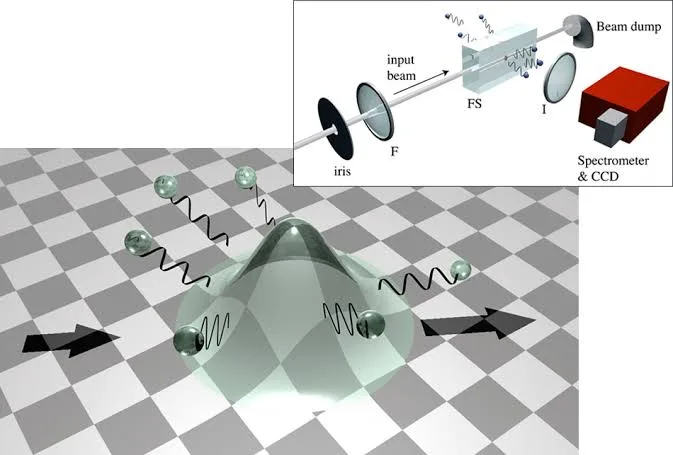
Physicists Create Black Hole ‘Light’ in Lab .
A Stationary Ring That Appears to Spin
The experimental device contained a circular network of time-modulated resonators.
Radio-frequency waves travelled through the network while the researchers changed the resonators’ properties. The synchronized modulation created the equivalent of motion around the ring.
From the wave’s perspective, the system behaved like a rotating medium.
This design gave the researchers control over several important variables. They could adjust the apparent rotational speed, change its direction, and select which wave modes entered the system.
That level of control would be extremely difficult with a mechanically rotating object.
It also allowed the team to study the connection between rotation and angular momentum. Angular momentum describes the rotational characteristics carried by a wave.
Not every incoming wave responded in the same way.
Only waves with suitable angular momentum and frequency gained significant energy from the synthetic rotation.
What “Superluminal Rotation” Really Means
The research includes a phrase that could easily cause confusion: effective superluminal rotation.
Superluminal means faster than the speed of light. However, no object, particle, or usable information moved faster than light during the experiment.
The term refers to the speed of the travelling modulation pattern around the electronic ring.
Patterns can appear to move faster than light without carrying matter or information at that speed. A familiar comparison involves sweeping a laser point across a very distant surface. The point can appear to cross the surface faster than light, although no physical object travels along that path.
In the new experiment, the resonators changed locally according to a programmed sequence. Together, those changes produced an apparent rotational pattern with an extremely high effective speed.
Relativity remained intact.
The importance of this regime lies in the way waves respond to it. At those effective rotational speeds, the system developed unusual ranges in which waves with selected angular momentum could undergo amplification.
The paper describes these regions as angular-momentum bandgaps. Within them, the modulated system transferred energy into particular orbital wave modes.
How the Black Hole Energy Extraction Experiment Amplified Waves
The researchers sent electromagnetic waves through the ring while running the rotating modulation.
Each wave carried a particular rotational structure. Some waves rotated in the same effective direction as the synthetic medium. Others carried different angular momentum values or moved in the opposite rotational sense.
The interaction depended on this relationship.
When a wave met the correct conditions, it gained energy from the externally powered modulation. Its amplitude increased as it travelled through the device.
In other words, the output signal became stronger than the input signal.
This behavior reproduced the essential mechanism behind rotational superradiance. A wave interacts with a rotating system and leaves with additional energy drawn from that system’s rotation.
In the laboratory device, the energy did not come from a black hole. It came from the electronic power used to modulate the resonators.
That point is crucial.
The experiment does not demonstrate free energy. It also does not provide a method for remotely collecting power from cosmic black holes.
Instead, it shows that researchers can recreate the same type of rotational energy transfer in a controlled electromagnetic platform.
Selective Amplification Was the Key Result
An ordinary amplifier strengthens signals by supplying extra energy through an active electronic component.
This experiment worked differently.
Its amplification depended on the wave’s angular momentum, frequency, and relationship with the synthetic rotation. The system therefore selected which rotational modes received energy.
Waves with the correct characteristics became amplified. Other modes behaved differently or remained outside the gain region.
The researchers call this angular-momentum-selective amplification.
That selectivity could become valuable in technologies that need to distinguish between complex wave patterns.
Modern communication systems already encode information through frequency, phase, polarization, and amplitude. Some experimental systems also use orbital angular momentum.
A device that can amplify selected angular momentum modes could provide another way to process or separate signals.
However, that application remains a future possibility. The current experiment mainly establishes the physical effect and the platform needed to study it.
Why This Was a Real Experiment, Not Just a Simulation
Scientists often use computer simulations to explore conditions that cannot easily exist in a laboratory.
A simulation can calculate how waves should behave around a rotating medium. It can also predict when energy extraction should occur.
The CUNY team went further.
They built physical hardware and sent real electromagnetic waves through it. The resonators changed in real time, and instruments measured the resulting signals.
Researchers could compare the wave before and after the interaction. They could also change the modulation and observe how the amplification responded.
The measured behavior matched the expected signatures of rotational superradiance in the engineered Floquet system.
That makes the device a physical analogue, rather than a visual model or software-only calculation.
Analogue experiments do not reproduce every feature of the original cosmic environment. A ring of electronic resonators clearly does not contain curved spacetime, an event horizon, or a genuine ergosphere.
Still, the device reproduces a specific mathematical and physical relationship found in the astrophysical process.
Scientists can now study that relationship repeatedly under controlled conditions.
A New Tool for Extreme Rotational Physics
The black hole energy extraction experiment creates a practical route into regimes that mechanical systems cannot reach.
Researchers can adjust the synthetic rotation without rebuilding the entire device. They can also reverse its direction, change the modulation rate, and test different wave structures.
This flexibility may help physicists explore broader questions about moving media, rotational Doppler effects, parametric amplification, and space-time-engineered materials.
The platform may also help researchers examine how energy, angular momentum, and dissipation interact.
Dissipation normally weakens a signal by converting part of its energy into heat or other losses. Yet the new study shows that carefully engineered loss and modulation can shape the frequency range where amplification occurs.
The paper refers to this as a dissipation-shaped spectral bandwidth.
That result may appear counterintuitive. Loss usually sounds undesirable. In advanced wave systems, however, researchers can sometimes use controlled loss as part of the design.
The experiment therefore combines rotation, gain, loss, and time modulation within one controllable network.
Potential Uses in Wireless Communications
The research team identifies communications as one area that may benefit from the concept.
Future wireless systems could use wave properties beyond basic frequency channels. Angular momentum may offer an additional method for encoding or sorting signals.
Selective amplification could strengthen one desired rotational mode while limiting others.
Such control might support advanced filters, signal routers, antennas, or receivers. Engineers may also use synthetic rotation to create nonreciprocal devices.
A nonreciprocal component treats waves differently depending on their direction. For example, it may allow a signal to travel forward while restricting unwanted reflections in the opposite direction.
Many current nonreciprocal systems depend on magnets or physically asymmetric components. Time-modulated structures may offer alternative designs.
Still, the laboratory demonstration does not yet represent a commercial communications device.
Engineers would need to improve efficiency, stability, bandwidth, and integration. They would also need to show that the method offers clear advantages over existing electronics.
New Possibilities for Optics and Photonics
The experiment operated at radio frequencies. Yet the same basic principle may extend to optical systems.
Photonics involves generating, guiding, and controlling light. Researchers already use modulated materials to change a light wave’s frequency, phase, direction, or intensity.
A photonic version of synthetic rotation could interact with optical angular momentum.
Light can carry orbital angular momentum through wavefronts that twist around the direction of travel. These modes sometimes resemble spirals or corkscrews.
Selective control over those modes could support optical communications, imaging, sensing, and information processing.
Synthetic rotation may also help create compact optical components with behavior that normally requires physical motion.
Before that happens, researchers must overcome major challenges. Optical frequencies are much higher than radio frequencies. Modulating materials fast enough at those scales requires advanced components and precise fabrication.
Even so, the new experiment provides a clear physical foundation for future work.
CUNY ASRC says the platform may support research at the intersection of astrophysics, wave physics, optics, and photonics.
Could the Concept Reach Quantum Science?
Quantum systems offer another possible direction.
At very low signal levels, electromagnetic energy arrives in individual packets called photons. Researchers may eventually study how synthetic rotation affects single photons or quantum states of light.
Such experiments could explore quantum versions of rotational superradiance.
They might also examine how amplification affects quantum noise. Any amplifier adds uncertainty or noise under fundamental quantum rules. Understanding that trade-off would become essential before the method could support quantum information technologies.
Time-modulated photonic systems already interest quantum researchers because they can create unusual energy structures and interactions.
A quantum implementation of rotational amplification could provide another tool for manipulating photons, transferring angular momentum, or studying nonequilibrium quantum systems.
For now, these possibilities remain speculative.
The Nature paper demonstrates the effect with classical electromagnetic waves in a radio-frequency resonator network. It does not demonstrate a quantum amplifier or quantum communications platform.
Future research must determine whether the underlying mechanism remains useful in that regime.
What the Experiment Does Not Demonstrate
The dramatic connection to black holes requires careful language.
Researchers did not create a miniature black hole.
They did not reproduce an event horizon or bend spacetime inside the laboratory.
The experiment also does not show that humanity can harvest energy from an actual black hole.
Furthermore, the device does not produce unlimited power. External electronics supplied the energy that amplified the electromagnetic waves.
The synthetic superluminal rotation does not send matter or information faster than light.
Instead, the achievement concerns an analogue physical process. The researchers recreated the relationship between rotation, angular momentum, and energy transfer.
That distinction does not reduce the experiment’s importance.
Laboratory analogues allow scientists to isolate specific effects that would otherwise remain hidden inside distant or inaccessible environments.
They can then measure those effects with far greater control than any astronomical observation could provide.
What Comes Next
Several steps must follow before the research produces practical technology.
First, scientists will need to reproduce and extend the result across other frequencies. Optical and terahertz versions may require entirely different materials and fabrication methods.
Next, researchers must improve conversion efficiency. A future device would need to amplify desired waves without consuming excessive power or producing too much unwanted noise.
Scaling also presents a challenge. The current ring network works as a research platform. Commercial systems would require compact, reliable, and manufacturable designs.
Quantum experiments would add even stricter demands. They would need low noise, precise control, and methods that preserve fragile quantum information.
Further studies may also test more complicated modulation patterns. These patterns could imitate other types of motion or create wave behavior with no direct mechanical equivalent.
The research therefore opens a platform rather than delivering a finished product.
Conclusion: Black Hole Energy Extraction Experiment Opens a New Path
The black hole energy extraction experiment turns a famous theoretical concept into measurable laboratory physics.
Researchers used a stationary ring of modulated resonators to create synthetic ultrafast rotation. Electromagnetic waves with selected angular momentum extracted energy from that engineered motion and became amplified.
The experiment neither created a black hole nor accessed cosmic energy. Instead, it reproduced the core physics of rotational superradiance in a controlled electronic system.
Its immediate value lies in fundamental research. Yet the same principles may eventually support new approaches to communications, photonics, signal processing, and quantum science.
A concept inspired by spinning black holes has now become a practical tool for controlling waves on Earth.
Main Sources:
Nature — “Observation of Floquet rotational super-radiance”
https://www.nature.com/articles/s41586-026-10725-y
Advanced Science Research Center, GC/CUNY — “A Black Hole Theory Comes to Life in the Lab”
https://asrc.gc.cuny.edu/headlines/2026/07/a-black-hole-theory-comes-to-life-in-the-lab/
ScienceDaily — “Physicists Recreate Black Hole Energy Extraction in the Lab”
https://www.sciencedaily.com/releases/2026/07/260711010120.htm