
BY:SpaceEyeNews.
NASA’s Perseverance rover has completed the equivalent of a full marathon on Mars. The Perseverance Mars marathon reached 26.2 miles, or 42.195 kilometers, after more than five years of exploration.
The rover crossed the milestone on June 14, 2026. It was the 1,890th Martian day, or sol, of the mission. Just one day earlier, NASA’s Mars Reconnaissance Orbiter photographed the rover from high above the planet.
In the orbital image, Perseverance appears as a tiny green speck. Its tracks stretch across the surrounding landscape and reveal part of its remarkable route.
However, this achievement is about much more than distance. Perseverance completed its marathon while studying ancient rocks, collecting samples, climbing difficult terrain, and searching for evidence of Mars’ habitable past.
The milestone also highlights how much rover technology has advanced. Perseverance covered the marathon distance in less than half the time required by NASA’s Opportunity rover.
Perseverance Mars Marathon Completed on Sol 1,890
Perseverance landed inside Jezero Crater on February 18, 2021. NASA selected the site because it once contained a lake and river delta.
Since then, the six-wheeled rover has followed a complex route through several geological environments. It explored the crater floor, examined the ancient delta, climbed the western rim, and entered terrain beyond Jezero.
On June 14, 2026, its total driving distance reached 42.195 kilometers. That figure matches the official length of a full marathon on Earth.
The rover did not cover this distance in one continuous journey. Instead, NASA calculated the total distance from all its drives since landing.
Those drives often lasted only a limited time. The rover regularly stopped to photograph rocks, inspect geological layers, drill samples, and study the Martian surface.
This makes the Perseverance Mars marathon more impressive. The rover was never racing across the planet. Every part of the route supported a scientific objective.
A Five-Year Journey Through Jezero Crater
Perseverance began its mission by exploring rocks on the floor of Jezero Crater. Scientists wanted to understand whether those rocks formed through volcanic activity or interactions with water.
The rover later moved toward the remains of an ancient river delta. Billions of years ago, water carried sediment into Jezero and deposited layers of material inside the crater.
River deltas on Earth can preserve organic material and signs of past microbial activity. For that reason, the Jezero delta became one of the mission’s most important targets.
Perseverance examined the delta’s rock layers and collected carefully selected cores. These samples may preserve a record of the environment that existed when liquid water flowed across the region.
After completing its delta campaign, the rover continued toward the western edge of the crater.
Perseverance Climbed Challenging Martian Terrain
The journey became more difficult as Perseverance approached Jezero’s western rim. The route included steep slopes, loose material, and fields of exposed rocks.
Such terrain can slow a rover significantly. Mission controllers must protect the wheels, avoid unstable surfaces, and select routes that allow safe movement.
Perseverance also needs suitable positions for scientific observations. The shortest route is not always the most useful one.
NASA engineers rely on orbital images, rover cameras, and navigation software to plan each drive. The rover can also make some decisions without waiting for instructions from Earth.
This autonomy allows Perseverance to identify hazards and adjust parts of its route while moving. It can cover longer distances than earlier rovers during some driving sessions.
By late 2024, the rover had started its climb toward the crater rim. It later completed the ascent and entered a new phase of exploration west of Jezero.
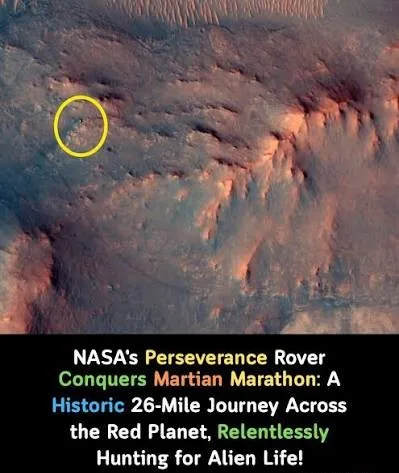
Orbital Image Reveals the Perseverance Mars Marathon Route
NASA’s Mars Reconnaissance Orbiter captured Perseverance on June 13, 2026. At that point, the rover was one day away from reaching the marathon milestone.
The orbiter used its High-Resolution Imaging Science Experiment, better known as HiRISE. This powerful camera can photograph small surface features from Mars orbit.
In the processed image, Perseverance appears as a tiny green dot. The color helps viewers identify the rover against the surrounding landscape. It does not represent how the vehicle would naturally appear to the human eye.
The image also shows the rover’s tracks curving across the surface. These tracks provide a visible record of recent movement through the area.
From orbit, the rover looks almost insignificant against the enormous Martian landscape. Yet that small machine has carried an advanced scientific laboratory across more than 42 kilometers of another planet.
Perseverance Spotted in the Arbot Region
When HiRISE captured the image, Perseverance was operating west of Jezero Crater. The mission’s science team informally calls the region “Arbot.”
This area represents a major transition for the mission.
Inside Jezero, the rover focused heavily on the crater floor, ancient lake deposits, and river-delta sediments. Outside the crater, it can reach rocks linked to a much earlier period in Mars’ history.
Some rocks beyond the rim may contain material from the planet’s ancient crust. Others may have been exposed or moved by powerful impacts.
These targets could help scientists examine how early Mars formed and changed. They may also reveal conditions that existed before the lake developed inside Jezero.
Therefore, the orbital image does more than celebrate a distance milestone. It captures Perseverance entering a new scientific frontier.
Why Mars Orbiters Matter to Rover Missions
Mars orbiters play a major role in surface exploration. They photograph terrain, map geological features, study weather, and support communication with robotic missions below.
The Mars Reconnaissance Orbiter has observed the planet since 2006. Its HiRISE camera has produced exceptionally detailed images of craters, dunes, landslides, and spacecraft.
Orbital teams can examine potential rover routes before surface vehicles reach them. They can identify steep slopes, rocky zones, and scientifically interesting formations.
Perseverance provides close-up measurements from the surface. The orbiter adds a wider view from above.
Together, the two missions allow scientists to connect individual rocks with the larger geological landscape.
Perseverance Versus Opportunity on Mars
Perseverance is not the first NASA rover to complete a marathon on Mars.
Opportunity reached the same distance on March 24, 2015. It crossed the milestone during sol 3,968 of its mission, about 11 years and two months after landing.
Perseverance needed only five years and four months. It reached the distance during sol 1,890.
That means Perseverance completed the same journey in less than half the mission time.
However, the comparison needs context. Opportunity landed on Mars in January 2004 with systems developed during an earlier generation of rover technology.
NASA originally designed Opportunity for a mission lasting about 90 Martian days. Instead, it continued operating for more than 14 years.
The rover ultimately covered 28.06 miles, or 45.16 kilometers. That remains the off-world driving record held by a robotic vehicle.
Perseverance is now only a few kilometers away from that total. Still, NASA will not prioritize a record attempt over scientific work or rover safety.
Smarter Navigation Increased the Driving Pace
One reason for Perseverance’s faster progress is its advanced autonomous navigation system.
Sending a command between Earth and Mars can take several minutes. The exact delay changes as the planets move in their orbits.
Because of this delay, engineers cannot control a rover in real time. They send instructions, and the rover carries them out independently.
Earlier rovers often stopped while evaluating obstacles or waiting for new plans. Perseverance can process images during a drive and make some route decisions by itself.
Its navigation system can identify rocks, slopes, and other hazards. It then selects a safe path through the terrain.
This ability reduces the number of pauses needed during some journeys. It also allows the rover to travel farther between major science locations.
Still, speed remains secondary. Perseverance can spend long periods at one site when scientists find an important target.
Science Behind the Perseverance Mars Marathon
NASA did not send Perseverance to Mars to collect distance records. The rover’s main goal is to search for signs of ancient microbial life.
It also studies Martian geology and climate history. In addition, it collects samples of rock and regolith for possible return to Earth by a future mission.
By May 2026, Perseverance had abraded 62 rocks and collected 27 rock cores. Of those cores, NASA reported that 25 had been sealed and two remained unsealed.
Each sample represents a specific geological environment. Scientists select targets that may help answer different questions about Mars.
Some samples came from igneous rocks on the crater floor. Others came from sedimentary formations linked to the ancient delta.
Together, they could reveal how volcanic processes, water, and surface conditions changed over time.
The Search for Ancient Martian Life
Jezero Crater once contained water. Orbital observations revealed an ancient river channel and a preserved delta before Perseverance arrived.
These features made the crater a strong location for astrobiology.
Perseverance does not search for living organisms on modern Mars. Instead, it looks for possible signs that microbial life existed billions of years ago.
The rover studies rock chemistry, mineral structures, textures, and organic compounds. No single observation can confirm ancient life on its own.
Scientists must consider non-biological explanations for unusual features. The most detailed tests may eventually require laboratories on Earth.
That is why the rover’s sample collection remains central to the mission.
Samples Could Provide a Martian Time Capsule
Perseverance seals selected material inside specially designed tubes. These tubes protect the samples from contamination and preserve them for potential future analysis.
Earth laboratories can use instruments that are too large or complex to send to Mars. Researchers could examine the samples at microscopic scales and measure their chemistry with high precision.
The collection may also answer questions beyond ancient life.
Scientists could study Mars’ volcanic history, the age of its crust, past water activity, and changes in the planet’s atmosphere.
Even if the samples contain no evidence of biology, they could transform our understanding of Mars.
A New Geological Frontier Beyond Jezero
The rover’s journey outside Jezero may prove as important as its earlier exploration inside the crater.
The western region contains geological units that differ from the lake and delta deposits. Some may date back to the earliest chapters of Martian history.
Impact events could have brought deeply buried rocks closer to the surface. These materials may provide clues about Mars’ interior and original crust.
Researchers also want to understand how the Jezero basin formed. Studying rocks around the rim can help reconstruct the impact that created the crater.
Other targets may record later activity involving water, heat, or chemical alteration.
This variety gives the mission access to a broader timeline. Perseverance can compare ancient crustal rocks with younger lake deposits from inside Jezero.
The route ahead may therefore produce discoveries that have little connection to driving records.
Will Perseverance Break Opportunity’s Record?
Opportunity’s final distance stands at 45.16 kilometers. Perseverance reached 42.195 kilometers in June 2026.
That leaves a difference of less than three kilometers.
Under normal conditions, Perseverance could eventually pass Opportunity’s total. However, predicting the exact date would be misleading.
The rover’s pace depends on several factors. Terrain conditions can slow movement. Scientific investigations may require extended stops. Engineers must also monitor the rover’s systems and wheels.
NASA could choose a longer route to reach a valuable rock formation. The rover may also remain in one area if scientists discover a promising sample target.
Opportunity’s record will remain historically important even if Perseverance travels farther. Opportunity survived far beyond its original design and transformed planetary exploration.
Perseverance builds on that legacy with stronger autonomy, improved instruments, and a sophisticated sample-caching system.
Perseverance Mars Marathon Marks a New Chapter
The Perseverance Mars marathon is a symbolic milestone, but it also reflects years of scientific progress.
The rover crossed crater-floor rocks, ancient delta deposits, steep slopes, and the western rim of Jezero. Along the way, it collected samples and examined environments shaped by water and geological change.
Its faster pace shows how autonomous navigation has improved since Opportunity’s mission. Yet distance alone does not define success.
Perseverance remains a working scientific laboratory on another world. Every stop can reveal a new detail about Mars’ climate, crust, or potential habitability.
From orbit, the rover appears as a small speck surrounded by an immense landscape. Its tracks, however, show how far robotic exploration has advanced.
As Perseverance continues beyond Jezero, its next major achievement may not involve a finish line. It could come from an ancient rock that preserves a previously unknown chapter of Martian history.
Main Sources:
NASA Science – NASA’s HiRISE Captures Perseverance Marking a Milestone on Mars
https://science.nasa.gov/photojournal/nasas-hirise-captures-perseverance-marking-a-milestone-on-mars/
NASA Jet Propulsion Laboratory – NASA’s HiRISE Captures Perseverance Marking a Milestone on Mars
https://www.jpl.nasa.gov/images/pia26726-nasas-hirise-captures-perseverance-marking-a-milestone-on-mars/
NASA – Perseverance Rover Snaps Selfie in Mars’ Western Frontier
https://www.nasa.gov/missions/mars-2020-perseverance/perseverance-rover/nasas-perseverance-rover-snaps-selfie-in-mars-western-frontier/
NASA Science – Mars 2020 Perseverance Rover
https://science.nasa.gov/mission/mars-2020-perseverance/
NASA Science – Perseverance Science Objectives
https://science.nasa.gov/mission/mars-2020-perseverance/science-objectives/
NASA Science – Opportunity Rover Mission
https://science.nasa.gov/mission/mer-opportunity/
NASA JPL – Opportunity’s Final Traverse Map
https://www.jpl.nasa.gov/images/pia23178-opportunitys-final-traverse-map/