
BY:SpaceEyeNews.
NASA has started the Artemis III SLS rocket assembly at Kennedy Space Center, turning separate flight components into the agency’s next crewed launch vehicle.
Teams have begun stacking the lower sections of the Space Launch System’s twin solid rocket boosters inside the Vehicle Assembly Building in Florida. At the same time, engineers are preparing the enormous core stage, processing its RS-25 engines, completing Orion’s heat shield, and training launch controllers.
The work marks a major shift for Artemis III. The mission has moved beyond component manufacturing and into launch-vehicle integration.
However, Artemis III will no longer attempt the first crewed Artemis Moon landing. NASA now plans to use the 2027 mission as a low Earth orbit demonstration. It will test Orion’s ability to work with one or both commercial lunar landers under development by SpaceX and Blue Origin.
Those tests could shape whether NASA can move ahead with its planned Artemis IV lunar landing in early 2028.
Artemis III SLS Rocket Assembly Starts with the Boosters
NASA began the latest assembly phase with the aft sections of the two solid rocket boosters.
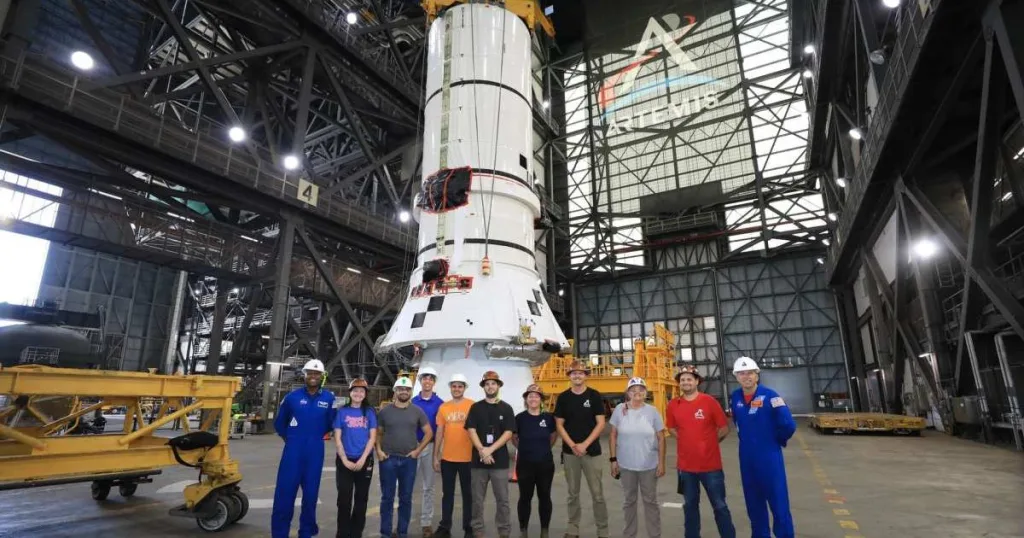
The aft assemblies form the bottom of each booster. Engineers positioned them on the mobile launcher inside Kennedy’s Vehicle Assembly Building, also known as the VAB.
This step creates the foundation for the rest of the SLS rocket.
The remaining booster motor segments arrived at Kennedy in June 2026. Before stacking, teams must inspect and prepare each section at the Rotation, Processing, and Surge Facility.
Engineers will also apply protective coatings and rotate the segments into the correct position. Cranes will then lift each section and place it vertically above the aft assemblies.
When complete, each booster will stand about 17 stories tall.
Together, the boosters and four RS-25 engines will help SLS generate roughly 8.8 million pounds of thrust at liftoff. The solid rocket boosters provide most of that initial force during the opening minutes of flight.
NASA astronaut Randy Bresnik and Andre Douglas visited the VAB as teams worked on the booster assemblies. They are two members of the four-person Artemis III crew.
Their presence connected the physical rocket work with the mission’s wider training effort.
Why NASA Builds the Boosters First
The booster stacking sequence is not only about propulsion.
The two boosters also support the central core stage while the rocket stands on the mobile launcher. NASA must secure them before lifting the core stage into position.
Once both boosters are complete, engineers can raise the core vertically and place it between them.
The boosters will connect to the core through structural fittings. Teams will also establish electrical and mechanical connections between the major sections.
That process requires careful alignment. Even small errors could affect later integration steps.
For that reason, stacking the rocket is a slow and controlled operation. Each segment undergoes checks before the next one can move into position.
The 212-Foot SLS Core Stage Is Moving Toward Integration
The SLS core stage forms the largest central section of the Artemis III rocket.
It measures about 212 feet, or nearly 65 meters, from end to end. NASA built the stage at the Michoud Assembly Facility in Louisiana and delivered it to Kennedy Space Center in April 2026.
The stage contains large tanks for liquid hydrogen and liquid oxygen. It also houses avionics, flight computers, structural connections, and several critical propulsion systems.
Engineers have already attached the engine section to the bottom of the core.
However, NASA still needs to install all four RS-25 engines before it can position the stage between the boosters.
At the time of NASA’s July 13 update, two of the four engines had arrived at Kennedy. Teams will inspect each engine before installation.
Once all four are in place, engineers will complete connections for fuel, electrical power, controls, and data.
The core stage will then undergo additional tests before moving into the VAB’s main stacking area.
What Happens After the Engines Are Installed?
The arrival of the engines does not immediately make the core stage ready for stacking.
Teams must connect each RS-25 engine to the stage’s propulsion and control systems. They also need to verify that sensors, wiring, plumbing, and structural mounts operate correctly.
Next, engineers will test communications between the stage and the launch-control systems.
After those checks, powerful cranes inside the VAB will lift the core stage from a horizontal position. Teams will slowly rotate it until it stands vertically.
The stage will then move into the narrow space between the two boosters.
This operation will create the recognizable lower structure of the Artemis III SLS rocket.
Later, NASA will add the upper-stage hardware, spacecraft adapters, Orion spacecraft, and launch abort system.
Orion Receives Its Upgraded Heat Shield
Work on the Artemis III Orion spacecraft is progressing in parallel with the rocket assembly.
Orion will carry four astronauts into low Earth orbit and return them safely through Earth’s atmosphere.
NASA recently installed the spacecraft’s heat shield at the Neil A. Armstrong Operations and Checkout Building at Kennedy.
The heat shield uses 186 blocks of Avcoat, an ablative material designed to withstand the intense conditions of atmospheric reentry.
Avcoat does not remain completely unchanged during the return. Instead, the material gradually burns and erodes in a controlled way.
That process carries heat away from the crew capsule.
The Artemis III design uses individually fitted blocks. This approach allows engineers to inspect sections closely and replace a block when needed.
NASA has continued to refine Orion’s heat shield after examining data and material performance from earlier Artemis missions.
The newly installed shield now clears the way for another important integration step.
Orion Will Join the European Service Module
NASA can now prepare to connect the Orion crew module with the European Service Module.
The European Space Agency built the service module through its industrial partners. It sits beneath Orion during flight and provides several essential functions.
These include propulsion, electrical power, thermal control, water storage, oxygen support, and orbital maneuvering.
The module also carries solar arrays that generate electricity during the mission.
Before integration, engineers tested its ability to withstand vibrations similar to those expected during launch.
Once the crew module and service module are connected, teams will perform additional electrical and structural checks.
The combined spacecraft will later receive its protective panels and other mission hardware before moving to the VAB.
Artemis III Is Now a Low Earth Orbit Demonstration
The most important change surrounding Artemis III involves the mission itself.
Earlier versions of NASA’s Artemis architecture assigned the first crewed lunar landing to Artemis III.
NASA revised that plan in 2026.
The agency now intends to launch Artemis III into low Earth orbit in 2027. The mission will demonstrate systems and procedures needed before astronauts attempt another lunar surface landing.
SLS will launch the four astronauts aboard Orion from Kennedy Space Center.
Once in orbit, the crew could conduct rendezvous and docking operations with one or both commercial lunar landers being developed by SpaceX and Blue Origin.
NASA has not finalized every mission objective. The final plan will depend on technical reviews and commercial lander readiness.
Still, the agency has identified several possible demonstrations.
These include docking, integrated life-support checks, communications testing, propulsion evaluations, and operations between connected spacecraft.
NASA may also test elements of its next-generation exploration spacesuits.
Why NASA Will Test the Systems Near Earth
Low Earth orbit gives NASA a controlled environment for a complicated demonstration.
Orion has never carried astronauts while docked to either of the commercial lunar lander systems.
Testing that connection near Earth allows NASA and its partners to study how the vehicles communicate and operate together.
Engineers can monitor power transfers, data links, life-support performance, propulsion interactions, and crew procedures.
The location also provides additional options if a technical problem develops.
An Orion spacecraft in low Earth orbit can return home much faster than one operating near the Moon.
This does not make Artemis III simple. Rendezvous and docking between newly developed spacecraft still involve significant technical challenges.
However, the mission separates those challenges from an actual lunar descent.
NASA can test integrated operations first. It can then apply the results to Artemis IV.
The Artemis III Crew Begins Preparing for the Mission
NASA announced the four Artemis III astronauts in June 2026.
Randy Bresnik will serve as commander. European Space Agency astronaut Luca Parmitano will serve as pilot.
NASA astronauts Frank Rubio and Andre Douglas will fly as mission specialists.
Each crew member brings experience from human spaceflight, spacecraft development, engineering, or complex orbital operations.
Their training will continue while NASA refines the final flight plan.
Because Artemis III may dock with commercial landers, the astronauts must prepare for more than Orion operations.
They may need to train with systems developed by SpaceX, Blue Origin, or both companies.
The crew will also practice emergency procedures, spacecraft transfers, communications, launch operations, and reentry scenarios.
As the hardware develops, mission simulators will change to match the latest vehicle configuration.
NASA Is Also Training Its Launch Controllers
The Artemis III SLS rocket assembly is only one part of the preparation effort.
NASA has also started monthly launch simulations at the Rocco A. Petrone Launch Control Center.
Those rehearsals began in May 2026.
Controllers are practicing the procedures needed to load liquid hydrogen and liquid oxygen into the SLS core stage.
Cryogenic propellant loading requires close coordination across many systems.
Teams must manage temperatures, pressure, valves, sensors, ground equipment, and communication links.
Controllers are also rehearsing the final ten minutes before liftoff. NASA calls this period the terminal countdown.
During that phase, several processes become automated. Launch teams must watch the vehicle closely and respond quickly to unexpected readings.
Regular simulations help each controller understand their role before the completed rocket reaches the launchpad.
The Mobile Launcher Returns After Artemis II
NASA is assembling Artemis III on the same mobile launcher used for Artemis II.
The large platform supports SLS inside the VAB and carries the rocket to Launch Complex 39B.
It also includes a tall tower that provides crew access, electrical power, communications, environmental control, and propellant connections.
Umbilical arms connect the tower to the rocket during countdown.
Those arms separate from the vehicle around the time of liftoff.
The Artemis II launch exposed the structure to intense heat, pressure, vibration, and acoustic energy.
After the mission, NASA inspected and refurbished the launcher. Teams repaired damaged areas before preparing it for another flight.
This work shows why Artemis schedules depend on more than spacecraft production.
Ground equipment must also meet strict launch requirements.
What NASA Still Must Complete
Starting the Artemis III SLS rocket assembly represents real progress, but much work remains.
NASA must complete both solid rocket boosters and receive the remaining RS-25 engines.
Engineers must then install the engines, test the core stage, and lift it between the boosters.
Orion and the European Service Module also need full integration.
NASA will later add the upper-stage structure, adapters, Orion spacecraft, and launch abort system.
Once the rocket is complete, teams will perform extensive integrated testing.
These checks will cover electrical systems, flight software, communications, guidance, ground equipment, and countdown controls.
NASA must also continue training the crew and launch teams.
Finally, the agency needs to determine which commercial lander systems will participate in the orbital demonstration.
SpaceX and Blue Origin must reach enough technical maturity for NASA to include their vehicles in the final mission plan.
Artemis III Will Prepare the Way for Artemis IV
NASA currently targets Artemis IV for the first crewed Artemis lunar landing in early 2028.
During that mission, astronauts would launch aboard Orion and travel toward the Moon.
Two crew members would transfer to a commercial human landing system in lunar orbit. They would then descend to the surface and conduct scientific work.
After the surface mission, the lander would return them to Orion for the journey home.
Artemis III is meant to reduce the risks behind that sequence.
Docking tests will help NASA evaluate crew transfers. Communications checks will reveal how the spacecraft exchange data.
Life-support demonstrations will test connected operations. Propulsion tests will help engineers understand how the vehicles behave together.
NASA can use those results to adjust procedures and hardware before Artemis IV.
A Major Milestone, Not a Launch Guarantee
The start of stacking does not mean Artemis III is ready to fly.
Rocket assembly remains one step in a larger sequence.
NASA must still finish the vehicle, complete Orion, certify the systems, train the crew, and coordinate with commercial partners.
Technical problems or delays could affect the 2027 target.
Still, the latest work provides visible evidence that the mission has entered a more advanced phase.
The boosters are taking shape inside the VAB. The core stage is at Kennedy. Orion now carries its heat shield.
Meanwhile, launch controllers are already practicing the countdown.
Together, these developments show that Artemis III has moved from long-term planning into active mission integration.
Conclusion
The Artemis III SLS rocket assembly marks one of NASA’s clearest steps toward its next crewed mission.
Teams at Kennedy Space Center have started stacking the boosters, preparing the core stage, processing RS-25 engines, and completing Orion’s protective systems.
Yet the mission’s purpose has changed.
Artemis III will not attempt a lunar landing. Instead, it will test the docking, communications, propulsion, life-support, and crew procedures needed for later missions.
That makes the 2027 flight a critical bridge between Artemis II and the planned Artemis IV lunar landing.
The rocket may now be rising inside the Vehicle Assembly Building, but the real value of Artemis III will come from proving that NASA, Orion, and commercial lunar spacecraft can operate as one integrated system.
Main Sources:
NASA – Artemis III Flight Hardware Stacks Up at Kennedy
https://www.nasa.gov/blogs/missions/2026/07/13/nasas-artemis-iii-flight-hardware-stacks-up-at-kennedy/
NASA – Artemis III Mission
https://www.nasa.gov/mission/artemis-iii/
NASA – Artemis III Crew Announcement
https://www.nasa.gov/news-release/nasa-marches-toward-artemis-iii-mission-in-2027-names-crew-members/
NASA – Preliminary Artemis III Mission Plans
https://www.nasa.gov/missions/artemis/artemis-3/nasa-outlines-preliminary-artemis-iii-mission-plans/
NASA – Updated Artemis Architecture
https://www.nasa.gov/news-release/nasa-adds-mission-to-artemis-lunar-program-updates-architecture/
NASA – Artemis IV Mission
https://www.nasa.gov/mission/artemis-iv/
NASA – Artemis III Core Stage Progress
https://www.nasa.gov/news-release/nasa-rolls-out-artemis-iii-moon-rocket-core-stage/