BY:SpaceEyeNews.
The Beta Pictoris d discovery has added a third confirmed planet to one of the best-studied young planetary systems near Earth. Astronomers identified the giant world about 63 light-years away, inside a bright disk of dust and debris. Researchers confirmed it through atmospheric spectroscopy, direct imaging, and archival observations. The result shows that even closely monitored systems can still contain previously unknown planets.
Beta Pictoris d Discovery Began During Another Study
The Webb team was not conducting a dedicated search for a new planet. Researchers were using the telescope’s Near-Infrared Spectrograph, or NIRSpec, to study Beta Pictoris b. During the analysis, they noticed an unexpected source farther from the star.
A bright feature alone does not confirm a planet. Instrumental effects, scattered starlight, and structures within a debris disk can produce similar signals. The team therefore examined the spectrum recorded at the same location.
NIRSpec’s Integral Field Unit collects spatial and spectral information together. The data revealed carbon monoxide absorption lines that matched the expected atmosphere of a giant planet.
The new object is Beta Pictoris d. Beta Pictoris b and Beta Pictoris c were already known before this study.
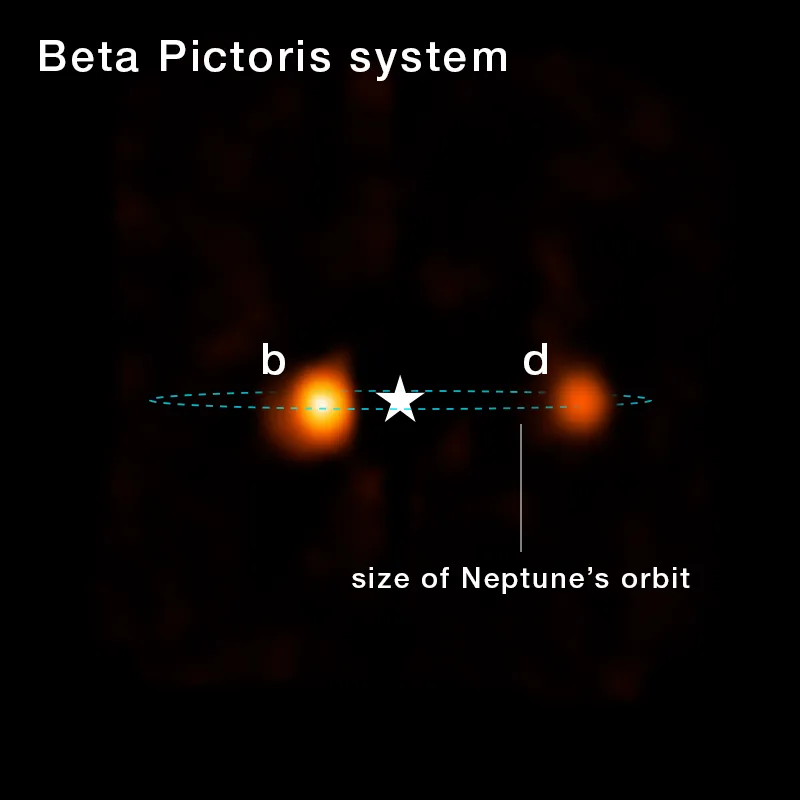
NASA’s Webb Discovers Hidden Planet in Famous Star System.
Webb Confirmed Beta Pictoris d Through Its Atmosphere
Spectroscopy was central to the Beta Pictoris d discovery. Instead of depending only on a visible point of light, the researchers searched for molecular signals within the system.
The carbon monoxide lines showed that the source had a planetary atmosphere. Their Doppler shift also revealed its motion along the line of sight. Its position and speed were consistent with an object orbiting Beta Pictoris.
Further Webb observations added more evidence. The telescope’s Mid-Infrared Instrument, or MIRI, detected water vapor and methane. These molecules supported the conclusion that the source was a cool giant planet rather than a background object or disk feature.
The combined observations also provided early information about the planet’s temperature, chemistry, and movement.
What Scientists Know About Beta Pictoris d
Beta Pictoris d has the widest orbit of the system’s three known planets. Current estimates place its mass at roughly two to four times that of Jupiter. One independent analysis calculated about 2.4 Jupiter masses.
That would make it less massive than Beta Pictoris b and Beta Pictoris c. Both inner planets are thought to have masses close to ten times Jupiter’s mass.
The planet’s orbit still requires further measurement. Webb-based estimates place its semimajor axis beyond 30 astronomical units. Another team calculated a value near 26 astronomical units. Both results place it at a distance broadly comparable to Neptune’s orbit around the Sun.
Its orbital period may be about 91 years. Researchers also estimate that the planet is around 100 times fainter than Beta Pictoris b. Its temperature may be close to 600 kelvins, although future observations could refine that figure.
Why the Planet Remained Undetected
Beta Pictoris is about 23 million years old and remains surrounded by material left from its formation. Its debris disk is one of the brightest examples known to astronomers.
That environment complicated the search for additional planets. Dust scatters the star’s light and creates structures that can resemble faint sources. A dim planet can therefore become difficult to distinguish from surrounding material.
Beta Pictoris d was not completely invisible. Its light was present in the observations, but conventional imaging did not clearly separate it from the disk. Spectroscopy helped by isolating molecular features associated with the planet’s atmosphere.
The case shows why direct images alone may not reveal every planet in a young and dusty system.
A Second Team Independently Identified Beta Pictoris d
A separate team reported the same planet using the ERIS instrument on the European Southern Observatory’s Very Large Telescope in Chile.
After detecting the object, researchers examined earlier observations from the VLT’s SPHERE instrument and Webb’s NIRCam. They identified the planet in archival data covering about 11 years.
Changes in its position showed orbital motion and supported the conclusion that it is gravitationally bound to Beta Pictoris.
The two groups used different methods. One team identified the planet mainly through Webb spectroscopy. The other used direct imaging and archival tracking. Their results provide independent confirmation of the same object.
Beta Pictoris is now one of the few known systems with more than two directly imaged confirmed planets. HR 8799 is another prominent example.
Beta Pictoris d May Help Explain the Debris Disk
The planet’s location may help astronomers understand the Beta Pictoris debris disk. The disk has a sharply defined inner edge and several features that remain difficult to explain.
Before the discovery, researchers had considered whether an unseen planet could influence this region. Beta Pictoris d now provides a possible candidate.
Its orbit lies inside the disk’s inner boundary. Its gravity may help clear material or maintain the edge over time. However, researchers have not confirmed that the planet caused the observed structure.
Additional orbital measurements and simulations will test this idea. They may also show how the three known planets interact with the disk and with one another.
Why the Beta Pictoris d Discovery Matters
NASA describes Beta Pictoris d as the first directly imaged planet discovered primarily through moderate-resolution spectroscopy. Researchers identified it by detecting atmospheric molecules rather than relying only on a clear image.
This method could support future searches in other young systems. It may prove especially useful where dust, scattered light, or complex disk structures make direct imaging difficult.
The discovery also gives astronomers another target for studying a young giant planet. Follow-up observations could refine its orbit, mass, temperature, and atmospheric composition.
The Beta Pictoris d discovery confirms that one of the nearest and most studied young systems still had an unknown planet. Webb identified its atmospheric signature, while ground-based and archival observations confirmed its movement. Together, the findings provide a more complete view of the system and a practical method for detecting planets hidden within bright debris disks.
Main Sources:
NASA Webb official release:
https://science.nasa.gov/missions/webb/nasas-webb-discovers-hidden-planet-in-famous-star-system/
European Southern Observatory official release:
https://www.eso.org/public/news/eso2609/
Webb spectroscopy research paper:
https://arxiv.org/abs/2606.23789
VLT direct-imaging research paper:
https://arxiv.org/abs/2606.23801
The Astrophysical Journal Letters:
https://iopscience.iop.org/article/10.3847/2041-8213/ae801b