
BY:SpaceEyeNews.
A rocky world could orbit at the perfect distance from its star and still remain hostile to life. The problem may not be temperature or water. Instead, the planet may simply be too small to keep an atmosphere.
A new scientific model has explored the minimum size for habitable planets that need stable atmospheres. The results suggest that location inside a star’s habitable zone is only part of the equation.
Under standard Earth-like conditions, a rocky planet may need a radius of at least 80% of Earth’s radius. Below that boundary, atmospheric gases often escape faster than geological activity can replace them.
However, planetary size does not decide everything. A world’s carbon supply, internal structure and early evolution could change its fate.
Minimum Size for Habitable Planets May Be Larger Than Mars
Planetary scientist Michelle Hill and her colleagues developed the Smaller Than Earth Habitability Model, known as STEHM. It examines whether small rocky planets can maintain atmospheres over billions of years.
The researchers simulated planets ranging from Earth’s size down to half of Earth’s radius. Each world orbited within the habitable zone of a Sun-like star.
The model connected two major processes. First, it calculated how stellar radiation removes atmospheric gases. Second, it measured how volcanic activity replaces those gases from the planet’s interior.
Under the default Earth-like conditions, planets with at least 0.8 Earth radii maintained atmospheres for 10 billion years or longer. Smaller planets generally lost their atmospheres much sooner. Some worlds around 0.7 Earth radii survived when other conditions favored them.
This result requires an important clarification. Mars has only about 53% of Earth’s radius. Therefore, the standard atmospheric threshold identified by STEHM sits well above the size of Mars.
The research does not prove that every planet smaller than Mars must remain lifeless. Instead, it shows that small planets face much greater difficulty preserving long-lived atmospheres.
That difference matters. Life may need billions of years to emerge, evolve and create detectable chemical signs. A temporary atmosphere may not provide enough time.
Why Small Exoplanets Lose Their Atmospheres
Gravity provides the first part of the explanation. Smaller rocky planets usually have weaker gravitational fields. Atmospheric particles can therefore escape into space more easily.
Stellar activity adds another challenge. High-energy radiation can break atmospheric molecules apart. Stellar winds may then carry the lighter particles away from the planet.
Young stars create especially difficult conditions. During their early lives, they often release stronger ultraviolet and X-ray radiation. A nearby planet may lose large amounts of gas during this active period.
Yet atmospheric escape represents only half of the story.
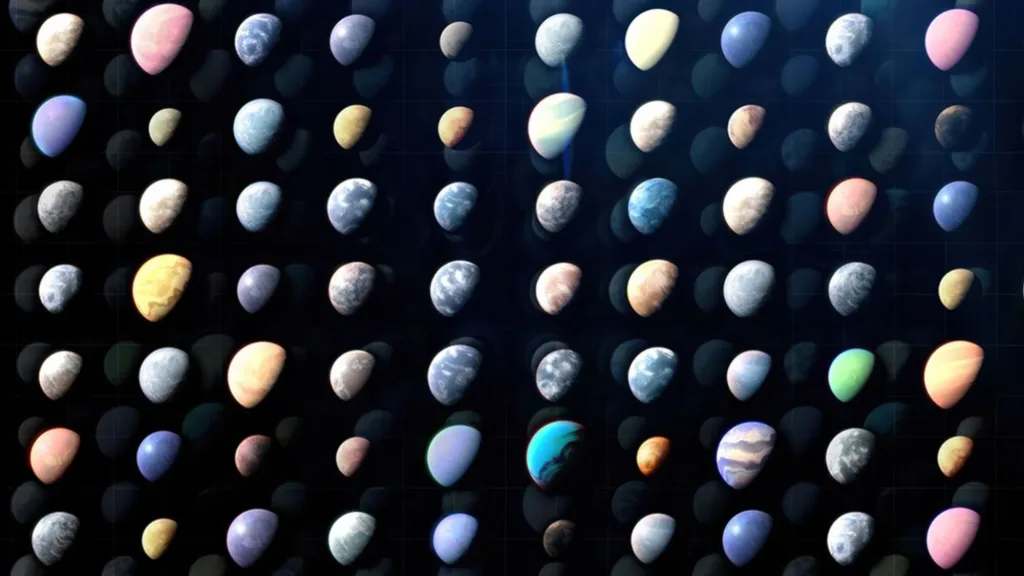
Alien life likely can’t survive on exoplanets smaller than Mars, scientists say.
Volcanism Must Replace Escaping Gas
A rocky planet can replenish its atmosphere through volcanic outgassing. Gases stored inside the mantle rise through the crust and enter the atmosphere during eruptions.
Carbon dioxide plays a central role in this process. It is heavier than many other atmospheric molecules, making it relatively difficult to remove.
Smaller planets, however, cool more quickly than larger worlds. Their outer layers become rigid earlier, while their geological activity declines sooner.
As volcanism slows, the planet releases less carbon dioxide. Eventually, atmospheric loss can exceed the amount of gas coming from the interior.
At that point, the atmosphere begins a long decline.
The STEHM research focuses on stagnant-lid planets. These worlds have rigid outer shells rather than Earth’s moving tectonic plates. That assumption limits the model, but it also applies to many rocky worlds that may lack plate tectonics.
A Hot Beginning May Hurt Atmospheric Survival
One of the study’s most surprising results concerns the planet’s starting temperature.
A very hot mantle may sound helpful because it can drive intense volcanic activity. However, strong early volcanism may release atmospheric gases at the worst possible time.
A young star can rapidly remove those gases through radiation and stellar wind. The planet may then use much of its internal gas supply before the star becomes calmer.
By contrast, a cooler initial mantle can delay major outgassing. More gas may remain stored inside the planet during the star’s violent youth.
Later, when stellar activity declines, volcanism can release that gas under safer conditions. The atmosphere then has a better chance of surviving.
This finding shows why the minimum size for habitable planets cannot depend on radius alone. Timing also matters.
How Smaller Planets Could Keep Their Air
Although size creates a strong boundary, unusual planetary conditions could help smaller worlds retain atmospheres.
The researchers found that the initial carbon inventory produced the largest effect. A carbon-rich mantle can supply more carbon dioxide through volcanic activity.
However, a small planet may need far more carbon than Earth contains to make a major difference. Such worlds remain theoretically possible, but scientists do not yet know how common they are.
Internal Structure Can Change the Outcome
A smaller core may also improve atmospheric survival. It leaves more room for a thick mantle, which can store larger quantities of carbon and heat-producing elements.
Radioactive elements release heat as they decay. That energy can keep part of the mantle active and support volcanism for longer periods.
The model found better atmospheric retention among planets with substantial carbon, more heat-producing elements, cooler starting mantles and smaller core fractions.
These factors do not guarantee habitability. A dense carbon dioxide atmosphere could make a planet extremely hot. The study mainly asks whether an atmosphere survives, not whether its surface remains comfortable for life.
Could an Airless World Get a Second Chance?
A small planet that loses its first atmosphere may not remain airless forever.
Comets and asteroids can deliver volatile materials such as hydrogen, oxygen and carbon. Those elements may later form water vapor, carbon dioxide and other atmospheric gases.
The timing would remain crucial. Early impacts could deliver material while the star is still highly active, allowing the new gases to escape again.
Later impacts may offer better prospects. By then, the host star may have entered a calmer stage.
Still, this possible second atmosphere should not serve as proof of habitability. Its chemistry, pressure and lifetime would determine whether it could support liquid water or biological activity.
A New Filter in the Search for Alien Life
Astronomers have discovered thousands of exoplanets, including many rocky worlds. Yet major telescopes cannot study every candidate in equal detail.
Atmospheric observations require valuable telescope time. Scientists therefore need reliable methods to identify the most promising targets.
STEHM could provide one such filter. Researchers could prioritize rocky planets that sit inside habitable zones and exceed the likely atmospheric size threshold.
The team also hopes to extend the model to planets around red dwarfs. These stars dominate the Milky Way and host several well-known rocky planetary systems.
Future work may also examine tidally locked planets and worlds with different tectonic systems. Such studies could reveal whether the atmospheric boundary changes under other conditions.
Conclusion: Planetary Size Redefines Habitability
The habitable zone remains useful, but it cannot tell the full story. A planet must also preserve enough atmospheric gas to support stable surface conditions.
The new model suggests that the minimum size for habitable planets may sit near 0.8 Earth radii under typical Earth-like conditions. Smaller planets could survive, but they may require unusual carbon supplies, internal structures or geological histories.
These findings do not eliminate every small world from the search for life. Instead, they reveal which planets face the greatest atmospheric challenges.
The search for another Earth may therefore depend on finding more than the right orbit. Astronomers may also need worlds large enough, active enough and chemically rich enough to keep their skies.
Main Sources:
Smaller Than Earth Habitability Model research paper:
https://arxiv.org/abs/2605.00170
Stanford University research summary:
https://news.stanford.edu/stories/2026/06/model-search-life-supporting-planets
Original Space.com report:
https://www.space.com/space-exploration/search-for-life/alien-life-likely-cant-survive-on-exoplanets-smaller-than-mars-scientists-say