BY:SpaceEyeNews.
A discarded Falcon 9 upper stage is heading toward the Moon. Current calculations place the Falcon 9 Moon impact near Einstein Crater on August 5, 2026, at about 06:35 UTC. The stage will reach the lunar surface at roughly 2.4 kilometers per second.
This was never designed as a lunar experiment. Yet astronomers now see a rare scientific opportunity. They know the object’s identity, launch history, and approximate path. That information could help them study the flash, dust plume, and crater created by the event.
The observations could also improve methods for tracking inactive hardware across the Earth-Moon region. NASA’s Jet Propulsion Laboratory currently lists the object as 2025-010D and confirms its expected lunar impact date.
How the Falcon 9 Moon Impact Began
The story started on January 15, 2025. A SpaceX Falcon 9 launched two private lunar landers from NASA’s Kennedy Space Center in Florida.
Firefly Aerospace’s Blue Ghost Mission 1 separated into a highly elliptical Earth orbit. Japan-based ispace also sent its RESILIENCE lunar lander toward the Moon on the same flight.
Blue Ghost separated from the rocket at about 2:17 a.m. Eastern Time. Firefly later guided the spacecraft to a successful lunar landing in March 2025. RESILIENCE deployed from the Falcon 9 later during the mission and followed a separate low-energy route toward the Moon.
However, the rocket’s upper stage remained in the wider Earth-Moon system.
NASA’s Jet Propulsion Laboratory now lists the stage under the designation 2025-010D. JPL’s Horizons service also provides trajectory data under spacecraft identification number -162719.
The service states that the object will reach the Moon on August 5, although its orbital information may receive further updates before the event.
A Complex Path Through Cislunar Space
The original report suggests the stage simply failed to return and burn up in Earth’s atmosphere. However, lunar launches often involve stretched trajectories that extend far beyond low Earth orbit.
After releasing its payloads, the stage continued moving under the combined influence of Earth, the Moon, and the Sun. Those forces gradually changed its orbit.
Smaller effects may also influence a large hollow object over long periods. Solar radiation pressure, for example, can produce slight changes in its path.
Astronomer Bill Gray, who developed the Project Pluto tracking software, used repeated telescope observations to refine the predicted route. His calculations indicate that the stage will strike near Einstein Crater within a few minutes of 06:35 UTC.
Even so, the precise time and coordinates may change as astronomers collect additional observations.
What Will Happen Near Einstein Crater?
Researchers expect the Falcon 9 upper stage to arrive on sunlit terrain near the lunar limb. That means the site will appear close to the Moon’s visible edge from Earth.
The stage will travel at around 2.4 kilometers per second. That equals approximately 8,600 to 8,700 kilometers per hour.
The rocket stage will not “explode” like an object carrying explosives. Instead, its speed will produce a high-energy surface impact.
The sudden stop will transform motion into heat, fractured material, and a rapidly expanding cloud of lunar dust. It should also form a new crater.
However, scientists cannot confirm the crater’s exact dimensions yet. Its final size will depend on several factors. These include the stage’s mass, shape, angle, construction, and exact velocity.
Could Astronomers See the Falcon 9 Moon Impact?
Visibility remains one of the biggest uncertainties surrounding the Falcon 9 Moon impact.
The predicted site will sit in sunlight. As a result, the bright lunar surface may hide a faint optical flash.
However, the viewing geometry offers another possibility. Since the site lies near the edge of the Moon, some material could rise above the visible horizon.
That dust may then appear against the darkness of space. Astronomers might find the ejecta plume easier to detect than the surface flash itself.
Professional and Amateur Observers Join the Search
A July 2026 scientific paper led by Benjamin Fernando encourages both professional and amateur astronomers to attempt observations.
Twenty-three researchers contributed to the observational plan. They suggest that suitable ground-based telescopes and lunar spacecraft could potentially record the flash or dust plume.
The research team also hopes that orbiting cameras can photograph the impact area before and after the event. Comparing those images may reveal the new crater and improve estimates of the final location.
Still, no one can guarantee a dramatic view.
The paper notes that several important properties remain uncertain. Researchers cannot yet predict the event’s visual brightness with high precision. Observers may detect a brief flash, a plume, or nothing obvious at all.
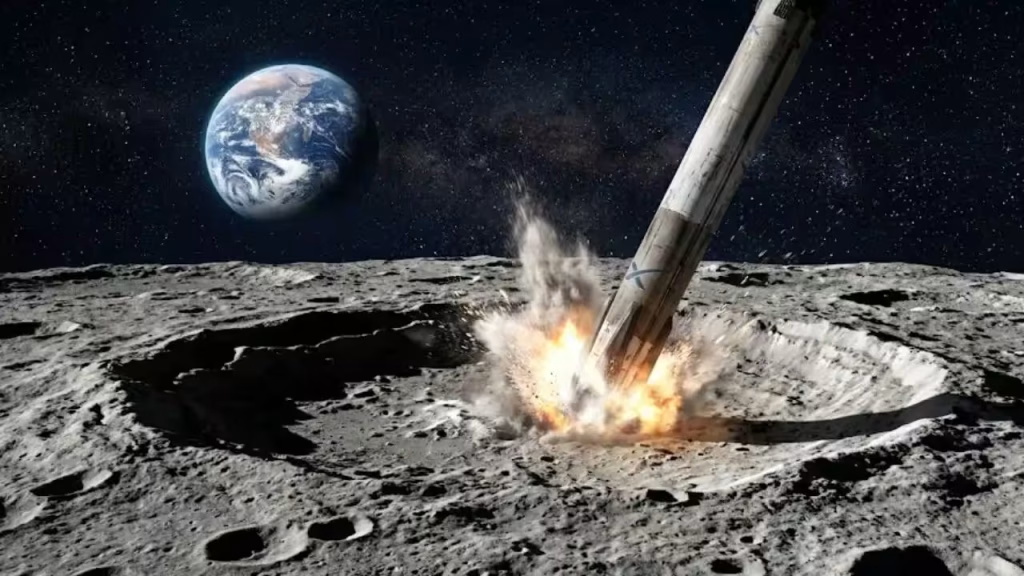
Scientists say SpaceX Falcon 9 rocket will strike the Moon at 5,400 miles per hour.
Why This Accidental Lunar Impact Matters
Artificial lunar impacts offer an advantage over random meteoroid events.
Scientists rarely know exactly when a natural object will reach the Moon. They may also lack reliable information about its mass, direction, or speed.
In this case, researchers have useful estimates for each factor. They can compare those predictions with telescope recordings and later orbital images.
That comparison may test how accurately astronomers can locate an impact from a flash or plume. It may also improve computer models of crater formation.
Scientists also want to examine how lunar dust responds.
The Moon has weak gravity and almost no atmosphere. Material can therefore follow long paths above the surface without wind disrupting the plume.
These observations could support future seismic experiments as well. Researchers hope to develop better methods for connecting a detected signal with a precise impact location.
A Test for Lunar Debris Tracking
The event also highlights a growing issue in cislunar space.
More government and commercial missions now travel between Earth and the Moon. Their landers, rocket stages, and support hardware do not always follow simple final paths.
This particular impact poses no known danger to Earth or current lunar missions. Still, future activity will place more robotic vehicles, communications systems, scientific equipment, and crewed facilities on or near the Moon.
Better tracking will help mission planners understand where inactive objects may travel. It could also support safer disposal decisions after future launches.
The upcoming collision will not solve the lunar debris problem. However, it can provide real data for models that describe how abandoned objects move through the Earth-Moon system.
Falcon 9 Moon Impact: An Unplanned Science Opportunity
The Falcon 9 Moon impact began as the long-term consequence of a discarded rocket stage. It may now become one of the most closely monitored artificial lunar impacts in recent years.
Astronomers may capture a flash, detect a rising dust plume, or identify the resulting crater later. Any of those outcomes could improve impact-location techniques and lunar dust models.
The results may also strengthen awareness of inactive hardware traveling through cislunar space.
The event remains scheduled for August 5, 2026. Its exact appearance, however, remains uncertain. That uncertainty makes the observation campaign both challenging and scientifically valuable.
Main Sources:
NASA Jet Propulsion Laboratory – Horizons News:
https://ssd.jpl.nasa.gov/horizons/news.html
Observational Planning for the August 5, 2026 Falcon 9 Upper-Stage Lunar Impact:
https://arxiv.org/abs/2607.14625
Firefly Aerospace – Blue Ghost Mission 1 Launch:
https://fireflyspace.com/news/firefly-aerospaces-blue-ghost-mission-1-successfully-launches-and-begins-45-day-transit-to-the-moon/
Firefly Aerospace – Blue Ghost Mission Updates:
https://fireflyspace.com/news/blue-ghost-mission-1-live-updates/
ispace – RESILIENCE Mission 2 Update:
https://www.ispace-inc.com/2025/01/15/ispace-completes-success-2-of-mission-2-milestones/
Project Pluto – 2025-010D Lunar Impact Tracking:
https://www.projectpluto.com/25010d.htm