BY:SpaceEyeNews.
Scientists have moved one step closer to understanding what happens around one of the universe’s most famous black holes. A Chinese-led research team has created the first spatially resolved map of M87 black hole radiation at scales comparable to its event horizon.
The result goes beyond producing another striking image. It shows how the radiation changes as distance from the black hole increases. This gives researchers a new way to examine the plasma surrounding M87*. It may also help explain how matter flows inward and how the black hole powers its enormous jet.
The study was led by researchers at the Shanghai Astronomical Observatory. It appeared in The Astrophysical Journal Letters in July 2026.
M87 Black Hole Radiation Moves Beyond a Single Image
M87* became famous in 2019 when the Event Horizon Telescope released the first image of a black hole’s shadow. The object sits around 55 million light-years from Earth. It has a mass about 6.5 billion times that of the Sun.
That historic image revealed a bright ring surrounding a darker central region. However, a single-frequency image mainly shows where radio emission appears bright. It cannot fully reveal why one region looks different from another.
The new study adds an important layer of physical information. Researchers compared observations at two radio wavelengths. They then measured how the intensity changed between those wavelengths across the image.
This technique allowed the team to create a spectral-index map. Instead of showing brightness alone, the map traces changes in the radiation process around the black hole.
How Scientists Created the Spectral-Index Map
The researchers combined data from international radio-telescope networks. Their analysis compared observations made at wavelengths of 1.3 millimetres and 3.5 millimetres.
These observations use very long baseline interferometry. In this method, radio telescopes located across different regions work together. The combined network acts like a telescope almost as wide as Earth.
Each wavelength provides a different view of the plasma. The 1.3-millimetre data examines a compact region near the event horizon. Meanwhile, the 3.5-millimetre observations show emission across a somewhat larger area.
By carefully aligning the two datasets, the team calculated the spectral index at different positions.
What the Spectral Index Reveals
The spectral index describes how radiation strength changes with frequency. Scientists often use it to investigate the physical state of emitting material.
In this case, the measurement can reveal whether the plasma is transparent or absorbs part of its own radiation. It also provides clues about magnetic fields and the energies of electrons near the black hole.
Earlier theoretical studies showed that spectral-index maps could separate models that look similar in ordinary images. The measurement is sensitive to optical depth, magnetic conditions and electron-energy distribution.
Therefore, the new map turns the M87 image into something closer to a physical diagnostic tool.
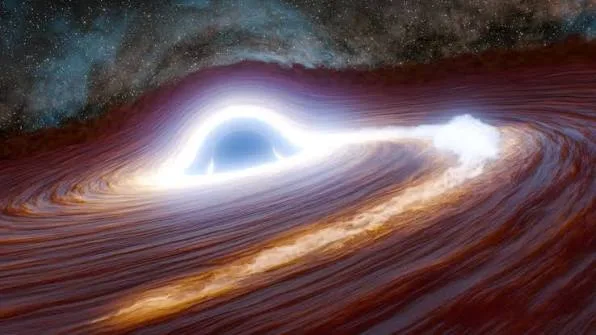
Chinese scientists decode M87 black hole’s radiation secrets.
Radiation Changes Near the Center of M87*
The most important result appears in the way the spectral index changes with distance.
Close to the center, the researchers detected a positive spectral index. This indicates that synchrotron self-absorption strongly affects the radiation.
Synchrotron radiation forms when energetic electrons move through magnetic fields. As the electrons spiral, they release radio emission. However, dense plasma can absorb some of that same radiation before it escapes.
As a result, the innermost region does not appear fully transparent. The radiation observed by telescopes represents only part of the energy produced there.
Farther from the center, the spectral index becomes increasingly negative. This shows that the plasma becomes optically thin. In an optically thin region, radio waves can pass through the material more easily.
The map therefore reveals a gradual transition. The plasma changes from a self-absorbed state near the center to a more transparent state farther out.
The 30-Microarcsecond Transition
One detail makes the discovery especially important. The transition occurs about 30 microarcseconds from the black hole’s center.
A microarcsecond is an extremely small angular measurement. Such precision is needed because M87* lies tens of millions of light-years away.
The transition distance closely matches the ring seen in the 3.5-millimetre observations. This connection suggests that the ring is not simply a visual boundary created by the imaging process.
Instead, its position appears closely linked to a real change in the plasma’s radiation state. The ring may mark a region where the emission changes between relatively opaque and more transparent conditions.
However, scientists must still interpret the structure carefully. The ring’s appearance comes from several combined effects. These include gravitational lensing, plasma density, magnetic fields, electron temperature and optical depth.
The new M87 black hole radiation map does not separate every effect completely. Still, it provides a valuable new constraint for models.
New Clues About Black Hole Accretion
Matter approaching M87* forms a hot, magnetized accretion flow. Scientists want to understand how this material heats up, moves inward and interacts with strong magnetic fields.
Computer simulations can produce many possible images of this environment. Several models may create similar ring-like structures at one wavelength. Yet they can predict different spectral-index patterns.
Researchers can now compare those predictions with the observed gradient. Models that fail to reproduce the transition may be ruled out or adjusted.
This makes multi-frequency imaging especially useful. It adds information that cannot be recovered from shape and brightness alone.
Connecting M87* to Its Giant Jet
M87* also powers one of astronomy’s best-known plasma jets. NASA observations show that the visible jet stretches for thousands of light-years from the galaxy’s center.
Scientists still do not fully understand how material near the event horizon enters and gains energy within such jets.
The spectral map may help researchers identify where emission from the accretion flow ends and where the jet base begins. It can also test how magnetic fields guide plasma away from the central region.
Future observations at additional frequencies could improve this picture. Polarization measurements may also reveal magnetic-field direction and structure.
Repeated observations could show whether the spectral pattern changes over time. That would move black hole research from static imaging toward a more dynamic examination of plasma activity.
M87 Black Hole Radiation Opens a New Research Era
The new M87 black hole radiation map represents a shift in how scientists study black holes. Researchers are no longer limited to seeing a bright ring around a dark center.
They can now measure how the radiation mechanism changes across that ring.
The study found self-absorbed emission close to the center and more transparent plasma farther away. It also linked that transition to the ring observed at 3.5 millimetres.
Scientists did not detect radiation from inside the event horizon. Light cannot escape from that region. Instead, they mapped the glowing plasma immediately outside it.
That distinction matters. The discovery turns M87* from a famous cosmic image into a detailed laboratory for studying accretion, magnetic fields, radiation and jet formation.
Main Sources:
Chinese Academy of Sciences:
https://english.cas.cn/newsroom/research-news/202607/t20260714_1178135.shtml
Shanghai Astronomical Observatory:
https://english.shao.ac.cn/news/202607/t20260714_1178114.html
Chinese Academy of Sciences media report:
https://english.cas.cn/newsroom/cas-in-media/202607/t20260723_1178935.shtml
Event Horizon Telescope 2019 announcement:
https://eventhorizontelescope.org/press-release-april-10-2019-astronomers-capture-first-image-black-hole
NASA M87 image and jet information:
https://science.nasa.gov/asset/hubble/m87-4/