BY:SpaceEyeNews.
A distant galaxy has produced one of the strangest recurring events ever seen around a supermassive black hole. The IC 3599 black hole outburst has returned for the third time in about 35 years.
Astronomers detected earlier giant brightenings in 1990 and 2010. Then, in late 2025, the galaxy’s center suddenly became extremely bright in X-rays once again.
This time, scientists caught the event while it was still unfolding. That allowed them to study the outburst with several observatories across different wavelengths.
The results point toward a powerful instability inside the black hole’s accretion disk. They also challenge other explanations that once appeared possible.
IC 3599 Black Hole Outburst Returns
IC 3599 lies about 280 million light-years from Earth. It belongs to a class of active galaxies whose central regions release intense radiation.
At the galaxy’s heart sits a supermassive black hole with an estimated mass of around two million Suns. Gas and dust orbit this object inside a hot accretion disk.
IC 3599 usually remains relatively faint. However, its central region occasionally changes dramatically.
Astronomers first noticed a giant X-ray flare in 1990 through observations from the ROSAT space telescope. Another major event appeared in data collected by NASA’s Swift Observatory in 2010.
Researchers then began monitoring the galaxy more regularly. Their patience finally paid off in 2025.
On October 31, Swift observations showed that IC 3599 had become around 50 times brighter than its normal low state. Data covering the broader event showed an increase of more than 100 times in X-ray brightness.
The black hole itself did not explode or release light. Instead, gas surrounding it heated rapidly as the flow of material toward the black hole increased.
Astronomers Caught the Event in Real Time
The latest event offered something the earlier outbursts could not. Scientists detected it early enough to organize a rapid observing campaign.
NASA’s Neil Gehrels Swift Observatory continued tracking the galaxy in X-ray and ultraviolet light. ESA’s XMM-Newton telescope then examined the source in much greater detail.
Ground-based facilities also studied the event in visible wavelengths. These included observatories in the United States, China and the Caucasus region.
Together, the telescopes allowed researchers to follow activity close to the black hole and measure its effect on surrounding gas.
One XMM-Newton observing session lasted about 120,000 seconds, or more than 33 hours. During that period, the X-ray brightness appeared to rise and fall in an unusual repeating pattern.
Scientists estimated a possible cycle of roughly 7.4 hours. They described it as a candidate quasiperiodic oscillation, or QPO.
However, the signal remains uncertain. XMM-Newton observed only a few apparent cycles, so astronomers need more data before confirming that the pattern represents a genuine cosmic clock.
If confirmed, the oscillation could provide important clues about matter moving through the innermost part of the accretion disk.
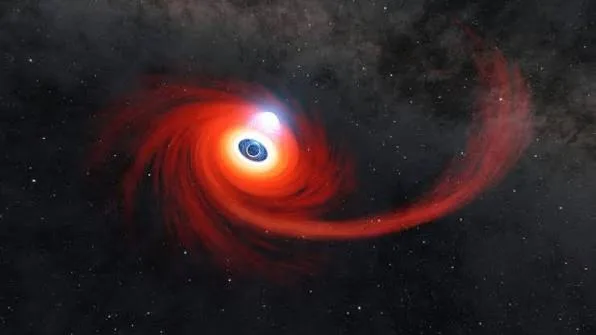
The black hole in IC 3599 flared to 50 times its usual brightness in 2025.
Unusual X-Rays Reveal an Extreme State
The IC 3599 black hole outburst also produced an exceptionally soft X-ray spectrum.
In astronomy, “soft” X-rays carry less energy than hard X-rays. During the latest outburst, Swift detected almost no photons above 2.5 kiloelectronvolts.
That detail suggests the emission came mainly from an extremely hot accretion disk. A harder X-ray-producing corona did not dominate the signal.
The brightness also approached the black hole’s estimated Eddington limit. This limit describes the point where outward radiation pressure strongly pushes against material falling inward.
Near that threshold, the inner disk can become highly unstable. Radiation changes how gas moves, while new material continues entering the system.
Optical observations revealed another major clue. Several bright coronal emission lines appeared during the high state.
These lines came from highly ionized atoms in gas surrounding the galaxy’s nucleus. Intense radiation had removed many electrons from those atoms.
Some lines had been weak or absent when IC 3599 was faint. Their return showed that the outburst affected a region far larger than the inner accretion disk.
What Causes the Repeated Outbursts?
Astronomers have considered several explanations for IC 3599’s unusual behavior.
One proposal involved a star repeatedly passing close to the supermassive black hole. During each approach, the black hole’s gravity could strip material from the star and produce another flare.
A second theory suggested that IC 3599 might contain two supermassive black holes. An orbiting companion could periodically disturb or cross the main black hole’s accretion disk.
Both possibilities could create repeating events. However, they should normally follow a more consistent schedule.
The gaps between the observed outbursts were not equal. About 19.5 years separated the 1990 and 2010 events. The next interval lasted roughly 15.7 years.
Earlier models involving repeat stellar stripping had predicted another major event around 2019 or 2020. Swift monitoring found no such outburst.
The irregular timing now favors a different explanation: radiation-pressure instability inside the accretion disk.
An Unstable Accretion Disk May Be Responsible
Under this model, gas slowly accumulates within part of the disk. As the amount of material increases, the disk becomes hotter, denser and more strongly influenced by radiation pressure.
Eventually, the flow can switch into an unstable state. A large amount of stored gas then moves inward much faster.
This sudden change produces intense heat and an enormous rise in X-ray brightness. After the inner disk uses much of its available material, the galaxy fades again.
The disk then begins another slow rebuilding process.
Unlike an orbiting star, this mechanism does not need to repeat at exact intervals. Local changes in gas density, temperature, magnetic fields and incoming material could affect when each new cycle begins.
The new study concludes that the observations agree well with radiation-pressure instability. Still, the model remains an interpretation of the available evidence.
Astronomers have not directly watched a physical envelope collapse, and the observations do not yet confirm a huge ejection of matter into space. The clearest result is a dramatic increase in accretion-powered radiation.
Why the IC 3599 Black Hole Outburst Matters
Recurring giant outbursts remain rare among active galaxies. Most astronomers never get the chance to study three extreme events from the same supermassive black hole.
IC 3599 therefore offers a valuable natural laboratory.
Scientists can compare how each event begins, brightens and fades. They can also examine how the accretion disk changes as the black hole approaches its Eddington limit.
The galaxy may improve our understanding of changing-look active galactic nuclei. These objects can transform far faster than traditional models once suggested.
IC 3599 is especially important because its changes happen over decades, years and possibly hours. Those different timescales reveal separate processes within the same system.
Future X-ray observations could confirm the 7.4-hour signal. Continued monitoring may also show how quickly the galaxy returns to its low state.
Conclusion
The IC 3599 black hole outburst has given astronomers their clearest view yet of this galaxy’s recurring transformation.
Three giant events have now appeared since 1990. The latest one became more than 100 times brighter in X-rays and triggered rapid observations from space and Earth.
Current evidence favors a radiation-pressure instability inside the accretion disk rather than a regularly orbiting star or second black hole.
IC 3599 may now begin another long rebuilding phase. By continuing to watch it, astronomers could learn how supermassive black holes suddenly change their feeding behavior under extreme conditions.
Main Sources:
The original 2026 research preprint:
https://arxiv.org/abs/2607.09036
Full study text:
https://arxiv.org/html/2607.09036v1
Previous Swift monitoring study:
https://arxiv.org/abs/2404.19107
Earlier repeated tidal-stripping proposal:
https://arxiv.org/abs/1502.07184
Phys.org research summary:
https://phys.org/news/2026-07-astronomers-recurring-black-hole-eruption.html
ESA XMM-Newton website:
https://www.cosmos.esa.int/web/xmm-newton