BY:SpaceEyeNews.
Webb early galaxies are creating one of the biggest puzzles in modern astronomy. Some appear bright, massive, chemically developed, or strangely mature. Yet we see them only a few hundred million years after the Big Bang.
That apparent contradiction has inspired dramatic claims. Some reports suggest that Webb has discovered galaxies containing stars older than the universe itself. However, current research does not support that conclusion.
The real discovery may be even more interesting. These galaxies did not receive extra time to develop. Instead, they seem to have grown at an unexpectedly rapid pace.
Why Webb Early Galaxies Can Look Impossibly Old
Astronomers estimate the universe to be about 13.8 billion years old. ESA’s Planck mission reached that figure by studying the cosmic microwave background and the expansion of space. Webb’s galaxy images do not independently replace that timeline.
Instead, Webb tests what galaxies could build within the available time.
The confusion often begins with the word “old.” A galaxy may look mature for several reasons. It may appear red, contain heavy elements, hold many stars, or show little current star formation.
None of those features acts as a simple clock.
A young galaxy covered in dust can look red. Bright gas emissions can make it appear more massive. Light from an active black hole can also affect its measured colors.
Even an inactive galaxy may have formed quickly before suddenly shutting down.
The original article makes the same distinction. Webb has found unexpectedly developed galaxies, but it has not securely identified a galaxy that spent billions of years forming stars before enough cosmic time had passed.
MoM-z14 Pushes Webb Deeper Into Cosmic History
MoM-z14 offers one of the clearest examples of the real mystery.
Researchers confirmed the galaxy at a spectroscopic redshift of 14.44. Its light left only about 280 million years after the Big Bang. That makes it the most distant spectroscopically confirmed galaxy reported in the 2026 study.
Webb’s Near-Infrared Spectrograph confirmed its distance through a sharp Lyman-alpha break and several weak ultraviolet emission features.
MoM-z14 is also remarkably bright and compact. Its estimated stellar mass reaches around 100 million times the mass of the Sun. Yet the evidence does not point toward a quietly aging galaxy.
Instead, the observations indicate a young system undergoing a strong rise in star formation. Its star-formation rate may have increased almost tenfold during the five million years before Webb captured its light. The galaxy also appears to contain very little dust.
The Abundance Problem
MoM-z14 raises another important question.
The survey behind the discovery suggests that bright galaxies around redshifts 14 to 15 may be more than 100 times as common as many pre-Webb models predicted.
That gap does not mean MoM-z14 contains billion-year-old stars. It means models may have underestimated how quickly early galaxies could become visible and productive.
The challenge concerns efficiency, not impossible age.
Astronomers Reconstruct Stellar Ages Indirectly
Webb cannot directly read the age of every star inside a distant galaxy. Researchers must reconstruct its history.
They compare the galaxy’s brightness across several wavelengths with computer-generated models. Those models test different mixtures of stars, dust, gas, chemical elements, and black-hole activity.
Several combinations can produce similar light.
For example, dust can make a young stellar population appear older. Strong emission lines from heated gas can boost the brightness inside a broad infrared filter. That extra light may increase the estimated stellar mass.
Assumptions about star formation also matter. One model may assume that stars formed gradually. Another may allow short and powerful bursts.
Both models can sometimes explain the same measurements.
Therefore, estimated stellar ages may shift by tens or hundreds of millions of years. However, responsible models do not allow stars to become older than the universe at the galaxy’s measured redshift.
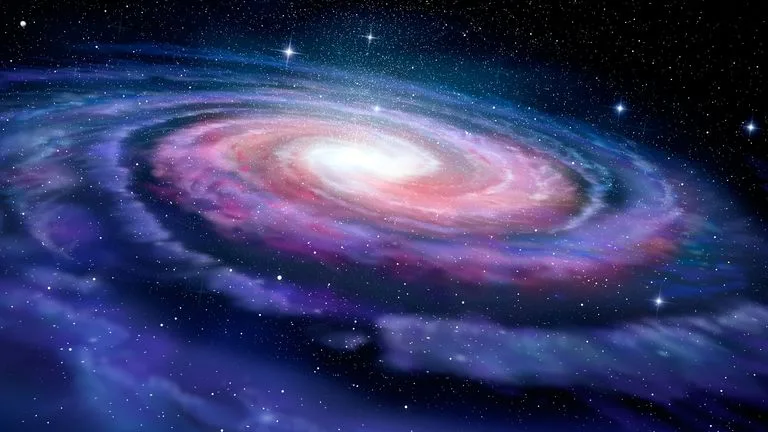
NASA’s James Webb Space Telescope provides revelations into how early galaxies formed.
JADES-GS-z14-0 Reveals Rapid Early Growth
JADES-GS-z14-0 was the distance record-holder before MoM-z14. Webb observed it at a redshift of about 14.3, when the universe was less than 300 million years old.
Later observations from Webb’s Mid-Infrared Instrument gave astronomers a better view of its visible-light emissions.
The preferred model suggests that JADES-GS-z14-0 contained about half a billion solar masses in stars. It also experienced an intense burst of star formation during the preceding few million years.
At least part of its mid-infrared brightness may come from oxygen and hydrogen emission lines. That signal suggests the galaxy had already produced heavier elements.
Such enrichment happened surprisingly early. Still, the preferred explanation involves rapid growth rather than impossible age.
An alternative model allows an older and more massive stellar population. However, researchers consider it less likely because it would require an extreme amount of mass for that stage of cosmic history.
A Young Galaxy Can Already Look Mature
Another Webb discovery shows why mature does not always mean ancient.
JADES-GS-z7-01-QU existed when the universe was about 700 million years old. Its spectrum contained a Balmer break, which can signal an evolved stellar population.
At the same time, Webb detected no strong emission lines linked to active star formation.
Researchers classified the object as quenched. In other words, it had recently stopped producing significant numbers of stars.
However, detailed modeling did not reveal a galaxy that had evolved for billions of years. Its oldest notable stars were between 40 million and 150 million years old.
The galaxy likely formed stars during a short burst lasting between 20 million and 100 million years. Star formation then ended shortly before Webb observed it.
Scientists call this process “mini-quenching.” The shutdown may have lasted only briefly. Fresh gas could later have restarted star formation.
Maturity Can Develop Quickly
This result changes how we should describe early galaxies.
A galaxy can form stars rapidly, lose or heat its available gas, and then become inactive. Its spectrum may look mature even though the entire process took less than 150 million years.
Early galactic development may have occurred through short and dramatic phases rather than slow, steady growth.
What Webb Early Galaxies Actually Challenge
Webb early galaxies have not overturned the measured age of the universe. Instead, they challenge models of galaxy formation.
The observations suggest that early systems may have converted gas into stars more efficiently than expected. Some may have experienced intense bursts, enriched themselves quickly, and switched between active and inactive phases.
Existing simulations may also underestimate the number of bright galaxies during cosmic dawn.
Researchers now need to improve models of gas cooling, stellar feedback, dust production, black-hole activity, and early stellar populations.
Webb has therefore exposed gaps in our understanding of galaxy evolution. Nature Astronomy has described these findings as evidence that massive galaxies formed earlier and faster than astronomers expected before Webb.
Conclusion: Fast Growth Solves the Apparent Paradox
Webb early galaxies do not currently provide secure evidence of stars older than the universe. MoM-z14, JADES-GS-z14-0, and JADES-GS-z7-01-QU instead reveal systems that developed with remarkable speed.
Some became luminous within a few million years. Others built large stellar populations, produced heavier elements, or temporarily stopped forming stars.
These discoveries still create a major scientific challenge. Yet the question is not how the galaxies received impossible amounts of time.
The deeper mystery is how the early universe accomplished so much with the limited time it had.
Main Sources:
The Open Journal of Astrophysics — MoM-z14 study:
https://astro.theoj.org/article/156033-a-cosmic-miracle-a-remarkably-luminous-galaxy-at-_z_-sub-spec-sub-14-44-confirmed-with-jwst
Nature Astronomy — JADES-GS-z14-0 MIRI observations:
https://www.nature.com/articles/s41550-025-02503-z
Nature — Recently quenched galaxy JADES-GS-z7-01-QU:
https://www.nature.com/articles/s41586-024-07227-0
ESA — Planck science highlights and age of the universe:
https://www.esa.int/Science_Exploration/Space_Science/Planck/Planck_science_highlights