BY:SpaceEyeNews.
Hubble Reveals a Remarkably One-Sided Galaxy
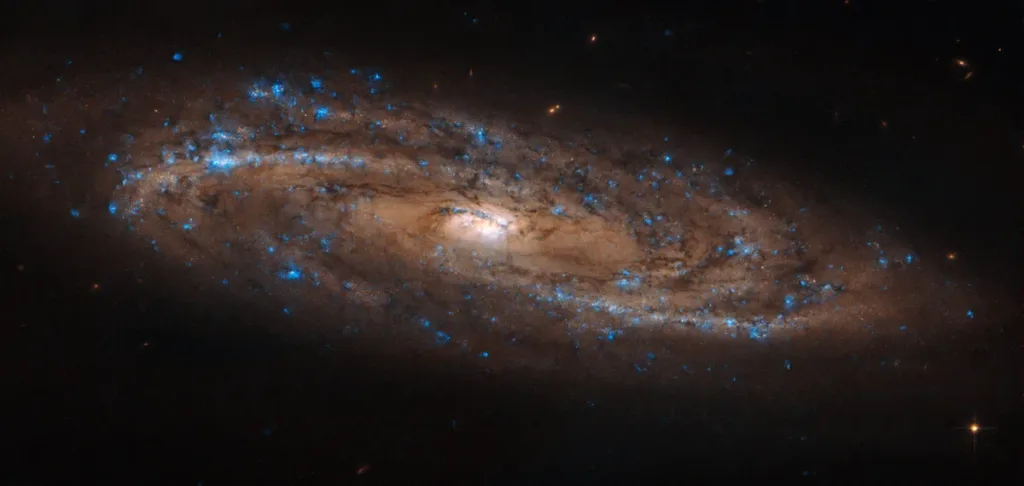
A new Hubble image shows a spiral galaxy whose two sides appear to tell very different stories. The NGC 4654 asymmetrical galaxy has one arm rich in gas and young stars. Its opposite arm looks far emptier.
The galaxy also has a rounded, sharply defined edge on one side. Meanwhile, a long stream of gas extends from the other side and continues beyond Hubble’s view.
Astronomers believe that no single event created this unusual shape. Instead, two forces altered the galaxy at different times. A close encounter disturbed it around 500 million years ago. Today, pressure from its environment continues to move gas through its disk.
Despite these changes, NGC 4654 still forms stars at an impressive rate.
NGC 4654 Is Difficult to Place in One Category
NGC 4654 lies about 72 million light-years from Earth in the constellation Virgo. It belongs to the Virgo Cluster, a massive collection of galaxies surrounded by hot, thin gas.
Astronomers classify NGC 4654 as an intermediate spiral galaxy. Its structure sits between a barred spiral and an unbarred spiral. A weak bar crosses its central region, but it does not dominate the galaxy’s appearance.
Its uneven structure makes it especially interesting. Gas often becomes distorted when a galaxy moves through a cluster. However, NGC 4654 also shows a clear imbalance in its stars.
One spiral arm contains abundant gas and bright stellar populations. The other has far less material. That difference suggests that the galaxy experienced more than environmental pressure alone.
Its disk now preserves evidence from separate events that unfolded over hundreds of millions of years.
Ram-Pressure Stripping Shapes the NGC 4654 Asymmetrical Galaxy
NGC 4654 travels rapidly through the Virgo Cluster. As it moves, it passes through the cluster’s intracluster medium.
This medium contains extremely hot and thin gas. Although its density remains low, the galaxy’s high speed creates significant pressure. Astronomers call this process ram-pressure stripping.
The effect resembles a strong headwind acting on the galaxy’s gas. The pressure compresses material along the leading side of the disk. As a result, that edge appears curved, bright and sharply defined.
At the same time, gas on the opposite side gets pushed backward. This displaced material forms an elongated tail that stretches well beyond the Hubble image.
Ram pressure mainly affects gas because stars remain much less vulnerable to the surrounding medium. Gas clouds can slow down, compress or move away from the disk. Stars continue following their gravitational paths.
This distinction helps researchers separate the effects of ram pressure from those of other processes.
Ram Pressure Cannot Explain Every Feature
The gas tail strongly supports the ram-pressure explanation. Yet it does not account for the galaxy’s entire structure.
NGC 4654’s stars also show an uneven distribution. The leading spiral arm contains many stars, while the opposite arm appears noticeably depleted.
Pressure from the intracluster medium should not easily rearrange stars in this way. Astronomers therefore looked for another influence.
Their investigation pointed toward NGC 4639, another spiral galaxy in the Virgo Cluster. Although the two galaxies now sit far apart, their current positions do not reveal their complete history.
Models suggest that NGC 4639 passed close to NGC 4654 around 500 million years ago.
An Ancient Flyby Left a Lasting Mark
The two galaxies likely experienced a gravitational flyby rather than a direct collision. During the close passage, NGC 4639’s gravity pulled on the stars and gas inside NGC 4654.
That tidal influence shifted material toward one side of the disk. It may also have removed part of the gas supply from the weaker arm.
With less cold gas available, that region produced fewer new stars. Over time, the difference became more visible. One arm remained rich in gas and stellar activity, while the other developed a depleted appearance.
The galaxies continued along separate paths after the encounter. However, NGC 4654 retained the structural imbalance.
This scenario explains why both its stars and gas look uneven. Ram pressure alone mainly accounts for the gas tail and compressed edge. The earlier gravitational encounter provides a stronger explanation for the lopsided stellar disk.
Two Forces Created One Unusual Spiral Galaxy
The NGC 4654 asymmetrical galaxy records two distinct stages of environmental change.
First, the encounter with NGC 4639 disturbed its disk. That event redistributed gas and reduced star formation along one side.
Later, NGC 4654 continued moving through the Virgo Cluster. Ram pressure compressed its leading edge and pulled gas into a long trailing structure.
Each process left a different signature. Gravity affected both stars and gas. Ram pressure acted most strongly on gas.
Together, these forces created the one-sided galaxy that Hubble sees today. The result shows why astronomers must consider several mechanisms when studying galaxies inside crowded clusters.
A galaxy’s current shape may reflect multiple events rather than one dramatic transformation.
Star Formation Remains Surprisingly Active
Galaxies often need large reserves of cold gas to maintain star formation. When ram-pressure stripping removes that material, star production usually declines.
NGC 4654 does not fully follow that pattern.
The galaxy still creates nearly two solar masses of stars each year. NASA and ESA note that this rate remains comparable to other galaxies of a similar size.
Hubble’s latest observations reveal where this activity occurs. Bright pink bubbles appear throughout the disk. These regions contain energized gas surrounding recently formed stars.
Several bubbles sit along the compressed leading arm. Others appear near the outer disk and around the galaxy’s weak central bar.
Pressure may help explain this activity. While ram-pressure stripping removes gas from some locations, it can compress clouds elsewhere. Dense clouds may then collapse and produce new stars.
Therefore, the same environmental force can reduce a galaxy’s future gas supply while temporarily supporting star formation in selected regions.
What the Latest Hubble Data Adds
Astronomers have studied NGC 4654 before. The new development is not the galaxy’s discovery. Instead, the latest Hubble data provides a clearer view of its active star-forming regions.
The observations include a narrow wavelength of red light emitted by energized hydrogen gas. This light allows researchers to locate areas where young stars recently formed.
The data came from two observing programs designed to connect gas distribution with star formation. Researchers want to understand how gas moves through galactic disks, where it forms dense clouds and how young stars affect nearby material.
NGC 4654 offers an especially useful case because its gas has experienced both gravitational disturbance and external pressure.
Why NGC 4654 Matters
The NGC 4654 asymmetrical galaxy demonstrates how strongly a cluster environment can influence galactic evolution.
Its unusual appearance connects an ancient gravitational encounter with a continuing interaction between the galaxy and the Virgo Cluster’s hot gas.
More importantly, the galaxy has not stopped producing stars. It continues building new stellar populations even while losing and redistributing its raw material.
Hubble’s image therefore captures more than a lopsided spiral. It reveals a galaxy adapting to several environmental pressures at once.
NGC 4654 carries its history across its disk. One event disturbed its structure hundreds of millions of years ago. Another force continues reshaping its gas today. Yet throughout that transformation, new stars still shine.
Main Sources:
NASA — Hubble Spies One-Sided Spiral
https://science.nasa.gov/missions/hubble/hubble-spies-one-sided-spiral/
ESA/Hubble — One-Sided Spiral
https://esahubble.org/images/potm2607a/
PHANGS Survey
https://www.phangs.org/