BY:SpaceEyeNews.
The SETI high-frequency alien signal search is moving into a part of the radio spectrum that scientists have barely explored. Instead of listening only near frequencies long considered logical for interstellar communication, researchers are now examining archived observations from the ALMA radio telescope.
The first survey found no candidate extraterrestrial transmission. However, its value lies in the method. Scientists showed that existing ALMA data can support sensitive searches for technological signals at frequencies above those covered by most traditional SETI programs.
This approach could greatly expand the search without requiring a completely new telescope campaign.
SETI High-Frequency Alien Signal Search Moves Beyond the Water Hole
For decades, many radio SETI surveys focused on frequencies between about 1.42 and 1.66 gigahertz. Astronomers often call this region the “water hole.”
The band lies between natural radio emissions associated with hydrogen and hydroxyl. Together, those molecules form water. Since water plays a central role in life on Earth, researchers once argued that another technological civilization might recognize the same scientific connection.
The region also contains relatively low cosmic radio noise. That makes it an attractive place to transmit or receive a weak signal.
Still, the water-hole idea rests on an assumption. It reflects what humans consider scientifically meaningful. An extraterrestrial society could choose a completely different frequency based on its technology, environment or communication needs.
As a result, focusing too heavily on one narrow region may leave large parts of the available spectrum almost untouched.
Astronomer Louisa Mason of the University of Manchester and her colleagues have now tested a different approach. Their work explores whether high-frequency observations can reveal narrowband technosignatures that earlier surveys may have missed.
ALMA Opens a New Radio Window for SETI
The team used data from the Atacama Large Millimeter/submillimeter Array, better known as ALMA. Located in northern Chile, ALMA studies the Universe at millimeter and submillimeter wavelengths.
It remains exceptionally sensitive at radio frequencies above 35 gigahertz. Yet SETI projects have rarely explored this region.
For the new study, researchers analyzed two small spectral windows within ALMA’s Band 3. The windows centered on frequencies of 90.642 and 93.151 gigahertz.
These frequencies sit far above the traditional water-hole range. Therefore, the survey entered a section of the radio spectrum that has received little attention in previous searches for extraterrestrial technology.
Rather than seeking broad radio emissions, the team looked for narrowband signals. These signals place much of their energy inside a very small frequency range.
A highly concentrated signal can attract interest because many natural sources produce wider or more complex emissions. However, a narrowband detection would not prove the presence of alien technology on its own.
Researchers would first need to rule out interference from Earth, telescope effects and known astrophysical processes.
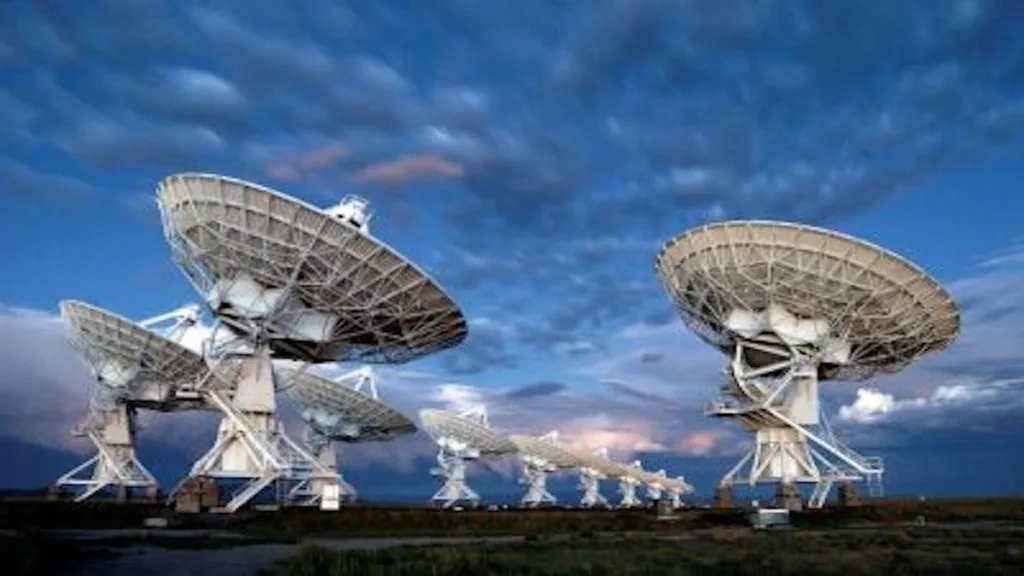
SETI scientists begin huge new hunt for intelligent aliens.
Archived ALMA Data Made the Search Possible
The researchers did not request new ALMA observations. Instead, they reused data originally collected for other astronomical studies.
This strategy offers an important advantage. Observatories gather enormous quantities of information, but scientists usually analyze those data for a specific target or research question. Other stars may appear within the same field even when they were not the original focus.
Mason’s team used this effect as a form of stellar “bycatch.”
The study examined four archived ALMA observations centered on calibrator sources. Within the usable fields, the researchers identified 28 Milky Way stars listed in the European Space Agency’s Gaia Data Release 3 catalogue.
The sample was modest. It did not include thousands of individually examined star systems, as some descriptions of the research may suggest.
Even so, the project demonstrated that scientists can search stars captured unintentionally during regular ALMA observations. A much larger archive could therefore contain many additional opportunities.
This makes the SETI high-frequency alien signal search more practical. Researchers can explore new frequencies while making better use of telescope time that has already been allocated and completed.
No Technosignatures Appeared in the First Survey
The team found no candidate technosignatures above the survey’s detection thresholds.
For the nearest star in the sample, the observations found no evidence of a continuously detectable transmitter with an equivalent isotropic radiated power above roughly 7 × 10¹⁷ watts.
Equivalent isotropic radiated power describes how powerful a transmitter would appear if it sent energy equally in every direction. The limit in this survey represents an extremely powerful hypothetical signal.
Therefore, the nondetection does not exclude ordinary communication systems or weaker transmissions. It also says nothing about signals outside the two narrow frequency windows.
A transmitter may have been inactive during the observation. It could also use another frequency, send its energy in a different direction or produce a signal below ALMA’s detection threshold.
The result only shows that researchers found no qualifying signal in the locations, frequencies and observation periods included in this study.
Galactic Models Reveal More Hidden Stars
The ALMA analysis forms only one part of the wider project. Mason has also examined how scientists estimate the number of stars covered by radio SETI surveys.
Researchers often use Gaia catalogues to identify stars inside a telescope’s field of view. Gaia provides precise measurements for a vast number of objects. However, it cannot reliably catalogue every star in the Milky Way.
Some stars remain too faint, too distant or too obscured to appear clearly in existing catalogues.
To address this problem, Mason used the Besançon Galactic Model. This computer model simulates the structure and stellar populations of the Milky Way.
When applied to a previous SETI survey containing 1,327 telescope pointings, Gaia data indicated that the observations covered about 288,000 stars. The galactic model raised the estimate to more than 6.1 million.
That difference does not mean researchers closely studied each simulated star. Instead, it suggests that many more stars occupied the observed fields than catalogue-based counts had revealed.
This method provides a clearer picture of how much of the Galaxy past searches may have covered.
High-Frequency SETI Still Faces Major Challenges
Searching at higher frequencies creates several technical problems.
Relative motion between Earth, the telescope, a distant planet and a possible transmitter can cause a signal to drift across frequency channels. At high frequencies, that drift may become more significant and can weaken a signal during processing.
Natural molecules also produce many spectral lines in the millimeter range. Researchers must distinguish those emissions from any unusual narrowband candidate.
ALMA’s sensitivity changes across its field of view as well. Scientists must carefully define which areas offer reliable measurements.
In addition, archived observations often cover only small frequency windows. They provide depth and sensitivity, but not continuous coverage across the entire radio spectrum.
These challenges limit what one survey can conclude. Nevertheless, they also help researchers design stronger searches in the future.
SETI High-Frequency Alien Signal Search Broadens the Hunt
The SETI high-frequency alien signal search has not uncovered evidence of extraterrestrial intelligence. Instead, it has opened another path for investigating the question.
ALMA gives astronomers access to frequencies that traditional SETI surveys have largely overlooked. Its archive also allows them to examine existing observations without starting every project from zero.
By combining ALMA measurements, Gaia astrometry and realistic models of the Milky Way, researchers can estimate both where they have searched and how many stars may have entered those observations.
The first survey covered only a small sample and two narrow frequency windows. Still, it showed that unexplored radio channels may already exist inside stored astronomical data.
Expanding into those channels will not guarantee a discovery. It will, however, reduce the number of places where a detectable signal could remain unexamined.
Main Sources:
Royal Astronomical Society:
https://ras.ac.uk/news-and-press/research-highlights/could-alien-signals-be-hiding-different-radio-channel
Peer-reviewed study, Conducting High-Frequency Radio SETI Searches Using ALMA:
https://doi.org/10.1093/mnras/stae2714
Preprint version of the ALMA study:
https://arxiv.org/abs/2411.19827
Peer-reviewed study, Simulating the Stellar Bycatch:
https://doi.org/10.1093/mnras/staf2112