BY:SpaceEyeNews.
Astronomers may have found the clearest evidence yet for a possible first exomoon, but the distant object looks nothing like the moons in our Solar System.
The candidate has almost the mass of Jupiter. It appears to orbit a brown dwarf called CD-35 2722 B. That brown dwarf, in turn, travels around a red dwarf star.
This arrangement creates an extraordinary three-level system: a star, a brown dwarf, and a planetary-mass satellite. It also raises a difficult question. Should such a large object count as a moon, a planet, or something between the two?
The research team currently prefers the term “exosatellite.” That wording reflects both the strength of the detection and the uncertainty surrounding its classification.
Possible First Exomoon Found in an Unusual System
The system is called CD-35 2722 and lies about 71 light-years from Earth. Its central object is a young M-type red dwarf with roughly half the Sun’s mass.
A brown dwarf known as CD-35 2722 B orbits the star at a wide distance. Earlier observations placed its mass at more than 30 times that of Jupiter. Brown dwarfs occupy the region between the largest planets and the smallest stars.
Now, researchers have detected signs that CD-35 2722 B has a companion of its own.
That creates a clear orbital hierarchy:
Red dwarf star → brown dwarf → planetary-mass exosatellite
The suspected satellite does not orbit the main star directly. Instead, it circles the brown dwarf while the entire pair moves around the star.
This structure makes CD-35 2722 one of the most unusual systems studied so far. It also makes familiar Solar System labels harder to apply.
A Repeating Wobble Revealed the Hidden Object
Astronomers have not photographed the possible first exomoon directly. They detected it by measuring the brown dwarf’s motion.
The team used the CRIRES+ spectrograph on the European Southern Observatory’s Very Large Telescope in Chile. This instrument separates infrared light into a detailed spectrum.
As the brown dwarf moved, tiny shifts appeared in its spectral lines. Those changes showed that CD-35 2722 B was repeatedly moving toward and away from Earth.
An unseen companion provides the strongest explanation for that motion. Its gravity pulls on the brown dwarf and creates a measurable wobble.
This approach is known as the radial-velocity method. Astronomers have used it for decades to find planets orbiting stars. However, this study applies the same principle to a brown dwarf and its suspected satellite.
The signal also followed a repeating cycle. According to the published study, the main candidate completes one orbit in about 170 days.
Researchers successfully predicted later velocity measurements using the proposed orbit. The new data agreed with those predictions, strengthening the case for a genuine companion rather than random measurement noise.
The Candidate Is Almost as Massive as Jupiter
The peer-reviewed study estimates that the main exosatellite has a minimum mass of about 0.9 times Jupiter’s mass.
That figure immediately separates it from familiar moons such as Earth’s Moon, Europa, Titan, or Ganymede. The newly detected object is probably a giant gaseous body rather than a small rocky or icy world.
Its description as a satellite comes from its orbital position, not its size.
The phrase “minimum mass” also matters. Radial-velocity measurements reveal how strongly an object pulls along our line of sight. Without knowing the orbit’s exact inclination, astronomers cannot yet calculate its full mass with complete precision.
The true value could therefore be higher.
An earlier version of the research also discussed evidence for a possible second, smaller companion. That signal suggested an object with roughly 0.28 Jupiter masses and an orbit lasting about 87 days.
However, the second candidate remains less certain. The published result focuses mainly on the stronger Jupiter-mass signal.
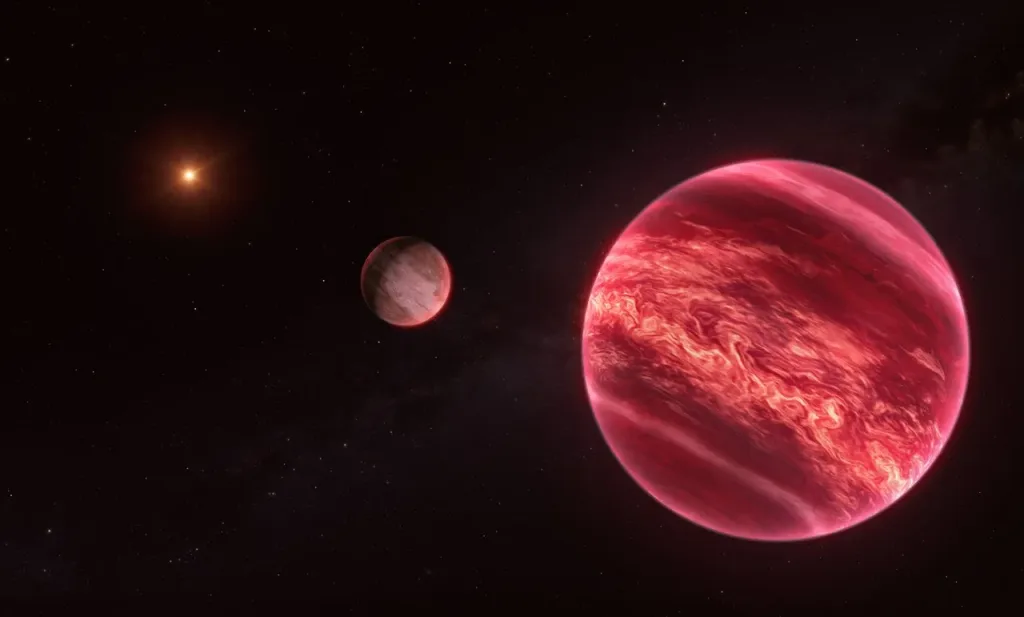
Astronomers Have Detected an Exomoon for the First Time.
Why the Possible First Exomoon Is Hard to Classify
The discovery has reopened a basic classification problem. What exactly qualifies as a moon?
The International Astronomical Union has formal definitions for planets and dwarf planets. Yet it has no universally accepted formal definition for a moon or exomoon.
In the Solar System, classification appears relatively simple. Planets orbit the Sun, while moons orbit planets or dwarf planets.
CD-35 2722 does not follow that familiar arrangement.
Its candidate satellite is massive enough to resemble a planet. However, it orbits a brown dwarf rather than a star. The brown dwarf then orbits a true star.
Researchers therefore use the broader term “exosatellite.” It describes a satellite outside the Solar System without deciding whether its host must count as a planet.
Several questions now become unavoidable. Should an object’s label depend on its mass? Should formation history matter? Does the nature of the host decide whether the companion becomes a planet or moon?
The system offers no easy answer. A Jupiter-mass body would normally qualify as a planet if it orbited a star. In this case, its place in the orbital hierarchy makes it behave like a moon.
Is This Really the First Confirmed Exomoon?
Astronomers have identified more than 6,000 exoplanets, but no exomoon has gained universal acceptance.
Earlier candidates appeared in transit measurements, timing variations, or astrometric observations. Some initially looked convincing. Later analyses often produced doubts or alternative explanations.
The CD-35 2722 signal stands out because researchers detected the gravitational effect directly in the brown dwarf’s velocity.
Even so, careful wording remains necessary.
The discovery represents strong evidence for a possible first exomoon or planetary-mass exosatellite. It does not yet provide a direct image of the object. Independent teams must also reproduce or confirm the result.
More observations should show whether the 170-day signal remains stable across additional orbital cycles. They may also reveal the system’s inclination and the candidate’s true mass.
Nature describes the result as a promising step toward an uncontroversial exomoon detection, rather than the final confirmation of one.
A New Test for Satellite Formation
The system matters for more than classification.
A massive body around a brown dwarf could reveal how satellites form in environments very different from our own. The candidate may have developed inside a disk surrounding the brown dwarf. It could also have formed through fragmentation or later gravitational interactions.
At present, astronomers cannot confirm which process created it.
The enormous mass ratio makes the problem especially interesting. This system may sit somewhere between conventional moon formation and the formation of a binary pair.
Future studies could examine its orbital stability, chemical composition, and relationship with the brown dwarf. Those details may reveal whether the two bodies formed together or followed separate paths.
The wide separation between the brown dwarf and the central star may also help the satellite survive. The brown dwarf follows an elongated orbit, but it remains far enough from the star to reduce disruptive interactions.
Future Observations Could Settle the Debate
Researchers now need more radial-velocity measurements. A longer observing period will refine the orbit and test whether other companions exist.
Future instruments may offer even greater precision. ESO’s Extremely Large Telescope could study similar systems and search for smaller satellites.
Those observations may eventually reveal objects closer in size to the large moons found around Jupiter and Saturn.
For now, CD-35 2722 remains a remarkable candidate. It shows that moons beyond the Solar System may appear in forms that astronomers never expected.
Possible First Exomoon Expands the Cosmic Family Tree
The possible first exomoon is not a distant version of Earth’s Moon. It is a Jupiter-mass object orbiting a brown dwarf that circles a red dwarf star.
That unusual hierarchy challenges the boundaries between stars, planets, and moons.
Further observations must confirm its mass and orbital properties. Yet the current evidence already demonstrates that radial-velocity measurements can reveal satellites around substellar objects.
Whatever name astronomers eventually choose, CD-35 2722 has opened a new path for studying moons and moon-like worlds beyond our Solar System.
Main Sources:
European Southern Observatory:
https://www.eso.org/public/news/eso2610/
Nature research paper:
https://www.nature.com/articles/s41586-026-10751-w
Research preprint:
https://arxiv.org/abs/2607.05193
Original IFLScience article:
https://www.iflscience.com/super-weird-star-system-has-clearest-evidence-yet-of-a-moon-like-object-beyond-our-solar-system-but-its-nothing-like-the-moons-back-home-84180