BY:SpaceEyeNews.
Enceladus ocean plume sampling could give scientists direct access to material from a hidden alien sea. Saturn’s icy moon contains a global salty ocean beneath its frozen crust. Yet scientists may not need to drill through that ice to study it.
Enceladus regularly ejects water vapour and frozen ocean-linked particles into space. A spacecraft could fly through this plume and analyse the material with advanced instruments. The approach offers a rare shortcut to one of planetary science’s hardest targets.
However, the plume does not provide a perfect bottle of untouched seawater. Scientists must understand how the material changes as it rises through the moon’s icy fractures.
Enceladus Ocean Plume Sampling Avoids Deep Drilling
Most ocean worlds create a major engineering challenge. Their water remains buried beneath thick layers of ice.
A lander would first need to reach the surface safely. It would then require enough power to melt or drill through the crust. The spacecraft would also need to prevent contamination, work autonomously and communicate through or around the ice.
Those problems would become harder with every kilometre of depth.
Enceladus offers a different route. The moon naturally carries material from its interior toward the surface. Water vapour and ice grains escape through fractures near the south pole, placing ocean-related material within reach of a passing spacecraft.
Instead of building a machine that travels down to the sea, scientists can send instruments through the plume above it.
The Moon Brings Its Ocean Into Space
Enceladus is only about 500 kilometres wide. Even so, evidence indicates that a global ocean lies beneath its bright icy crust.
Four long fractures cross the moon’s south polar region. Scientists often call them tiger stripes. These cracks release water vapour and frozen droplets at high speed.
Some particles return to the surface. Others escape Enceladus’s weak gravity and help supply Saturn’s E ring.
The plume carries water, salts, ammonia, methane, silica particles and organic material. These substances can provide valuable clues about conditions inside the ocean. They may also reveal whether water interacts with the moon’s rocky core.
This natural delivery system makes Enceladus different from many other icy moons. Its ocean remains hidden, but part of its chemistry does not.
What Cassini Found Inside the Plume
NASA’s Cassini spacecraft was not designed to search for life at Enceladus. Scientists did not know about the moon’s plume when the mission launched in 1997.
Once Cassini discovered the eruptions, mission planners adjusted later flybys to study them.
The spacecraft eventually completed 23 targeted encounters with Enceladus. Its Ion and Neutral Mass Spectrometer examined gases. Meanwhile, the Cosmic Dust Analyzer studied tiny solid grains.
During a close flyby on October 28, 2015, Cassini passed about 49 kilometres above the surface. It travelled directly through material linked to the moon’s subsurface ocean. NASA stressed that the spacecraft could assess habitability, but it could not make a definitive life detection.
Cassini still revealed an important chemical picture. Its measurements identified salts, organic compounds and evidence linked to hydrothermal activity. Scientists also found molecular hydrogen and phosphorus in plume material.
Together, these findings suggest that the ocean contains liquid water, useful chemistry and a possible energy source. Those ingredients can support habitability. Still, a habitable environment is not proof that life exists there.
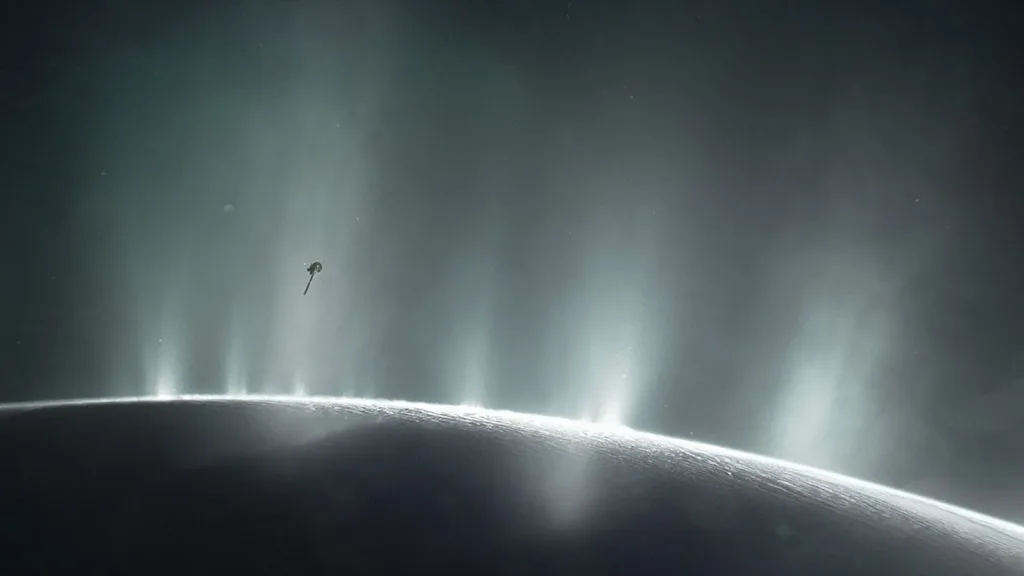
Enceladus hides a salty ocean beneath its ice but also blasts that ocean directly into space.
The Plume Is a Processed Ocean Sample
The word “direct” needs careful use when describing Enceladus ocean plume sampling.
Material in the plume comes from, or remains closely connected to, the subsurface ocean. Yet it changes during its journey through the crust.
Ocean water may form droplets that freeze into grains. Dissolved gases can separate from the liquid at different rates. Water vapour may also condense onto the cold walls of the fractures.
As a result, some compounds become concentrated. Others become depleted before they reach space.
Gas measurements and ice-grain measurements may therefore reveal different parts of the ocean’s chemistry. Scientists cannot simply copy the plume’s measured proportions and call them the exact composition of the sea.
A model discussed in a 2022 study suggested that over 99 percent of the rising water vapour could condense on fracture walls. Other gases would not behave in the same way. Their proportions above the surface could therefore differ from those below.
Individual Ice Grains May Hold Rare Clues
Not every particle in the plume contains the same material.
Cassini found that only a small share of grains carried high concentrations of organic compounds. The source material indicates that roughly 1 to 4 percent showed especially rich organic signals.
That finding matters for future missions.
Combining billions of particles into one bulk sample could weaken rare chemical signatures. A spacecraft may gain more information by analysing each grain separately.
Researchers could then compare particles collected at different locations and times. They could also identify unusual grains that carry concentrated salts, complex organics or other important compounds.
This approach would protect rare signals from disappearing inside an average measurement.
Flyby Speed Changes the Chemical Evidence
Sampling the plume does not involve gently collecting snowflakes.
An ice grain strikes the spacecraft’s instrument at several kilometres per second. The impact vaporises and ionises the particle. Scientists then study the resulting ions to identify its chemical contents.
High speed can reveal hidden compounds. Yet it can also break large molecules into fragments.
During Cassini’s 2008 E5 flyby, the spacecraft crossed the plume at about 17.7 kilometres per second. A 2025 analysis examined 1,519 spectra from that encounter. Researchers identified several families of organic fragments, including oxygen-bearing and aromatic chemistry.
However, the impact speed heavily fragmented some molecules. Scientists could recognise chemical groups, but they could not always reconstruct the original compounds or measure their exact concentrations.
A future spacecraft could cross the plume more slowly. It could also use mass spectrometers with greater resolution and a wider detection range.
Could Enceladus Ocean Plume Sampling Detect Biology?
Laboratory studies suggest that modern instruments may detect extremely small amounts of biological material inside individual ice grains.
In one experiment, researchers placed cold-water bacterial cells inside droplets. They froze the droplets and simulated their impact on a spacecraft instrument.
Recognisable signals remained visible even when a grain contained less than one full cell’s worth of material.
This result does not show that Enceladus contains cells. It also does not prove that alien biology would resemble organisms on Earth.
Instead, the research shows that sensitive instruments could identify tiny biological signatures under controlled conditions.
A convincing result would require several independent clues. Scientists would also need to rule out contamination and non-biological chemical processes.
A Dedicated Mission Would Still Face Challenges
Avoiding deep drilling does not make an Enceladus mission easy.
Saturn lies around 1.4 billion kilometres from the Sun. A spacecraft could take many years to arrive. Sunlight is also weak, while communication delays complicate mission control.
Repeated low-speed plume crossings would demand careful navigation and substantial propulsion. Engineers would also need to keep the spacecraft exceptionally clean.
Even a tiny terrestrial contaminant could produce a misleading chemical signal.
The European Space Agency identified Enceladus as the leading target for its first large-class Voyage 2050 mission concept. Current plans focus on studying the moon’s habitability and searching for possible signs of life. The concept may include an orbiter and a lander, though the mission remains under development.
Enceladus Offers Access to a Hidden Alien Sea
Enceladus ocean plume sampling provides a rare opportunity to study a subsurface ocean without crossing kilometres of frozen crust.
The samples will not reach a spacecraft in an untouched state. Water freezes, gases separate and high-speed impacts fragment molecules. Scientists must account for each of those changes.
Even so, Enceladus continues to release salts, gases, organic compounds and frozen droplets into space.
A clean spacecraft equipped with advanced mass spectrometers could analyse those materials in remarkable detail. It could test the ocean’s habitability and search for complex chemical patterns.
The sea remains hidden below the ice. Its most revealing clues may already be rising into space.
Main Sources:
Space Daily:
https://spacedaily.com/t-enceladus-ocean-plume-sample-without-drilling/
NASA — Enceladus Flyby 21:
https://science.nasa.gov/missions/cassini/enceladus-flyby-21-e-21-deepest-dive-through-the-plume/
NASA — Free Samples from Enceladus:
https://science.nasa.gov/missions/cassini/free-samples/
Nature Astronomy — Organic Compounds in Fresh Enceladus Ice Grains:
https://www.nature.com/articles/s41550-025-02655-y
European Space Agency — Enceladus Top Target for ESA:
https://www.esa.int/Science_Exploration/Space_Science/Saturn_s_moon_Enceladus_top_target_for_ESA/