BY:SpaceEyeNews.
A dark matter hidden force should seemingly help the Universe build galaxies and clusters faster. Stronger attraction would pull dark matter particles together more efficiently. However, a new theoretical study has reached the opposite conclusion.
The proposed force can increase the concentration of dark matter in dense regions. At the same time, it may cause dark matter to become effectively lighter as the Universe expands. This reduces its overall gravitational influence. As a result, the growth of large cosmic structures can slow down rather than accelerate.
The research offers a counterintuitive lesson. Stronger attraction between individual particles does not always produce stronger gravitational structures across the Universe.
Why Researchers Tested a Dark Matter Hidden Force
Scientists mainly understand dark matter through its gravitational influence. They can observe how it shapes galaxies, bends light and affects the cosmic web. Yet current evidence does not prove that gravity is dark matter’s only interaction.
Dark matter may belong to a hidden sector with its own particles and forces. Such forces could remain almost invisible to ordinary matter. However, they could still alter the expansion and structural development of the Universe.
Marco Costa, Cyril Creque-Sarbinowski, Olivier Simon and Zachary J. Weiner explored this possibility. Their study examined minimal models in which dark matter particles experience an additional long-range attraction.
A very light scalar field carries this hypothetical interaction. In simple terms, that field allows dark matter particles to pull on one another through a force beyond standard gravity.
The work appeared in the Journal of Cosmology and Astroparticle Physics. It remains a theoretical investigation rather than a detection of a new force. The researchers studied what such an interaction would do and compared its predictions with cosmological observations.
The Expected Effect on Cosmic Structure
The first prediction seems straightforward.
Small variations in matter density existed in the early Universe. Gravity gradually amplified those variations. Denser regions attracted more material and developed into the cosmic web. Galaxies and clusters later formed within this large-scale framework.
An additional attractive force should strengthen that process. Dark matter would move into dense regions more quickly. Those regions would become more pronounced, and cosmic structure should grow faster.
The calculations confirm part of that expectation. The proposed force does increase the dark matter density contrast. This measurement describes how much denser one region becomes compared with the average cosmic background.
However, density contrast does not tell the entire story. Observatories measure the total gravitational effect of matter. That signal also depends on how much dark matter remains in the background as the Universe evolves.
This second factor changes the conclusion.
Why Stronger Attraction Can Slow Cosmic Growth
The dark matter hidden force produces two competing effects.
First, it draws dark matter particles together more efficiently. Overdense regions become more concentrated. On its own, that process would encourage faster structure formation.
Second, the interaction changes the effective mass of the dark matter particles. As the Universe expands, the particles lose effective mass within these models. The average dark matter energy density therefore falls more quickly than it does in the standard cosmological model.
Dark matter can consequently become more concentrated while exerting less total gravitational influence.
Consider a crowd gathering inside a smaller area. The crowd’s concentration rises. Yet suppose each person becomes lighter at the same time. The group may occupy less space without gaining additional total weight.
A similar balance appears in the researchers’ calculations. The force strengthens local clustering, but the faster decline in background dark matter density offsets that gain.
Weak gravitational lensing shows why this difference matters. Lensing occurs when matter bends light from distant galaxies. It responds to the total density perturbation, not density contrast alone.
Therefore, dark matter may appear more clustered relative to the cosmic background without producing a stronger lensing signal. In the minimal models studied, the two effects can largely cancel during the matter-dominated era.
The Cosmic Microwave Background Adds Another Effect
Any new cosmological model must also match observations of the cosmic microwave background, or CMB.
The CMB preserves information from the early Universe. Its temperature and polarization patterns place tight limits on cosmic expansion, matter density and the initial conditions that later produced galaxies.
The proposed dark force changes the evolution of dark matter density. It also affects the Universe’s expansion history. Researchers must therefore adjust other cosmological quantities to keep the model consistent with CMB measurements.
According to the study, maintaining the correct distance to the surface of last scattering requires a substantially higher dark energy density in the relevant minimal models.
More dark energy increases the expansion rate at later times. That expansion works against the gravitational assembly of matter. Consequently, cosmic structure becomes even more suppressed.
This result makes the mechanism especially surprising. The direct force encourages dark matter particles to cluster. However, the broader cosmological adjustments required by CMB observations can produce less structure overall.
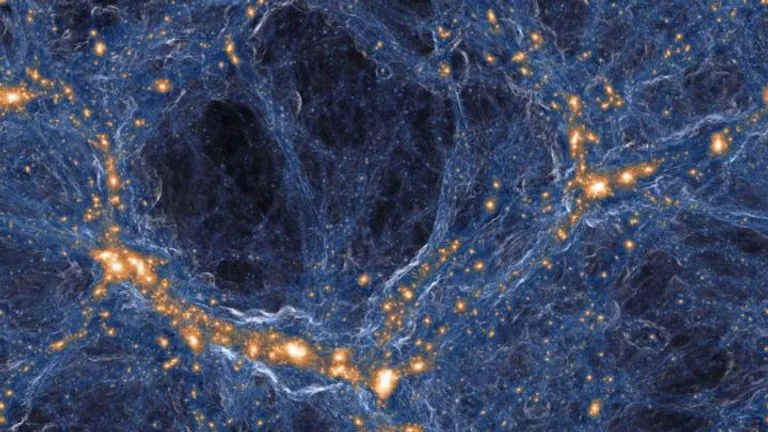
Mystery of dark matter may have been solved by Oxford scientists.
Massive Force Carriers Do Not Offer a Simple Escape
The researchers also studied models with a massive force-carrying field.
A massive mediator can begin oscillating during cosmic evolution. Those oscillations may remove part of the cancellation between increased clustering and faster dark matter dilution.
Still, another problem appears. The mediator can behave like a component of matter that does not cluster efficiently.
Its smooth distribution weakens the total growth of structure. In the models considered, this effect can outweigh the added attraction between dark matter particles. Cosmic growth may then become even slower.
The findings suggest that suppression is not limited to one special mathematical case. Different versions of scalar-mediated dark forces can produce similar observational outcomes through separate physical mechanisms.
What This Could Mean for DESI Results
The study may influence attempts to interpret observations from the Dark Energy Spectroscopic Instrument, or DESI.
DESI maps millions of galaxies and quasars. Its measurements help researchers reconstruct the history of cosmic expansion and investigate whether dark energy has changed over time.
Some proposed explanations for recent DESI results involve interactions between dark matter and scalar fields. The new calculations show that researchers must treat those models carefully.
Adding an attractive interaction does not automatically increase measurable structure. Scientists must calculate its effects on particle mass, background density, dark energy, CMB calibration and gravitational lensing together.
The mechanism may also affect neutrino mass constraints. Cosmologists often infer neutrino properties by studying how structure grows. Any dark-sector interaction that changes this growth could alter those limits.
What the Study Does Not Prove
The research does not confirm the existence of a dark matter hidden force. It also does not identify the dark matter particle or prove that dark matter physically loses mass in our Universe.
Instead, the study explores a defined class of theoretical models. It reveals how those models behave when researchers consider both particle clustering and background cosmic evolution.
More complex models may produce different results. The authors even discuss possible nonminimal extensions that could enhance structure growth. However, those theories would require additional ingredients beyond the simplest setup.
A More Subtle Dark Universe
The central result challenges an intuitive assumption. More attraction does not necessarily mean faster cosmic growth.
A dark matter hidden force could pull particles together while reducing their effective mass. CMB requirements could then demand more dark energy, slowing structure growth further. Even massive force carriers may introduce smooth matter components that weaken clustering.
Future galaxy surveys, lensing maps and CMB observations will continue testing these possibilities. For now, the study shows why scientists must examine the full cosmic system. In the dark Universe, a force that strengthens attraction on one level may weaken structure on another.
Main Sources:
Original research paper, arXiv:
https://arxiv.org/abs/2510.00098
Journal of Cosmology and Astroparticle Physics research announcement:
https://www.eurekalert.org/news-releases/1133097
ScienceDaily summary:
https://www.sciencedaily.com/releases/2026/08/260801042822.htm