BY:SpaceEyeNews.
More than 6,000 exoplanets have now been confirmed beyond our Solar System. Yet the most important discoveries are no longer simply increasing that total. Astronomers can now examine how distant planets form, maintain atmospheres, reshape their surroundings, and gradually lose material.
The stunning exoplanets discovered recently reveal worlds unlike anything nearby. Some orbit in unexpected directions. Others contain magma oceans or trail clouds of rocky dust. One remained hidden in telescope data for more than a decade.
Together, these seven planets show how quickly exoplanet science is changing.
Beta Pictoris d: A Hidden Giant Revealed
Beta Pictoris d demonstrates how a major discovery can remain unnoticed inside existing observations.
Astronomers first identified the planet with the ERIS instrument on the European Southern Observatory’s Very Large Telescope. They then searched older observations from the VLT and the James Webb Space Telescope. Those records showed the planet across an 11-year period.
Beta Pictoris d is about 100 times fainter than Beta Pictoris b, another planet in the system. Its mass is estimated at around 2.4 times that of Jupiter. That makes it one of the lightest exoplanets directly imaged from the ground.
The discovery also gives Beta Pictoris three directly imaged planets. Scientists can now compare worlds that formed around the same young star. This may reveal how planetary mass and orbital distance influence formation.
It also highlights the scientific value of archival data. Better processing methods can uncover planets that earlier searches missed.
BD+05 4868 Ab: A Rocky Planet Losing Material
BD+05 4868 Ab circles its star in only 1.3 days. Its extremely close orbit exposes the planet to intense heat.
Observations from NASA’s TESS mission show unusual and changing dips in the star’s brightness. Astronomers interpret those signals as dust flowing away from the planet. The material forms two comet-like tails that stretch far beyond the rocky world itself.
Scientists do not directly see the planet shrinking. Instead, they measure how the escaping dust blocks different amounts of starlight during each orbit.
The planet may have a molten surface that continuously releases rocky material. Radiation from the star then pushes the smallest particles outward.
BD+05 4868 Ab offers a rare chance to study the interior of a rocky exoplanet. By examining its dust, astronomers may identify minerals that once formed part of the planet.
WISPIT 2b: Watching a Planet Form
Most known exoplanets entered scientific catalogs long after they finished forming. WISPIT 2b gives astronomers a view of an earlier stage.
The young gas giant remains embedded inside the gas-and-dust disk surrounding its star. It has nearly five times Jupiter’s mass and orbits at about 60 times the Earth-Sun distance.
Images show WISPIT 2b inside a gap in the disk. That gap supports the idea that growing planets collect, redirect, and remove material from their surroundings.
The system has become even more valuable since astronomers confirmed a second forming planet, WISPIT 2c. It circles closer to the star and appears more massive than WISPIT 2b.
These two worlds allow researchers to study how several giant planets can develop inside one disk. They may also explain why young planetary systems contain rings, gaps, and other complex structures.
TOI-561 b: An Atmosphere Above a Magma Ocean
TOI-561 b completes an orbit in roughly 0.4 days. It receives intense radiation and likely contains a global or widespread magma ocean.
Astronomers once expected such a small, hot planet to lose nearly all its surrounding gases. However, James Webb Space Telescope observations suggest that TOI-561 b is not a bare rock.
Webb measured heat from the planet’s dayside as it passed behind its star. The observed temperature was lower than researchers expected for an exposed surface. Models indicate that a thick, volatile-rich atmosphere could move heat and reduce the dayside temperature.
The atmosphere may interact directly with molten material below it. Gases released from the interior could also help replace atmospheric material lost over time.
TOI-561 b therefore challenges simple assumptions about ultra-hot rocky planets. Even a world close to its star may preserve a substantial atmosphere under the right conditions.
2M1510 (AB) b: A Planet on a Polar Orbit
2M1510 (AB) b does not simply orbit two unusual objects. Its orbital direction makes the system exceptional.
The planet circles a pair of young brown dwarfs. These objects are more massive than most planets but lack enough mass to sustain normal hydrogen fusion like stars.
Most planets that orbit two objects move in roughly the same plane as their hosts. In this system, the planet follows a polar orbit. Its path sits almost perpendicular to the plane of the brown dwarfs’ motion.
Astronomers inferred the planet’s presence from changes in the brown dwarfs’ orbital movements. The evidence provides the clearest known example of a circumbinary planet following this unusual geometry.
The discovery shows that planetary systems can remain stable even when their orbital arrangements look very different from our Solar System.
K2-18 b: A Continuing Habitability Debate
Among the stunning exoplanets discovered recently, K2-18 b has attracted the greatest discussion about possible habitability.
The planet lies about 120 light-years away and orbits within its star’s habitable zone. Webb observations identified methane and carbon dioxide in its hydrogen-rich atmosphere.
Researchers have also discussed a possible signal linked to dimethyl sulfide, or DMS. On Earth, biological processes produce much of this molecule. However, a possible detection is not evidence of life.
Scientists must first confirm the signal and rule out non-biological chemistry. They must also understand the planet’s pressure, clouds, temperature, interior, and atmospheric structure.
K2-18 b may be a Hycean world with a deep ocean beneath a hydrogen-rich atmosphere. That interpretation remains under study. Regardless of the outcome, it remains a major target for atmospheric research.
L 98-59 d: A Sulfur-Rich Molten World
L 98-59 d may represent another unfamiliar type of rocky planet.
The super-Earth lies about 35 light-years away. Recent studies suggest that it could contain a long-lived magma ocean beneath a volatile-rich atmosphere.
Initial Webb data produced tentative evidence for sulfur-bearing gases. These may include sulfur dioxide and hydrogen sulfide, which could come from material released by the planet’s interior.
However, scientists have not yet confirmed the exact atmospheric composition. Additional observations will test whether volcanic outgassing can explain the available evidence.
If the interpretation holds, L 98-59 d could connect atmospheric chemistry with processes occurring deep inside rocky exoplanets. It may also help researchers understand how magma oceans survive and evolve over long periods.
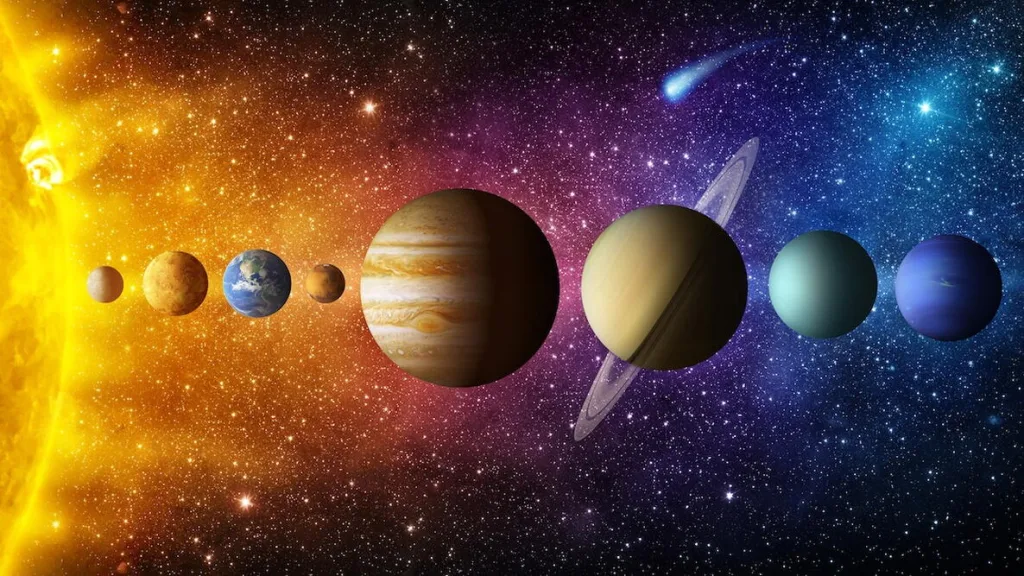
Discover the Planets in Order From the Sun.
Stunning Exoplanets Discovered Recently Reveal a New Era
These seven worlds represent more than a collection of cosmic curiosities.
Beta Pictoris d shows what may remain hidden in archived observations. WISPIT 2b reveals planetary formation in progress. BD+05 4868 Ab exposes material from a rocky world, while TOI-561 b challenges expectations about atmospheric survival.
Meanwhile, 2M1510 (AB) b expands the known range of orbital structures. K2-18 b tests the limits of atmospheric biosignature research. L 98-59 d may reveal a direct connection between a magma ocean and sulfur-rich gases.
The stunning exoplanets discovered recently show that planetary systems can follow many different paths. Modern astronomy is no longer focused only on finding distant worlds. It is beginning to reconstruct their formation, environments, interiors, and possible futures.
Main Sources:
European Southern Observatory — Beta Pictoris d:
https://www.eso.org/public/news/eso2609/
NASA Exoplanet Catalog — BD+05 4868 A b:
https://science.nasa.gov/exoplanet-catalog/bd05-4868-a-b/
NASA TESS Weekly Bulletin — BD+05 4868 Ab:
https://heasarc.gsfc.nasa.gov/docs/tess/tess-weekly-bulletin-mar-31st.html
European Southern Observatory — WISPIT 2 system:
https://www.eso.org/public/news/eso2604/
NASA Webb — TOI-561 b atmosphere:
https://science.nasa.gov/missions/webb/nasas-webb-detects-thick-atmosphere-around-broiling-lava-world/
European Southern Observatory — 2M1510 (AB) b:
https://www.eso.org/public/news/eso2508/
NASA Webb — K2-18 b atmospheric molecules:
https://science.nasa.gov/missions/webb/webb-discovers-methane-carbon-dioxide-in-atmosphere-of-k2-18-b/
Space Telescope Science Institute — L 98-59 d follow-up program:
https://www.stsci.edu/files/live/sites/www/files/home/jwst/science-execution/approved-programs/general-observers/cycle-5-go/_documents/jwst-cycle5-general-observer-abstracts.pdf
NASA Exoplanets — Confirmed planet total:
https://science.nasa.gov/exoplanets/