BY:SpaceEyeNews.
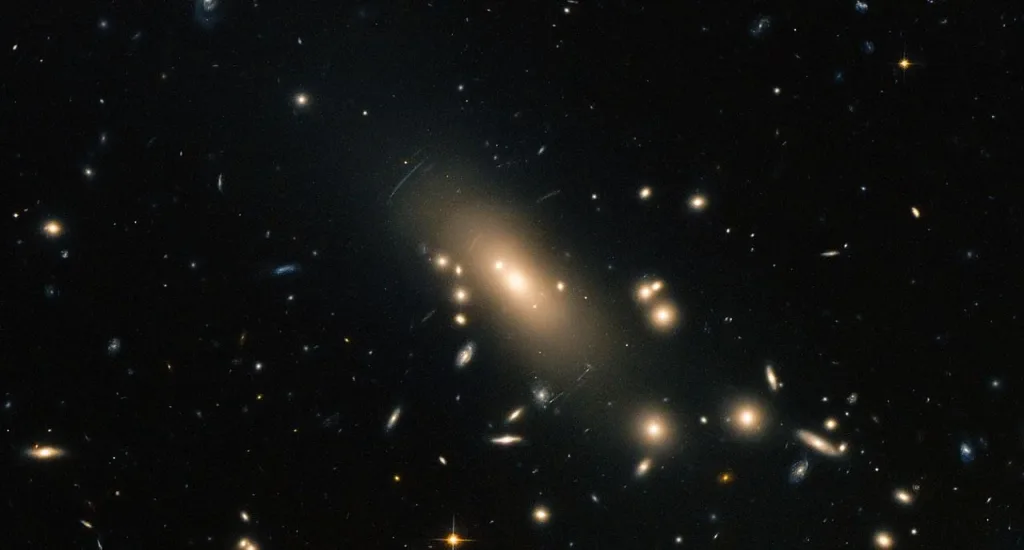
Astronomers have produced the deepest images yet of IC 1101, the largest known galaxy, and finally identified a measurable boundary around its main stellar body. The enormous galaxy spans about 520 kiloparsecs, or nearly 1.7 million light-years. It also contains an estimated 3.4 trillion solar masses in stars.
However, the result offers more than a new size record. The images reveal faint structures beyond the galaxy’s main edge. Those features suggest that this cosmic giant is still collecting material and increasing in size.
The research team posted its findings to the arXiv preprint server on July 16, 2026. Therefore, the results have not yet completed formal peer review. Still, the study provides the clearest measurement so far of one of the universe’s most extreme galaxies.
Why IC 1101 Largest Known Galaxy Was Hard to Measure
IC 1101 sits at the center of Abell 2029, a large galaxy cluster located hundreds of millions of light-years from Earth. It belongs to a class known as brightest cluster galaxies. These galaxies usually dominate the central regions of massive clusters.
Over billions of years, such systems grow by absorbing smaller galaxies and collecting stars from repeated interactions. As a result, they develop broad and extremely faint outer envelopes.
That faint light creates a major measurement problem. The outskirts of a central galaxy gradually blend into intracluster light. This light comes from stars that move through the cluster without clearly belonging to one galaxy.
Consequently, astronomers cannot simply point to a sharp line and declare that the galaxy ends there. Its brightness slowly fades into the surrounding environment.
Previous studies already showed that IC 1101 was exceptionally large. Yet they produced different estimates because researchers used different definitions of galaxy size.
Some measurements rely on the radius that contains half of a galaxy’s light. Others use a fixed brightness limit. A third method tracks the faint stellar halo as far as instruments can detect it.
For this reason, the phrase “largest galaxy” needs context. A galaxy may appear larger or smaller depending on the measurement method. The new study aimed to find a physical transition in IC 1101’s stellar profile rather than relying only on an arbitrary brightness limit.
How Astronomers Found IC 1101’s True Edge
The team used ultra-deep observations from the Wide Field Camera on the Isaac Newton Telescope. The images covered two optical wavelength bands known as g and r.
These observations reached exceptionally faint surface-brightness levels. That sensitivity allowed astronomers to examine regions that usually disappear into the background.
Yet greater sensitivity also introduces new challenges. Light from bright foreground stars can scatter inside a telescope and spread across the image. The galaxy’s bright central region can create a similar glow.
Without careful correction, this scattered light may resemble a faint stellar halo. It may also hide genuine structures in the galaxy’s outskirts.
Removing Scattered Starlight
To solve the problem, the researchers built a detailed model of the telescope’s point spread function. This model describes how light from a source spreads across the detector.
They used stars with different brightness levels to trace that scattered glow over large distances. The team then removed contamination from more than 250 foreground stars.
In addition, the researchers applied a wavelet-based deconvolution method. This technique helped separate real low-brightness structures from unwanted optical effects.
After cleaning the images, they measured how surface brightness, color and stellar mass density changed with distance from the center. They also examined the galaxy from several directions instead of relying on a single radial profile.
Multiple indicators showed a clear transition at about 260 kiloparsecs along the galaxy’s semi-major axis. Doubling that radius gives a total projected diameter of approximately 520 kiloparsecs.
How Large Is the Largest Known Galaxy?
A diameter of 520 kiloparsecs equals roughly 1.7 million light-years. That places IC 1101 at the extreme upper end of the known relationship between galaxy mass and size.
The study estimates that the region inside the measured edge contains about 3.4 trillion solar masses in stars. That figure refers only to stellar material. It does not include the galaxy’s full dark matter contribution.
Comparisons with the Milky Way require care. Our galaxy’s familiar bright stellar disk measures about 100,000 light-years across. IC 1101 is therefore around 17 times wider than the Milky Way’s commonly quoted disk diameter.
However, the Milky Way also has a faint stellar halo and a much larger dark matter halo. Those components extend far beyond the bright disk.
For that reason, saying IC 1101 is 17 times wider than every part of the Milky Way would be misleading. The comparison works best when both measurements refer to visible stellar structures.
Even with that qualification, the scale remains extraordinary. The stellar mass of IC 1101 alone exceeds the estimated total mass of the Milky Way cited in many current models. Yet those Milky Way estimates carry uncertainty and include dark matter, so the values should not be treated as a direct like-for-like comparison.
The new measurement makes IC 1101 a valuable test case. It may help astronomers understand the maximum size that a galaxy can reach in the present-day universe.
IC 1101 Is Still Growing
Perhaps the most interesting result lies beyond the measured edge.
The team found several large, faint and asymmetric structures surrounding the main galaxy. These features do not form a smooth, settled halo. Instead, they resemble debris left by earlier interactions.
Some of the structures also align with disturbances detected in the hot X-ray-emitting gas inside Abell 2029. That connection suggests that the galaxy’s visible outskirts and the surrounding cluster environment share the same complex history.
Evidence of Ongoing Assembly
Central cluster galaxies grow through a gradual process. They absorb smaller systems, capture stars and collect material stripped during close encounters.
The outer structures around IC 1101 appear to preserve evidence of that process. They indicate that the galaxy has not reached a final, stable form.
Earlier X-ray research also found signs of a large-scale disturbance in Abell 2029. One possible explanation involves an encounter with another galaxy group several billion years ago.
The new optical images do not identify the exact origin of every faint structure. More observations will be needed to determine their ages and histories.
Nevertheless, the overall pattern supports ongoing mass assembly. IC 1101 may already be the largest known galaxy under this measurement method, but its outskirts suggest that it continues to expand.
What IC 1101 Reveals About Galaxy Growth
The new images provide the strongest measurement yet of the main stellar boundary of IC 1101, the largest known galaxy. They also demonstrate how difficult it is to define the edge of a galaxy embedded inside a rich cluster.
By correcting scattered light and tracing several stellar properties, astronomers placed the edge about 260 kiloparsecs from the center. That produces a diameter of nearly 1.7 million light-years.
More importantly, IC 1101 does not appear complete. Its faint outer structures show that even the universe’s largest galaxies can keep evolving.
Future observations may refine the exact boundary. Formal peer review could also adjust parts of the analysis. For now, however, IC 1101 offers a remarkable view of how far galaxy growth can go—and how the largest cosmic structures continue to assemble long after they first formed.
Main Sources:
Original research paper:
https://arxiv.org/abs/2607.15340
Full HTML version of the research:
https://arxiv.org/html/2607.15340v1
Phys.org research summary:
https://phys.org/news/2026-07-astronomers-full-size-largest-galaxy.html
Earlier IC 1101 core study:
https://arxiv.org/abs/1707.02277