BY:SpaceEyeNews.
Apollo astronauts collected Moon rocks to help scientists understand lunar history. More than half a century later, those samples may reveal something unexpected about our own planet.
A new analysis suggests that lunar soil could preserve material from Earth’s ancient atmosphere. The particles may date to the Archean eon, around 3.5 billion years ago. At that time, Earth’s air, oceans, climate, and young biosphere looked very different from those of today.
The reported results point to an atmosphere rich in sulfur, carbon dioxide, and methane. Together, these gases may explain how early Earth kept liquid oceans beneath a dimmer young Sun. However, the detailed findings remain preliminary. Researcher Jared Landry presented them at the Origins 2026 conference, and they have not yet completed peer review.
How Earth’s Ancient Atmosphere Reached the Moon
Earth constantly loses small amounts of material from its upper atmosphere. Solar radiation can remove electrons from gas atoms and molecules, turning them into electrically charged ions.
These particles can then move through the space environment surrounding Earth. Some eventually reach the Moon, where they become implanted in lunar soil.
Scientists once thought Earth’s magnetic field mainly blocked this transfer. More recent modeling offers a different picture. The magnetic field may also guide atmospheric ions toward the Moon through Earth’s magnetotail.
The magnetotail forms on the night side of Earth as the solar wind stretches the planet’s magnetic field away from the Sun. The Moon passes through this region near its full phase. During that part of its orbit, the transfer of atmospheric particles appears to become more efficient.
A 2025 peer-reviewed study used three-dimensional simulations to examine this process. The researchers found that terrestrial atmospheric ions could reach the Moon throughout much of Earth’s magnetic history. They also concluded that lunar soils may preserve a long-term record of Earth’s changing atmosphere.
Why Apollo’s Near-Side Samples Matter
All six Apollo landing sites lie on the Moon’s near side, which always faces Earth. That position makes the collected samples especially relevant when searching for particles that originated from our planet.
Still, the process is not as simple as a steady stream flowing directly from Earth to the lunar surface. Particle transport changes with solar activity, magnetic conditions, atmospheric structure, and the Moon’s orbital position.
Researchers must reconstruct those variables before estimating how much material came from Earth’s ancient atmosphere.
Why the Moon Preserves Earth’s Missing History
Earth offers only a limited direct record of its earliest atmosphere. Plate tectonics continually recycles crust. Erosion wears down ancient landscapes, while water, heat, and biological activity alter minerals and sediments.
The Moon experiences none of these processes on the same scale. It has no oceans, rainfall, or active global plate tectonics. As a result, lunar regolith can preserve implanted particles for extremely long periods.
NASA already studies lunar soil as an archive of ancient solar activity. Solar-wind particles and cosmic radiation leave chemical and physical signatures inside exposed grains. Regolith buried beneath lava or impact material can protect those signatures from later alteration.
Apollo samples therefore contain more than a record of the Moon. They may hold traces of the Sun, meteorites, and Earth itself.
Lunar Soil Is Not a Perfect Time Capsule
The Moon’s surface remains active in subtle ways. Small meteorites constantly strike and mix the upper regolith. Solar radiation changes exposed grains, while larger impacts can heat, bury, or redistribute material.
Solar wind and meteorites can also deliver many of the same elements that researchers seek. That creates a difficult identification problem.
Scientists must calculate the expected contribution from every known source. Any remaining material may have come from Earth, but researchers still need chemical or isotopic evidence to confirm that origin.
Apollo Samples Point to a Sulfur-Rich Atmosphere
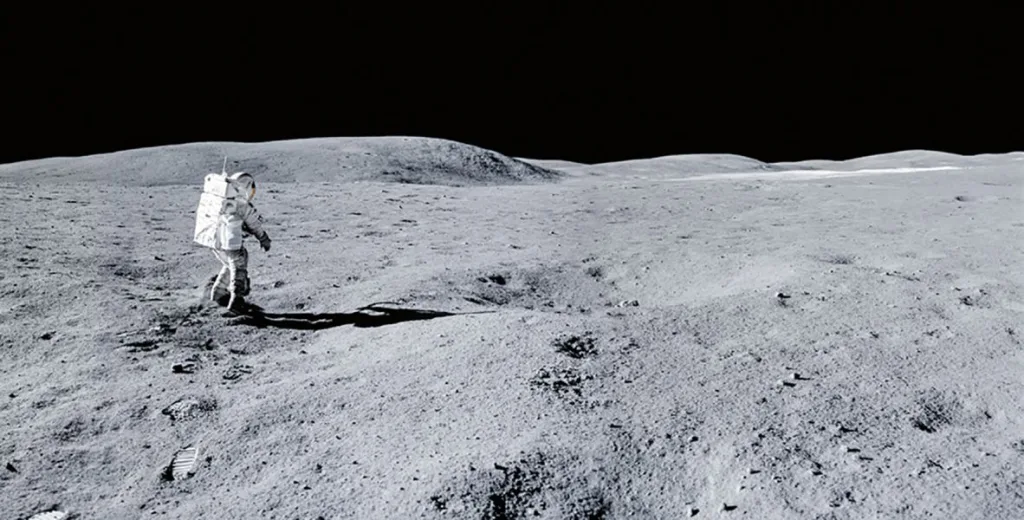
Earth’s oldest rock was found by Apollo 14 astronauts – on the moon.
Landry’s reported analysis focused on material found in Apollo lunar samples. His model considered ancient solar-wind conditions, meteoritic dust, regolith exposure, and other possible sources.
After accounting for those contributions, the unexplained material reportedly supported an atmosphere containing much more sulfur than today.
That result fits a broader scientific picture of the Archean as a low-oxygen world with an active sulfur cycle. Geological studies show that sunlight processed sulfur gases in the early atmosphere. Volcanic activity also supplied sulfur compounds, while oceans and hydrothermal systems redistributed them.
What Sulfur Meant for Early Oceans
Sulfur could have influenced the chemistry available in ancient seas. Certain sulfur compounds participate in reactions that produce complex organic molecules. Iron-sulfur minerals may also have supported chemical pathways important to early metabolism and prebiotic chemistry.
This does not mean sulfur directly created life. Instead, a sulfur-rich environment may have expanded the range of possible reactions before and during life’s early development.
The model raises another question. Sulfur does not remain in an atmosphere easily under modern Earth conditions. Landry suggested that its persistence may have required a weaker water cycle or a cooler climate.
Either possibility would make Archean Earth very different from the warm, rain-driven planet people often imagine.
Earth’s Ancient Atmosphere and the Faint Young Sun
Around 3.5 billion years ago, the Sun produced much less energy than it does today. Yet geological evidence shows that Earth maintained liquid water.
This apparent contradiction is known as the faint young Sun paradox. Scientists have proposed several possible solutions, but greenhouse warming remains central to most explanations.
Landry’s calculations reportedly suggest that Archean Earth contained around 100 times more carbon dioxide than the modern atmosphere. Methane could have supplied additional warming.
NASA notes that higher concentrations of carbon dioxide, methane, and water vapor may have helped early Earth retain enough heat for liquid oceans. Some climate models also show that carbon dioxide combined with smaller amounts of methane could provide substantial warming.
One New Constraint, Not a Final Answer
The Apollo analysis does not settle the faint young Sun paradox. Estimates of Archean carbon dioxide vary, and no single climate model explains every geological observation.
Clouds, ocean chemistry, atmospheric pressure, surface reflectivity, organic haze, and other gases may also have influenced global temperatures.
For that reason, the reported carbon dioxide estimate should be treated as a potential new constraint. Peer review must confirm the model, its assumptions, and the interpretation of each sample.
What Scientists Need to Test Next
The first priority is publication of the full study. Researchers need to examine the sample list, calculations, exposure ages, and methods used to separate terrestrial material from solar and meteoritic sources.
Isotopic measurements may provide stronger evidence. Different sources can carry distinctive isotope ratios, allowing scientists to identify material that likely came from Earth.
Future lunar missions could offer even better samples. Deep cores and buried ancient regolith may preserve clearer time-separated records than surface soil. Samples from new locations could also reveal whether the atmospheric signature appears across the near side.
Scientists may eventually apply the same approach to other planetary systems. Mars and Phobos offer one possible example. Material lost from the Martian atmosphere may have reached its small moons and survived inside their surfaces.
Earth’s Ancient Atmosphere May Still Be on the Moon
Apollo samples continue to produce discoveries long after astronauts returned them to Earth. Their value now extends beyond lunar geology.
The Moon may preserve particles from periods that Earth can no longer record directly. If the sulfur and carbon dioxide results survive peer review, they could improve our understanding of Archean climate, ocean chemistry, and early biological environments.
For now, the findings remain a promising reconstruction rather than a confirmed description. Even so, they strengthen a remarkable idea: part of Earth’s ancient atmosphere may still exist inside the soil of the Moon.
Main Sources
Universe Magazine:
https://universemagazine.com/en/analysis-of-apollo-samples-confirmed-the-hypothesis-about-earths-ancient-atmosphere/
Communications Earth & Environment — Terrestrial atmospheric ion implantation in lunar regolith:
https://www.nature.com/articles/s43247-025-02960-4
NASA Science — Record of the Ancient Sun:
https://science.nasa.gov/lunar-science/focus-areas/record-of-the-ancient-sun/
NASA Science — The Faint Young Sun Paradox:
https://science.nasa.gov/astrobiology/learning-resources/alp/sun-when-it-formed/
NASA Astrobiology — Warming the Early Earth for Life:
https://astrobiology.nasa.gov/news/warming-the-early-earth-for-life/
Nature Reviews Earth & Environment — Early atmosphere and hydrosphere:
https://www.nature.com/articles/s43017-026-00803-0