
BY:SpaceEyeNews.
Chinese astronomers have found that the Milky Way’s distant gas disk is far less orderly than earlier models suggested. Instead of following one smooth bend, the outer region contains enormous vertical waves layered over its familiar warp.
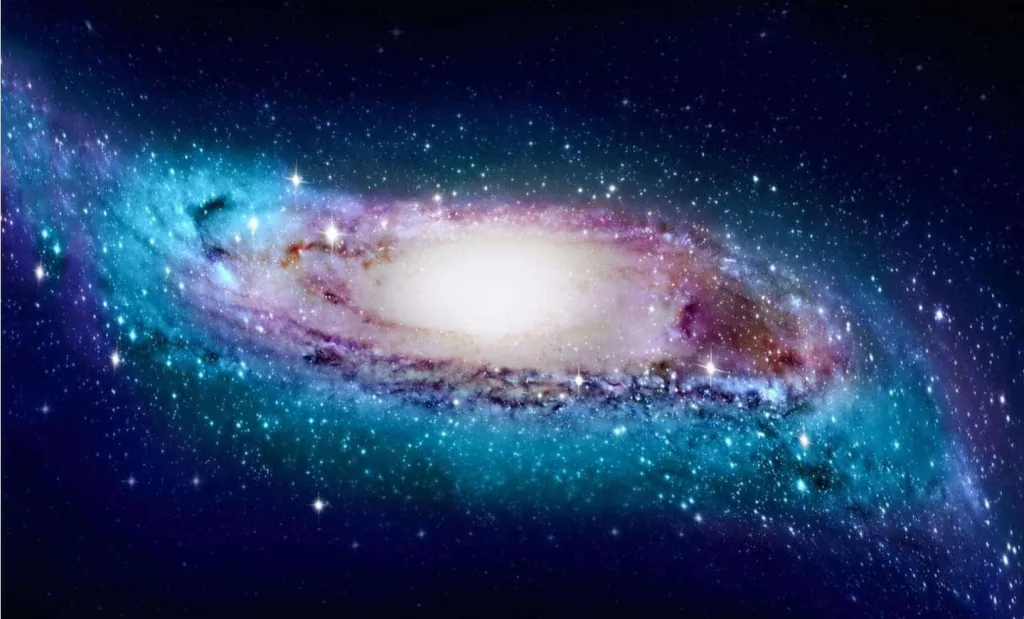
The newly mapped Milky Way outer disk ripples stretch across vast sections of cold molecular gas. Some rise or fall hundreds of light-years from the modeled galactic plane. Their scale suggests connected features, not unrelated clouds.
Milky Way Outer Disk Ripples Complicate the Familiar Warp
Astronomers have known for decades that the Milky Way’s outer disk is warped. Its edges curve away from a flat plane and twist farther from the galactic center.
A warp, however, is only the broadest part of the structure. The new study reveals smaller vertical corrugations superimposed on it. These corrugations resemble long waves that carry material above and below the average disk.
The dominant warp previously made subtle changes difficult to separate. The latest results replace the image of one smoothly curved disk with something more layered. The Milky Way now appears to contain a broad warp plus ripples at several scales.
Mapping the Milky Way’s Cold Molecular Gas
The Purple Mountain Observatory team analyzed more than 30,000 molecular clouds. The observations came from the Milky Way Imaging Scroll Painting survey, known as MWISP.
MWISP uses China’s 13.7-meter millimeter-wave telescope to detect emissions from carbon monoxide molecules. The survey observes several CO molecular lines across the northern galactic plane.
Carbon monoxide traces cold molecular gas. Molecular hydrogen makes up most of these clouds, but it is difficult to detect directly under typical cold conditions. CO therefore helps astronomers map gas linked to future star formation.
Removing the Large Galactic Warp
Finding the smaller waves required more than plotting cloud positions. First, the researchers constructed a global model of the outer CO disk’s warp.
They then subtracted that broad structure from the measured cloud distribution. Clear residual displacements remained. Many formed coherent patterns across large distances, showing that the signals were not simply random irregularities.
The team also tested different disk thicknesses and mass-weighting methods. It made the cloud catalogue and modelling code public, allowing other researchers to examine the analysis.
How Large Are the Milky Way Outer Disk Ripples?
The measurements reveal structures on a genuinely galactic scale. Typical vertical amplitudes range from about 100 to 200 parsecs. That equals roughly 326 to 652 light-years.
Their radial wavelengths extend from approximately 3.9 to 7.9 kiloparsecs, or about 12,700 to 25,800 light-years. Some spiral-arm regions show vertical offsets close to 200 parsecs.
The team also identified a coherent azimuthal pattern around 12.7 kiloparsecs from the galactic center. This feature extends for about 40 kiloparsecs, equal to roughly 130,000 light-years, along the curved disk.
Its total traced extent should not be confused with its wavelength. At that radius, the measured azimuthal wavelength is about 11.6 kiloparsecs. These dimensions show that the corrugations organize many clouds across immense regions.
What Could Have Created the Galactic Corrugations?
The observations establish that widespread corrugations exist. Their exact origin remains uncertain.
The researchers consider bending waves produced by gravitational disturbances the leading explanation. A galactic disk can respond to an outside influence by developing long vertical motions. Those patterns may remain visible long after the original event.
Interactions with surrounding objects could provide such an influence. However, the study does not identify one satellite galaxy or event as the confirmed source. Internal processes, including spiral structure, may also contribute.
The distinction is important. Astronomers directly measured coherent offsets in the molecular gas. The idea that external gravity generated them remains an interpretation that future work must test.
The Milky Way is not rippling rapidly like water. These structures instead represent the slow response of a disk spanning tens of thousands of light-years.
Why These Ripples Matter for Galactic History
The Milky Way outer disk ripples may preserve a record of earlier changes. Their positions, amplitudes, and wavelengths could reveal what kinds of gravitational influences shaped the disk.
Scientists can use these waves and motions to infer events that are no longer directly visible. Combining gas measurements with stellar data can make that reconstruction stronger.
The result also matters for models of spiral arms and gas movement. Cold molecular clouds provide material associated with star formation. Their vertical distribution may affect how astronomers interpret conditions across the outer galaxy.
Researchers have also observed corrugated structures in other disk galaxies. Our own galaxy offers a nearby laboratory for investigating how these patterns develop.
What Astronomers Need to Measure Next
More precise velocity data could show how these molecular structures move through the disk. Comparisons with atomic hydrogen, young stars, and other tracers may reveal whether each component follows the same waves.
Numerical simulations can test which external interactions or internal processes reproduce the observed scales.
Distance estimates remain another challenge. The team used kinematic distances, which connect gas velocities with galactic rotation models. Noncircular motions can introduce uncertainty. Future surveys can refine the three-dimensional map and test individual features.
Milky Way Outer Disk Ripples Reveal a Dynamic Galaxy
The discovery shows that the Milky Way’s outer molecular disk combines a broad warp with widespread vertical corrugations. It is a layered and evolving structure, not one simple curve.
Astronomers know the waves exist but have not confirmed their source. By tracing their motion and comparing them with stars and atomic gas, researchers may recover new details of galactic history. The Milky Way outer disk ripples could ultimately reveal how repeated gravitational influences shaped the galaxy we see today.
Main Sources:
Nature Astronomy:
Widespread corrugations superimposed on the Galactic warp in the outer CO disk
Purple Mountain Observatory, Chinese Academy of Sciences:
Official research announcement
Chinese Academy of Sciences:
China Releases Observation Data of Galactic Millimeter-Wave Molecular Lines
CGTN:
Milky Way’s outer disk isn’t the smooth curve we thought