
BY:SpaceEyeNews.
The August 12, 2026 Solar Eclipse will bring complete totality to Greenland, Iceland, northern Spain, and several other locations. However, the most memorable phase will last for only one or two minutes in many popular destinations. That makes precise timing essential. Millions across Europe will also experience a deep partial eclipse. Some cities will see more than 90% of the Sun’s disk covered as the eclipse approaches sunset.
Where the August 12, 2026 Solar Eclipse Will Be Total
The path of totality will begin in the Arctic region. It will then cross a remote section of northern Russia before reaching Greenland and western Iceland.
From Iceland, the Moon’s central shadow will continue across the Atlantic Ocean. It will enter northwestern Spain and travel east across the country. A small corner of northern Portugal also falls within the totality path.
NASA calculates that the greatest phase will occur at approximately 17:47 UTC. The longest possible totality anywhere along the path will reach about 2 minutes and 18 seconds.
However, most accessible viewing locations will receive a shorter total phase. The duration depends on the observer’s exact position. Locations closer to the center of the path usually experience longer totality.
Exact Eclipse Times for Popular Destinations
Local timing will determine whether viewers witness complete totality or arrive moments too late. These are the key times for several popular destinations:
| Location | Totality begins | Duration |
|---|---|---|
| Scoresby Sund, Greenland | 4:35 p.m. | 1 minute 46 seconds |
| Snæfellsjökull, Iceland | 5:45 p.m. | 2 minutes 10 seconds |
| Reykjavik, Iceland | 5:48 p.m. | 1 minute 1 second |
| Gijón, Spain | 8:26 p.m. | 1 minute 46 seconds |
| A Coruña, Spain | Around 8:27 p.m. | 1 minute 15 seconds |
| Burgos, Spain | Around 8:28 p.m. | 1 minute 44 seconds |
| Mallorca, Spain | Around 8:31 p.m. | 1 minute 36 seconds |
All times in this table are local. Exact circumstances may differ by several seconds across a city or island.
Snæfellsjökull offers the longest totality among these listed destinations. Reykjavik receives a shorter total phase because of its position within the shadow path.
In Greenland, Scoresby Sund lies inside the totality zone. However, Nuuk remains outside it and will receive a partial eclipse of around 79%.
Spain Will See Totality Near Sunset
Northern Spain offers one of the eclipse’s most dramatic settings. Yet it also creates one of its greatest viewing challenges.
Spain sits near the end of the Moon’s shadow path. Therefore, totality will arrive when the Sun appears low in the western sky.
Spain’s National Geographic Institute calculates that the Sun will stand about 12 degrees above the horizon in A Coruña. It will appear only around 8 degrees high in Burgos.
Conditions become even tighter in Palma. Maximum eclipse will occur at approximately 8:32 p.m., shortly before sunset. The Sun will stand only about 2 degrees above the horizon.
Buildings, hills, trees, haze, or clouds could easily hide the event. Observers should choose a location with an open western horizon. They should also inspect the site before eclipse day.
The event carries historical significance for Spain. It will become the first total solar eclipse visible from the Iberian Peninsula in more than a century.
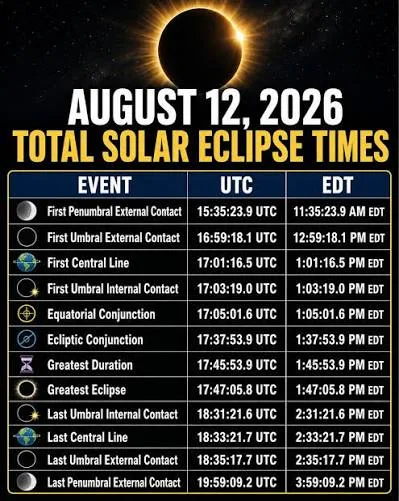
Total Solar Eclipse Times – August 12, 2026 One of the most spectacular celestial events of the decade .
Partial Eclipse Times Across Europe
Much of Europe lies outside the narrow totality path. Nevertheless, many major cities will see most of the Sun’s disk covered.
London will reach maximum eclipse at around 7:13 p.m., with approximately 91% coverage. Dublin will reach about 94% at 7:10 p.m. Lisbon will also receive roughly 94% coverage, peaking near 7:36 p.m.
Paris will see around 92% coverage at 8:17 p.m. Berlin will reach approximately 84% to 85% at 8:08 p.m. Nice will experience about 95% coverage at 8:24 p.m.
Northwestern Africa will also receive a major partial eclipse. Tangier will see roughly 92% of the Sun’s disk covered at around 7:40 p.m.
North America receives a smaller partial event. New York City will see approximately 9% coverage at 1:54 p.m. St. John’s in Newfoundland will reach about 53% at 3:35 p.m.
Why 99.96% Coverage Is Not Totality
Madrid will reach approximately 99.96% coverage at 8:32 p.m. Barcelona will reach about 99.82% at 8:29 p.m.
Those figures sound almost identical to totality. Visually, however, the difference remains enormous.
Even a very thin uncovered section of the Sun produces intense light. The sky will not become as dark as it does inside the totality path. Viewers will also miss the complete appearance of the solar corona.
Madrid and Barcelona therefore remain partial-eclipse locations. Observers in both cities must keep their eclipse glasses on throughout the event.
How to Prepare for the Solar Eclipse
Viewers should arrive long before maximum eclipse. The listed times show when totality begins or when maximum partial coverage occurs. They do not show the beginning of the entire eclipse.
Check the exact timing for your coordinates. A nearby city may experience slightly different circumstances. The edge of the totality path can also pass between neighboring towns.
Weather will play a crucial role, especially in Iceland and northern Spain. Monitor official cloud forecasts as August 12 approaches. If possible, prepare an alternative location within reasonable traveling distance.
Use certified eclipse glasses during every partial phase. Cameras, binoculars, and telescopes need solar filters fitted securely over the front of their lenses. Eclipse glasses alone cannot protect someone looking through unfiltered optical equipment.
Only viewers inside the totality path may remove eye protection during confirmed totality. Glasses must go back on as soon as the bright Sun begins to reappear.
Conclusion
The August 12, 2026 Solar Eclipse will reward viewers who choose their location carefully. Greenland and Iceland offer afternoon and early-evening totality. Northern Spain provides a spectacular sunset setting, although the low Sun creates extra challenges.
London, Paris, Dublin, Lisbon, and other European cities will receive deep partial coverage. Madrid and Barcelona will come extremely close to totality but will remain outside it.
Because complete totality lasts only briefly, every second matters. Confirm your local timing, find a clear horizon, monitor the weather, and prepare approved solar protection in advance.
Main sources:
NASA – Total Solar Eclipse on August 12, 2026
NASA GSFC – Solar Eclipses from 2021 to 2030
Spain’s National Geographic Institute – August 12 Eclipse
Timeanddate – August 12, 2026 Total Solar Eclipse