
BY:SpaceEyeNews.
A hidden galaxy in Webb data first appeared to belong to the early universe. However, improved measurements changed that interpretation. The elongated object, called A1, now appears to sit at a redshift of about 1.4, not 4.4. Researchers therefore see it as it existed roughly nine billion years ago. The discovery reveals both the scientific value and the hidden risks inside public telescope archives.
Hidden Galaxy in Webb Data Found in a Public Archive
Astrophysicist Homer Dávila Gutiérrez found A1 while examining public images from the James Webb Space Telescope. Webb’s Near-Infrared Camera collected the observations under General Observer program GO-5293. That program targeted the massive galaxy cluster MACS J0308.9+2645 on February 4, 2025.
The search covered 54 public JWST/NIRCam fields and evaluated 1,591 extended sources. Only A1 and a weaker source named A2 survived as strong arc candidates.
A1 also lacked an entry in SIMBAD, NED, VizieR, and the cluster’s published multiple-image inventory. Here, “uncatalogued” means no previous classification appeared in the records checked. The findings appear in a revised arXiv preprint, which has been submitted to PASJ but has not yet completed peer review.
A Shape Consistent With Gravitational Lensing
A1 immediately stood out because of its stretched appearance. Its length reaches about 5.1 arcseconds when researchers include its fainter outer light. It also has an axis ratio of about 6.5, making it far longer than it is wide.
The object lies 50.9 arcseconds from the cluster’s X-ray center. Its long axis sits almost perfectly tangential to that center, within about 1.4 degrees. Such an orientation matches the pattern expected when a galaxy cluster stretches the light of a background galaxy.
Webb and Hubble images recovered the same source, ruling out a simple detector artifact. A1 also appears to curve toward the cluster center. Yet correlated image noise makes this curvature suggestive rather than established.
Why the Galaxy Initially Looked Much Older
The first analysis produced a photometric redshift near 4.4. The estimate came from EAZY, software that compares brightness across several filters with expected galaxy spectra.
However, the software received unsuitable measurements. The catalog’s aper_total photometry was designed for unresolved, point-like sources. A1 is a long, extended object. Small catalog apertures therefore captured only a fraction of its total light.
In Webb’s F200W filter, the aperture retained about 3% of A1’s isophotal flux. The effective aperture also increased at longer wavelengths. It therefore captured more light in redder filters than in bluer ones.
That changing aperture imposed about 1.4 magnitudes of artificial red color. EAZY interpreted this false redness as evidence for a much more distant galaxy. The high-redshift result was therefore a measurement artifact, not a newly confirmed early-universe object.
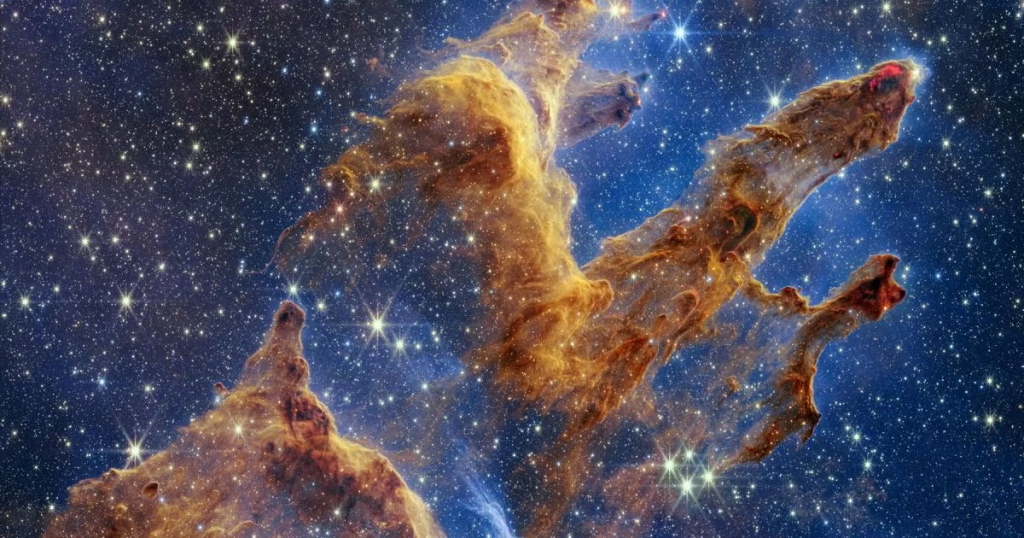
James Webb Space Telescope: The Story Unfolds | South Carolina State Museum.
Corrected Photometry Changed the Redshift
The researcher remeasured A1 with methods suited to extended sources. These included isophotal measurements, fixed matched apertures, point-spread-function matching, and curve-of-growth photometry. All four approaches produced consistent results.
Webb-only measurements gave a best photometric redshift near 1.53. Adding archival Hubble data supported a lower value. The revised preprint adopts z ≈ 1.4, with a plausible range from 1.2 to 1.7.
This correction offers a broader warning. Automated software can return a precise-looking answer even when the input measurement does not fit the source. Researchers must first ask whether the chosen photometry captures the object correctly.
Hubble Data Tested the Hidden Galaxy in Webb Data
Hubble supplied an independent check. A1 appears clearly in its F435W filter. If the galaxy sat at z = 4.4, intervening hydrogen would absorb its light in that band. Astronomers should see a complete dropout, but they detected the arc.
The cluster’s public lens model provided another test. At z = 4.4, the model predicts a bright counter-image at an observable location. No matching object appears there.
At z ≈ 1.4, the same model predicts a single visible image without a counter-image. That outcome agrees with the observations. Earlier Hubble observations and lens models for MACS J0308.9+2645 are available through the official RELICS archive.
What A1 Most Likely Is
The strongest interpretation describes A1 as a singly lensed background galaxy. MACS J0308.9+2645 sits at z = 0.356 and bends its light. The model suggests magnification of roughly 10 to 20 times. However, the value depends on A1’s true redshift and the cluster’s mass distribution.
A1 remains a candidate. An intrinsically narrow, edge-on galaxy could sit behind the cluster with a coincidental orientation. Its uncertain curvature prevents morphology alone from settling the issue.
Spectroscopy could measure the redshift directly. A dedicated lens model using newer Webb data could also test the amount and direction of stretching at A1’s exact position.
A2 Remains an Open Question
The search uncovered a second, fainter source called A2. It lies at a similar projected distance from the cluster center and also appears strongly elongated. However, its smaller size and lower brightness make reliable measurements harder.
Early catalog photometry suggested a redshift near 3.0, but the researcher does not treat it as reliable. The aperture problem could distort A2 even more. Its nature will remain open until astronomers use extended-source photometry.
Webb’s Archive Is Becoming a Discovery Engine
The hidden galaxy in Webb data demonstrates how existing observations can generate new discoveries. Scientists often revisit public images to investigate questions unrelated to the original observing program.
The Mikulski Archive for Space Telescopes provides access to public Webb observations. Official records also confirm that GO-5293 was led by principal investigator Xinfeng Xu.
Large archives also encourage automated searches across thousands of sources. Those tools require transparent criteria and suitable measurements. A1 shows why researchers must compare instruments and challenge unusually dramatic results.
Conclusion
The hidden galaxy in Webb data is not currently supported as a galaxy from the universe’s first billion years. Instead, the evidence favors a lensed galaxy at z ≈ 1.4. That correction strengthens the scientific lesson rather than diminishing it. Public archives can reveal overlooked objects, while careful follow-up can expose subtle errors. Spectroscopy and an updated cluster model must now determine A1’s true identity.
Main Sources:
- Revised A1 research preprint – arXiv
- JWST General Observer Program 5293 – STScI
- RELICS data and lens models – MAST/STScI
- James Webb Space Telescope archive – MAST/STScI
- NASA explanation of gravitational lensing