
BY:SpaceEyeNews.
Recent liquid water on Mars may have left an unexpected record beneath the sands of Utopia Planitia. A Nature Astronomy study of Zhurong data points to large gypsum crystals that likely grew from concentrated salty water. The surrounding surface dates to about 757 million years ago. That places the suspected water activity far later than expected.
The finding does not reveal water flowing on Mars today. Nor does it prove that life existed there. Instead, it suggests that shallow, local pools of brine may have reached the surface during a period considered cold and dry.
Zhurong Finds Unusual Rocks in Utopia Planitia
Zhurong landed in southern Utopia Planitia in May 2021. Its cameras later recorded pale, flat rocks rising through the sand. Earlier investigations found hydrated minerals, but researchers could not confidently identify them.
Jiacheng Liu of the University of Hong Kong led a new analysis of those observations. His team examined a surface layer about five to ten centimetres thick and found distinctive crystal structures.
Some formations curved upward like cabbage leaves. Others branched into fishbone or Christmas-tree patterns. Similar shapes appear in Earth’s selenite, a crystalline variety of hydrated gypsum.
Appearance alone could not identify the mineral. The team therefore combined the images with chemical and spectral measurements from the rover.
How Zhurong Identified the Gypsum Crystals
Zhurong’s Mars Surface Composition Detector, or MarSCoDe, examined nearby material using infrared and laser instruments.
Infrared spectroscopy tracks how minerals absorb and reflect specific wavelengths of light. The laser instrument briefly heats a tiny target, allowing scientists to identify its chemical elements from the resulting light.
Infrared measurements detected features associated with water and hydroxyl. Meanwhile, the laser instrument identified calcium, sulfur and hydrogen. Their relationships matched hydrated calcium sulfate and agreed with the rover’s gypsum reference.
Together, the chemistry, infrared signatures and shapes produced a strong case for selenite. However, Zhurong collected no sample for laboratory analysis. Selenite therefore remains a high-confidence interpretation, not an absolute confirmation.
A returned sample could reveal the crystals’ structure, precise age and chemistry with much greater accuracy.
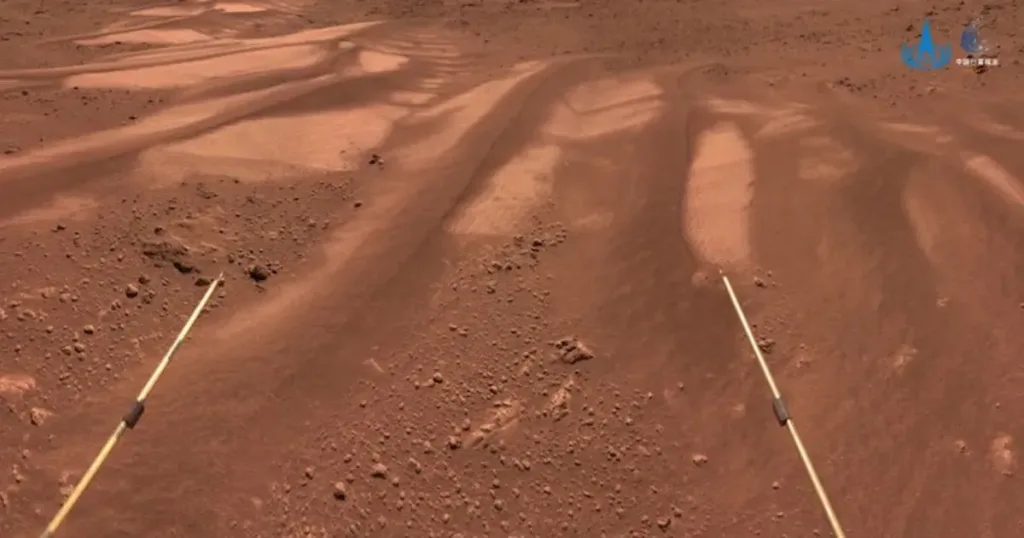
Chinese Rover Finds Evidence of Liquid Water on Mars.
Why a Primary Evaporite Changes the Story
Scientists have identified gypsum and other sulfates at several locations on Mars. Many of those deposits formed when groundwater moved through existing rocks. The minerals later filled fractures or cemented older sediment. Geologists call such materials secondary deposits.
The Zhurong rocks appear different. Liu’s team interprets them as a primary evaporite, meaning crystals grew directly from concentrated water. On cold Mars, freezing may have concentrated the liquid instead of ordinary evaporation.
Large selenite crystals need time and a suitable watery environment to grow. If the interpretation holds, these rocks record shallow, salty surface water rather than moisture moving through cracks.
Recent Liquid Water on Mars Was Probably Shallow
The team calculated that forming the mineral layer required a cumulative water-equivalent column of at least 6.25 to 25 metres. That number does not describe the depth of a single Martian lake.
Instead, it represents the total water needed over time, perhaps through repeated brine supplies. The liquid layer was probably around one metre deep or less at any moment.
The researchers propose that magmatic activity warmed buried ice or salty groundwater. Brine could then have moved upward into a shallow surface basin.
An ice cover probably limited water loss to the thin atmosphere. As the pool froze downward, salts concentrated in the remaining liquid. Those conditions could have produced large gypsum crystals. Scientists have not directly confirmed this underground system or its heat source.
Why the 757-Million-Year Age Matters
Crater density places the surrounding surface at 757 million years old, with an uncertainty of about 66 million years. Scientists did not directly date the gypsum crystals in a laboratory.
Crater counting estimates when terrain formed or underwent major resurfacing. It cannot establish the exact day—or even exact geological period—when each crystal grew.
Even with that limitation, the timing could prove important. Mars entered its Amazonian period roughly three billion years ago. Scientists generally describe this era as cold, dry and hostile to long-lasting surface water.
The evidence does not require a warm global climate or a vast young ocean. Instead, it supports local episodes when heat, ice and salts created temporary liquid environments. These events may have linked the subsurface and surface much later than expected.
Here, “recent” remains a geological term. Seven hundred and fifty-seven million years is ancient by human standards. Yet it represents a surprisingly young chapter in Mars’s long water history.
Martian Crystals Could Preserve Ancient Brine
Selenite offers another reason for future exploration. As large gypsum crystals grow, they can trap microscopic pockets of their original liquid. Scientists call these sealed pockets fluid inclusions.
The surrounding crystal may shield these inclusions from later changes, preserving information that loose surface material has already lost.
Future instruments could examine any trapped salts, dissolved gases and organic compounds. These inclusions might preserve a chemical snapshot of Amazonian groundwater and help researchers assess past habitability.
That possibility does not amount to evidence of life. Zhurong detected no confirmed biological signatures. Nevertheless, the location could become a valuable drilling or sample-return target.
Recent Liquid Water on Mars Reframes Future Exploration
Recent liquid water on Mars now has a compelling mineral record to support it. Zhurong’s observations suggest that shallow, salty pools may have formed in Utopia Planitia around 757 million years ago. Repeated groundwater upwelling, local heat and surface freezing could explain the unusual gypsum layer.
Direct samples could verify the mineral, date its formation and reveal fluid inclusions. Even so, Mars’s surface-water story may extend much closer to the present than older models suggested.
Main Sources:
- Nature Astronomy — Primary evaporite in southern Utopia Planitia on Mars from Zhurong rover observations
- China National Space Administration — China’s first Mars rover named Zhurong
- China National Space Administration — Mars rover continues scientific mission