
BY:SpaceEyeNews.
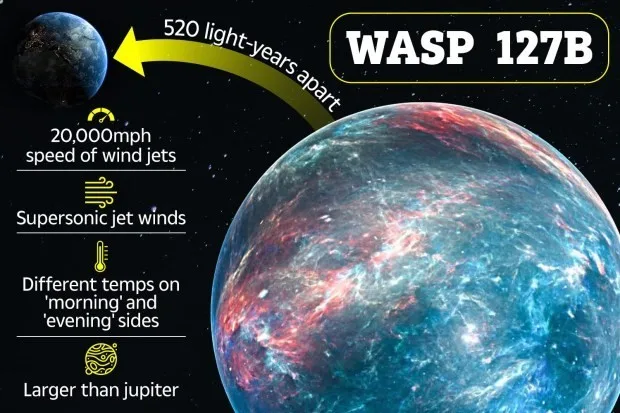
The WASP-127b jet stream appears to carry atmospheric gas around the planet’s equator at extraordinary speed. The maximum equatorial motion reaches about 33,000 km/h, based on observations from the European Southern Observatory’s Very Large Telescope. Yet the record is only part of the discovery. Astronomers also separated signals from different regions of this distant atmosphere, even though WASP-127b remains an unresolved point of light more than 500 light-years away.
Why WASP-127b Is an Ideal Atmospheric Target
WASP-127b is a giant gas planet with unusual proportions. NASA lists its radius at about 1.31 times Jupiter’s radius. However, it contains only around 16.5% of Jupiter’s mass. This combination makes it one of the least dense known giant planets.
The planet circles its star every 4.2 days at a distance of roughly 0.048 astronomical units. It likely keeps the same side facing its star, although astronomers have not measured its rotation directly.
Its low gravity supports a broad, extended atmosphere. That gives researchers a stronger signal when the planet crosses its star. During a transit, a small amount of starlight passes through the atmosphere before reaching Earth. The gas leaves identifiable patterns in that light.
These properties made WASP-127b a valuable target for studying atmospheric motion, not only atmospheric chemistry.
Two Molecular Peaks Revealed the WASP-127b Jet Stream
The international research team studied one transit using CRIRES+. This high-resolution infrared instrument operates on ESO’s Very Large Telescope in Chile. The observations covered the infrared K band.
Researchers removed interference from Earth’s atmosphere and separated the host star’s contribution. They then compared the remaining spectrum with expected molecular patterns. Clear signatures of water vapour and carbon monoxide appeared in the data.
However, each molecule produced two velocity peaks instead of one central peak. One part of the atmosphere was moving partly toward Earth. Another part was moving partly away at a similar speed.
The team connected those signals to the opposite edges of the planet visible during transit. These edges mark the morning and evening boundaries between the permanent day and night hemispheres. A two-dimensional atmospheric model showed that a fast eastward equatorial flow could produce the paired signals.
The telescope did not photograph clouds or directly see separate zones on the planet. Instead, the Doppler shifts separated atmospheric regions by their velocities. This distinction makes the result both more accurate and more impressive.
What the 33,000 Km/h Figure Actually Means
The headline number needs careful explanation. The atmospheric model retrieved an overall equatorial velocity of about 9.3 kilometres per second. That equals approximately 33,500 km/h and is commonly rounded to 33,000 km/h.
Researchers then accounted for the planet’s expected rotation. They assume that WASP-127b is tidally locked because its orbital period lasts only 4.2 days. Using the planet’s estimated radius and orbital period gives a rotational speed near 1.6 kilometres per second.
After subtracting that expected rotation, the study calculated a WASP-127b jet stream speed of 7.7 ± 0.2 kilometres per second. That equals about 27,700 km/h relative to the assumed rotating planet.
Therefore, the two figures describe different quantities. The 33,000 km/h value represents the maximum total equatorial motion. The 27,700 km/h figure isolates the modeled atmospheric jet after accounting for rotation. Neither speed came from a direct wind instrument.
The result first appeared in Astronomy & Astrophysics on January 21, 2025. Later coverage in 2026 revisited the finding, but it did not describe a new observation.
Mapping Morning, Evening and Polar Weather
The paired molecular peaks revealed more than speed. They allowed the team to examine the morning and evening boundaries separately.
The model tentatively indicated that the morning boundary could be about 175 kelvin cooler than the evening boundary. However, the uncertainty remains substantial. The result should not be treated as a confirmed temperature difference.
Signals from the polar regions also appeared weaker. Cooler polar temperatures could explain this pattern. A high cloud layer could also hide molecular signatures at those latitudes. The available data cannot firmly distinguish between those possibilities.
This is not a conventional weather map with visible cloud bands. It is a velocity-based reconstruction of an atmosphere that telescopes cannot resolve as a disc. Even so, it reveals genuine regional differences that one-dimensional atmospheric averages could miss.
Is It Really 18 Times Faster Than Neptune?
ESO compared the 33,000 km/h motion with a Neptune wind speed of 1,800 km/h. That produces a ratio slightly above 18.
NASA uses a somewhat different benchmark. It says Neptune’s winds exceed 2,000 km/h. Using that rounded value lowers the comparison to about 16.5 times. The exact multiplier therefore depends on the chosen Neptune figure.
The comparison also combines different measurement techniques. Scientists tracked Neptune’s clouds, while they inferred WASP-127b’s motion from spectral shifts and atmospheric modeling. The comparison remains useful for scale, but it is not an exact like-for-like measurement.
Why This Alien Weather Map Matters
The main achievement extends beyond a speed record. High-resolution spectroscopy allowed astronomers to separate the equator, poles, morning boundary and evening boundary on a spatially unresolved planet.
That ability matters because a single averaged spectrum can hide major atmospheric differences. Temperature, clouds and chemical abundances can vary across a planet. Models that ignore this structure may produce misleading conclusions.
The carbon monoxide detection also challenges earlier studies that did not identify the molecule clearly. CRIRES+ offered the spectral resolution and wavelength coverage needed to separate its paired signals.
Future instruments could improve this approach. ESO expects its Extremely Large Telescope and planned ANDES spectrograph to detect finer wind patterns. Researchers may eventually apply similar methods to smaller planets, although rocky worlds will present much weaker atmospheric signals.
WASP-127b Jet Stream: The Larger Scientific Story
The WASP-127b jet stream ranks among the most extreme atmospheric flows measured on a planet. Its precise speed depends on whether total motion or wind relative to rotation is quoted. More importantly, the observation shows how astronomers can reconstruct regional weather hundreds of light-years away. The discovery marks a shift from simply identifying molecules to exploring how alien atmospheres circulate, redistribute heat and change from one region to another.
Article length: Approximately 960 words.
Main Sources:
European Southern Observatory:
https://www.eso.org/public/news/eso2502/
Astronomy & Astrophysics peer-reviewed study:
https://doi.org/10.1051/0004-6361/202450438
University of Göttingen:
https://www.uni-goettingen.de/en/73613.html?id=7695
NASA WASP-127b catalog:
https://science.nasa.gov/exoplanet-catalog/wasp-127-b/
NASA Neptune facts:
https://science.nasa.gov/neptune/neptune-facts/