
BY:SpaceEyeNews.
A rare Martian meteorite found in Algeria has opened a window onto a poorly sampled period of Mars’ volcanic history. Scientists dated Northwest Africa 13441, or NWA 13441, to about 1.273 billion years ago. That age places it inside a vast gap in the record of shergottites, the most common Martian meteorite group. Its chemical signature also points toward a source inside Mars that researchers had never sampled before.
The discovery does not complete the planet’s geological timeline. However, it adds a vital data point and challenges assumptions built from a limited collection of Martian rocks.
Rare Martian Meteorite Dates to a Missing Era
Collectors found NWA 13441 in Algeria in 2019. Researchers later received a small cleaned and crushed sample, along with a thin rock section mounted on glass. The team included scientists from Boston College, Scripps Institution of Oceanography, The Open University and Appalachian State University.
First, the researchers had to confirm that the stone came from Mars. Mineral chemistry and oxygen isotope measurements supported its Martian origin. They classified it as an olivine-rich basaltic shergottite. The rock contains large olivine crystals within a finer mixture of minerals and impact-altered glass.
Next, the team used samarium-neodymium isotope analysis to calculate its crystallization age. The result was 1.273 billion years, with an uncertainty of 21 million years.
That date marks when the rock crystallized from Martian magma. It does not indicate when the meteorite left Mars or arrived on Earth. This distinction matters because a rock can remain on a planet for a very long time before an impact ejects it into space.
Filling a Gap in the Shergottite Record
Shergottites dominate the Martian meteorites available for laboratory study. Yet their known ages form an uneven timeline. Most dated examples are younger than about 600 million years. The next much older group dates to roughly 2.4 billion years ago.
NWA 13441 falls between those two clusters. It therefore bridges an interval of around 1.8 billion years in the shergottite record.
Mars did not necessarily stop producing magma during that interval. Instead, the meteorites recovered on Earth had failed to represent that activity. A Martian rock must leave the planet, survive its journey, reach Earth and land somewhere accessible. Researchers must then recognize and study it. That chain of events creates a highly selective record.
Other Martian meteorite families do cover part of this period. Nakhlites and chassignites have ages of about 1.3 to 1.4 billion years. However, their chemistry differs from that of shergottites. NWA 13441 supplies the first known shergottite from this missing age range.
For that reason, the find fills a gap within one major meteorite family. It does not fill a complete two-billion-year gap in all knowledge of Mars.
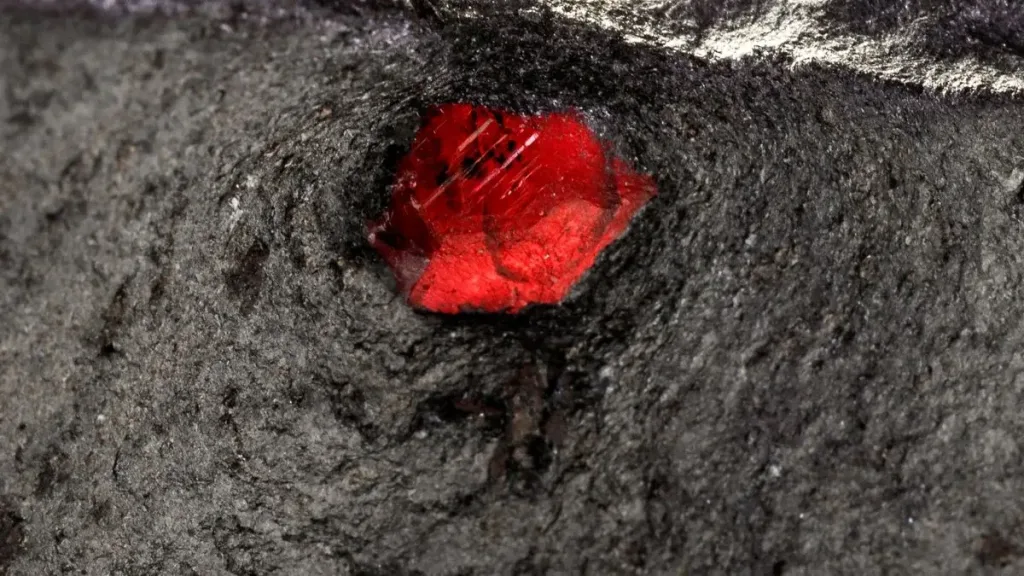
Scientists Cracked Open a Mars Meteorite And Found a Big Surprise .
Unusual Neodymium Signature Deepens the Mystery
The age was only the first surprise. NWA 13441 also carries an unusual initial neodymium isotope composition.
Scientists use isotope ratios to trace the origin and history of magma. The initial value in this rock sits close to the chondritic reference composition. That reference reflects primitive material associated with the early solar system, which formed about 4.56 billion years ago.
No other known shergottite has shown the same starting neodymium signature. Yet this result does not turn NWA 13441 into a chondrite. It remains a Martian igneous rock. The finding concerns the proportions of neodymium isotopes, not the simple presence of the element.
The meteorite therefore records two different timescales. Its crystallization age captures a magmatic event about 1.27 billion years ago. Its isotope pattern may preserve a chemical inheritance linked to the much earlier formation and differentiation of Mars.
Did It Sample an Ancient Martian Reservoir?
The research team offers two main explanations for the chondritic signature. First, the magma may have reached a previously unsampled and relatively undifferentiated reservoir inside Mars. Such a region could have retained an ancient chemical pattern for billions of years.
Alternatively, the magma may record mixing between enriched and depleted Martian sources already identified in other shergottites. The current evidence does not decisively separate these possibilities. Therefore, claims about a confirmed pristine reservoir would go beyond the study’s findings.
Mineral-pressure analysis provides another clue. It suggests that crystallization began near the boundary between the Martian crust and mantle. The magma then continued to cool and develop at shallower levels.
Mars may preserve ancient chemical zones more effectively than Earth. Our planet continually recycles large parts of its crust through plate tectonics. Mars lacks a comparable modern global system. Its more stable outer shell can allow old interior signatures to survive much longer.
What NWA 13441 Changes About Mars
This rare Martian meteorite expands both the age range and chemical diversity of known shergottites. It shows that Earth’s meteorite collections capture only a fraction of the magma sources that existed inside Mars.
Still, the sample has limits. Scientists do not know its original crater or volcanic region. Without that location, they cannot connect the rock directly to nearby layers or specific surface features. Meteorites provide detailed laboratory evidence, but they usually arrive without geological context.
The team now plans to examine more isotope systems. Those measurements could reveal how NWA 13441 relates to other Martian meteorites and test the competing source explanations.
Rare Martian Meteorite Opens a New Chapter
NWA 13441 does not rewrite the entire story of Mars. Instead, it places one carefully measured rock where the shergottite timeline once showed a major blank.
The rare Martian meteorite records magmatic activity 1.273 billion years ago. At the same time, its neodymium signature may carry information inherited from early Mars. Together, those clues reveal a more varied and long-lived Martian interior than the meteorite record previously suggested.
Main Sources:
Geochimica et Cosmochimica Acta — Peer-reviewed NWA 13441 study
The Open University — Institutional research record
Boston College — Research release via EurekAlert
NASA Technical Reports Server — Background on shergottite meteorites