BY:SpaceEyeNews.
A cosmic object with almost 48 times Jupiter’s mass is giving astronomers a rare test of how planets and stars form. The HIP 61637 b brown dwarf is only slightly wider than Jupiter, yet it circles a massive, evolving star every 6.83 days. Its measurements place it in the sparsely populated “brown dwarf desert.” More importantly, its well-constrained age lets researchers test competing formation and evolution models with unusual precision.
HIP 61637 b Brown Dwarf Emerges From TESS Data
NASA’s Transiting Exoplanet Survey Satellite first observed HIP 61637 in 2020. TESS revisited it in 2021 and 2022. Across three sectors, it recorded seven complete transits.
Each transit lasted almost ten hours. As HIP 61637 b crossed its star, repeated light dips revealed its radius and orbital period.
To measure its mass, the team collected 46 spectra with the Tillinghast Reflector Echelle Spectrograph in Arizona. These observations tracked the star’s movement over three years.
Combining both data sets gave the researchers a reliable mass, radius and orbit. The team presented its findings in an arXiv preprint submitted to The Astronomical Journal. The results have not yet completed peer review.
Forty-Eight Jupiters Packed Into a Jupiter-Sized Body
HIP 61637 b weighs approximately 47.8 Jupiter masses. However, its radius measures only about 1.15 times Jupiter’s radius. That combination produces an estimated density of 39.1 grams per cubic centimetre. Jupiter’s average density is only about 1.33 grams per cubic centimetre.
The object travels around its star at roughly 0.1005 astronomical units. Its equilibrium temperature may reach about 2,908 kelvin because it receives intense stellar radiation. Meanwhile, its orbital eccentricity is only 0.054. That value describes a nearly circular path.
These figures place the companion near the middle of the brown dwarf desert. Astronomers use that term for the unexpected scarcity of brown dwarfs in relatively close stellar orbits. The region around 40 to 50 Jupiter masses remains especially valuable because planet-like and star-like formation channels may overlap there.
An Evolving A-Type Star Provides a Reliable Age
The host star makes this system even more unusual. HIP 61637 has 2.86 times the Sun’s mass and 4.33 times its radius. Its temperature reaches 9,180 kelvin, while its luminosity exceeds the Sun’s by about 120 times.
About 692 light-years away, HIP 61637 is not simply an “old giant star.” It is a hot A-type subgiant nearing the end of its main-sequence life.
Massive stars consume fuel faster than Sun-like stars. Consequently, HIP 61637 has reached this phase at about 396 million years old. The uncertainty is roughly 46 million years.
It is the brightest and most massive star currently known with a transiting brown dwarf. Its evolutionary stage provides an independent clock for studying the companion.
Did the Brown Dwarf Form Like a Planet?
The main question concerns the origin of the HIP 61637 b brown dwarf. One possibility involves core accretion, the process that builds giant planets inside disks of gas and dust. Because HIP 61637 is unusually massive, its original disk may also have contained an exceptional amount of material.
Even so, creating an object close to 50 Jupiter masses through core accretion remains difficult. A growing companion can disturb its surrounding disk and limit the material available for further growth.
Another pathway resembles binary-star formation. A dense section of a molecular cloud could fragment and collapse under gravity. That mechanism can produce large companions more naturally, but it does not explain every detail automatically.
The nearly circular orbit cannot settle the debate. A disk-born object may begin with an orderly circular path. Alternatively, a companion created through fragmentation could start on an elongated orbit. Tidal interactions may then reduce that eccentricity as the companion travels close to its star.
Therefore, the present orbit may not preserve a clear record of the object’s birth. Both explanations test the limits of current formation theories.
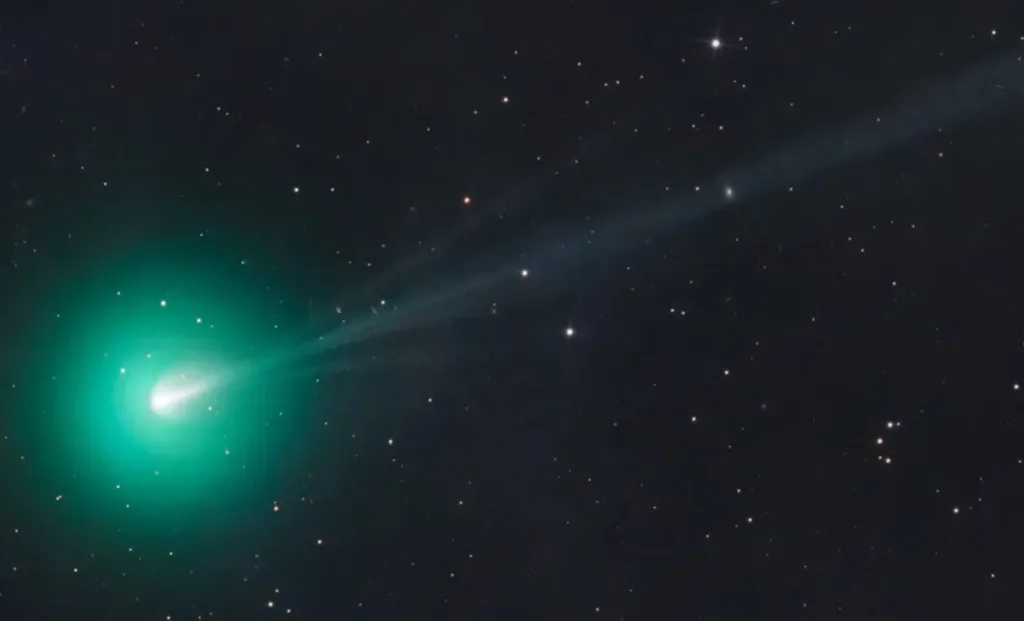
TESS Finds a 48-Jupiter-Mass Brown Dwarf Around an Aging Star.
The HIP 61637 b Brown Dwarf Tests Evolution Models
The system’s known age allows a direct comparison with brown dwarf evolution models. One model family, known as COND03, places its age between about 120 and 500 million years. That broad range agrees with the age derived from the host star.
Sonora models produce a younger estimate of roughly 150 to 200 million years. This result conflicts with the stellar age. Intense irradiation may explain part of the difference.
HIP 61637 b orbits at one-tenth of Earth’s distance from the Sun, beside a far hotter and brighter star. That energy may inflate its radius. An inflated object cools and contracts differently, making it appear younger in models that omit external heating.
The mismatch suggests that current calculations may need stronger treatment of irradiation. Other unknown mechanisms could also influence the radius. The research team leaves that question open.
What Astronomers Need to Observe Next
The short orbit creates frequent opportunities for follow-up observations. However, the ten-hour transit makes complete ground-based coverage difficult. A slow velocity drift also hints at another unresolved companion.
Despite its brightness advantage, HIP 61637 is too bright for direct JWST follow-up under the limits discussed in the paper. Future atmospheric studies of comparable brown dwarfs could still help. Instruments such as Ariel may compare their chemical composition with their host stars. Larger TESS catalogs will also show whether similar systems are truly rare.
Why HIP 61637 b Matters
The HIP 61637 b brown dwarf does not establish a final boundary between planets and stars. Instead, it shows why that boundary remains difficult to define through mass alone. Its precise mass, radius, orbit and age create a valuable benchmark for future models. Whether it grew inside a disk or formed through gravitational collapse remains uncertain. Either answer would expand current ideas about how massive substellar companions develop and evolve.
Main Sources:
DailyGalaxy, “TESS Finds a 48-Jupiter-Mass Brown Dwarf Around an Aging Star”
Ephremidze et al., “HIP 61637 b: a TESS Brown Dwarf in a Near-circular Orbit around a Massive A-type Star”
NASA, “What’s a Transit?”
MIT TESS Science Office, TESS Mission
NASA Exoplanet Archive, TESS Project Candidates