BY:SpaceEyeNews.
The Alpha Centauri A planet candidate has created one of the most intriguing puzzles in nearby exoplanet research. NASA’s James Webb Space Telescope recorded a faint source beside the star in August 2024. When Webb returned in February and April 2025, however, the source was no longer visible.
That sequence inspired descriptions of a “disappearing planet.” Yet nothing literally vanished. The source, named S1, remains unconfirmed. Its absence may reflect the limits of direct imaging rather than the loss of a real world.
Two peer-reviewed studies in The Astrophysical Journal Letters examine the three observations. They also use image tests and millions of simulated orbits. Their conclusion remains cautious but significant. A Saturn-scale planet offers a plausible explanation, and future observations could settle the question.
What Webb Detected Near Alpha Centauri A
Alpha Centauri lies just over four light-years away. Alpha Centauri A is the closest Sun-like star to Earth, making any possible planet around it an unusually valuable target.
Webb observed the star with the Mid-Infrared Instrument, or MIRI, using a coronagraph to suppress its powerful glare. The observation was especially difficult because Alpha Centauri B also added light to the scene. Researchers had to model and subtract the patterns produced by both stars before searching for faint objects.
In the August 2024 data, the team found S1 about 1.5 arcseconds from Alpha Centauri A. That angle equals a projected separation of roughly two astronomical units. In other words, it was twice the average Earth-Sun distance. The source appeared more than 10,000 times fainter than the star.
The signal had a signal-to-noise ratio of about four to six, depending on the processing method. Tests made a detector defect or subtraction artifact unlikely. They also ruled against a passing foreground object or distant background source. Still, the observation came from only one successful telescope orientation. That limitation prevented the team from confirming S1 as a planet from the first epoch alone.
Why the Alpha Centauri A Planet Candidate Disappeared
Webb searched again in February and April 2025 but did not recover S1. This result weakened any claim of immediate confirmation, yet it did not automatically rule out a planet.
A coronagraph does not create a uniformly clear view. Areas near its mask and along residual diffraction patterns remain less sensitive. An orbiting planet can enter one of these regions and fall below the detection threshold.
The research team tested that possibility by simulating millions of dynamically stable orbits. The calculations included Webb’s three results and the gravitational influence of Alpha Centauri B. They also considered an earlier candidate signal called C1. The European Southern Observatory’s Very Large Telescope recorded C1 in 2019. However, astronomers never confirmed that source independently, and warm dust remained another explanation.
No evidence proves that S1 and C1 are the same object. Still, the researchers tested that specific scenario. Their simulations found a 52% chance of missing the candidate during both Webb follow-ups. In that scenario, orbital motion would place it in low-sensitivity regions. Therefore, two missed detections would not be surprising.
The viable modeled orbits generally have periods of two to three years. They favor a moderately eccentric path. Along it, the object could travel between roughly one and two astronomical units from Alpha Centauri A. These are possible orbital families, not a measured final orbit.
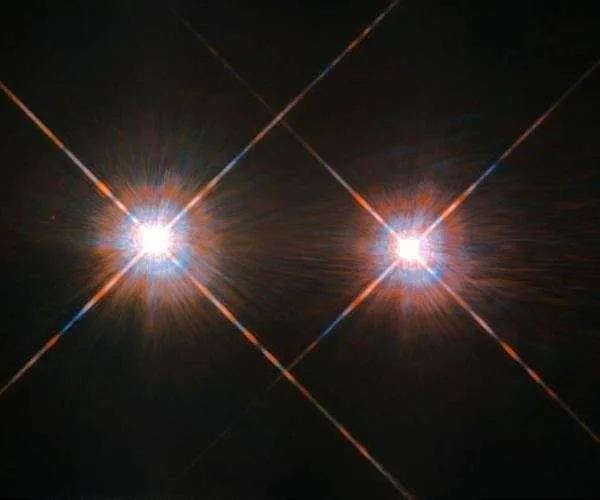
Webb found strong evidence of a Saturn-mass planet in the habitable zone of Alpha Centauri.
What Kind of World Could S1 Be?
Webb measured S1 in one mid-infrared filter centered near 15.5 micrometers. Researchers therefore had to estimate its physical properties by comparing its brightness with planetary models.
Those models suggest an effective temperature near 225 kelvin. They also indicate a radius around one to 1.1 times Jupiter’s radius. The estimated mass spans approximately 90 to 150 Earth masses. Saturn contains about 95 Earth masses, which explains the “Saturn-mass” label. However, the range extends considerably above Saturn’s mass. No direct dynamical mass measurement exists.
If confirmed, S1 would stand apart from most directly imaged exoplanets. Existing examples are often young, hot giants on wide orbits. Retained heat and greater separation make them easier to see. This candidate would instead be mature, comparatively cool, and close to its host star.
Habitable Zone Does Not Mean Habitable Planet
The candidate’s possible orbit overlaps the habitable zone of Alpha Centauri A. That phrase can easily create the wrong impression.
The habitable zone marks where a suitable rocky planet might maintain liquid water under the right atmospheric conditions. It does not guarantee habitability. S1, if real, appears to be a gas giant without an Earth-like solid surface. NASA and ESA both stress that it would not support life as we know it.
Possible moons may attract speculation, but Webb has detected no moon, liquid water, atmosphere, or biological signature around S1. “Closest solar twin” describes Alpha Centauri A, not the candidate world.
What Would Confirm the Candidate?
The next decisive step is another detection. A genuine planet should reappear at a position consistent with orbital motion. Repeated measurements could then establish common motion with Alpha Centauri A and progressively constrain the orbit.
Additional filters could test whether S1’s infrared emission matches a cool giant planet. They could also point toward another source, such as structured warm dust. Independent astrometry and radial-velocity measurements may tighten the limits. However, the nearby companion star makes both methods difficult.
A carefully timed non-detection could be equally important. Nearly all viable orbits may predict that S1 should appear during a future visit. If Webb still finds nothing, the planet interpretation would become much harder to sustain.
For now, the Alpha Centauri A planet candidate is neither a confirmed discovery nor a dismissed signal. It is the strongest direct-imaging evidence yet for a planet around our nearest Sun-like neighbor. The simulations explain how a real world could evade two follow-up searches. Only seeing that faint point of light again can turn an appealing possibility into a confirmed planet.
Main Sources:
NASA — Webb Finds New Evidence for Planet Around Closest Solar Twin:
https://science.nasa.gov/missions/webb/nasas-webb-finds-new-evidence-for-planet-around-closest-solar-twin/
ESA/Webb — Webb Finds New Evidence for Planet Around Closest Solar Twin:
https://esawebb.org/news/weic2515/
Beichman et al. — Orbital and Physical Properties of Candidate S1:
https://arxiv.org/abs/2508.03814
Sanghi et al. — Image Analysis and Sensitivity Tests:
https://arxiv.org/abs/2508.03812
Nature Communications — The 2019 C1 Candidate:
https://www.nature.com/articles/s41467-021-21176-6