
BY:SpaceEyeNews.
The Helix Nebula discovery has exposed a missing stage in the life cycle of Sun-like stars. Astronomers detected 22 complete or partial bow shocks in the nebula’s extremely faint outer halo. These glowing arcs trace clumps of stellar material as they meet the gas between stars.
The result offers rare evidence of stellar debris losing its distinct structure and joining the interstellar medium. It also shows what may happen to material released by our Sun billions of years from now. The peer-reviewed findings appeared in Nature on August 12, 2026.
The Helix Nebula Discovery Began as a Calibration Test
The Helix Nebula lies about 650 light-years away in the constellation Aquarius. Its far dimmer outskirts still contained an important surprise.
Researchers were testing MOTHRA at the El Sauce Observatory in Chile. MOTHRA stands for the Modular Optical Telephoto Hyperspectral Robotic Array. The team selected the Helix as a calibration target.
Even so, the partially completed instrument revealed a network of arcs beyond the bright nebula. Earlier hydrogen-alpha images had not shown these structures with the same clarity.
Once completed, MOTHRA should combine 1,140 high-end telephoto lenses with specialized filters and computational processing. Its design targets faint, diffuse ionized gas across wide areas of sky.
Unlike telescopes designed for narrow, detailed views, MOTHRA surveys faint emissions across a broad field. That wide view allowed researchers to connect multiple outer structures. They could then compare how their shapes changed with distance.
Twenty-Two Bow Shocks Trace Stellar Material
The researchers identified 22 complete or partial bow shocks, mainly on the eastern side of the Helix Nebula. A bow shock forms when rapidly moving material encounters surrounding gas. Its curved shape resembles the wave that develops ahead of a boat.
Here, the arcs mark individual gas clumps moving through the interstellar medium. Astronomers did not find one enormous shock surrounding the entire nebula. They found compact shocks connected to separate pieces of material expelled by the aging star.
The team detected the arcs through hydrogen-alpha emission.
The shocks also change with distance from the central white dwarf. Inner examples appear large, thin and clearly defined. More distant examples look smaller, less organized and increasingly fragmented. That progression provides the main evidence for gradual erosion.
Across distances of roughly 0.4 to 1.4 parsecs, the shocks’ radius of curvature falls by about a factor of 100.
Why the Changing Shapes Matter
The changing structures create a physical timeline across the nebula. Fragments closer to the center retain more of their original form. Those farther away show greater disruption after longer interaction with surrounding gas.
Researchers interpret this pattern as progressive stripping and fragmentation of shells released during the star’s late giant phase. Each clump gradually loses coherence before mixing into the wider interstellar environment.
The team estimates that a fragment remains coherent for about 10,000 years after meeting the surrounding gas. However, astronomers did not watch one object for that entire period. They calculated the timescale from the relationship between shock size and distance.
That distinction keeps the conclusion in perspective. The observations provide strong evidence of stellar recycling in progress. They do not record the full history of one fragment from release to complete dispersal.
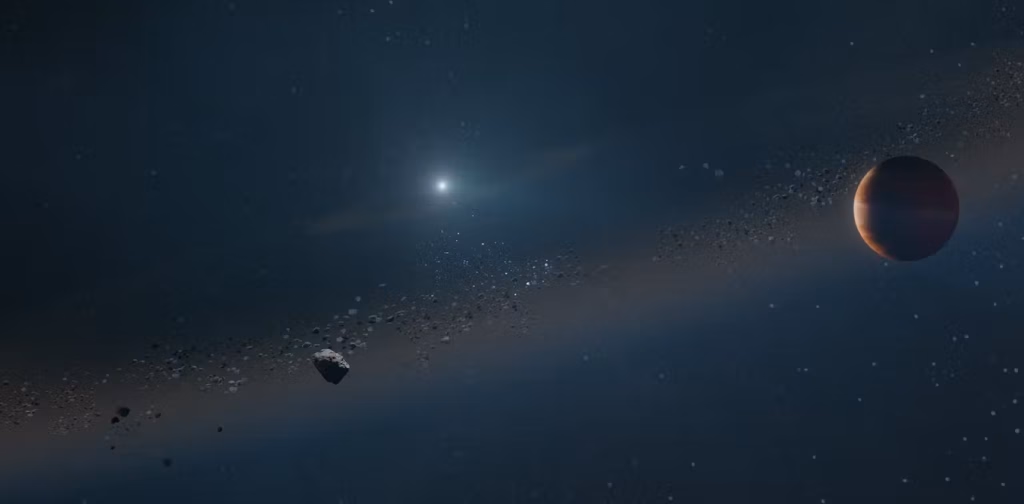
A distant dead star shows a glimpse of our Solar System’s future.
Helix Nebula Discovery Fills an Observational Gap
Scientists already knew that low- and intermediate-mass stars return material to space near the end of their lives. Those stars release gas enriched by processes that occurred during their evolution. What remained difficult to observe was the final handoff.
The Helix Nebula discovery connects recognizable stellar debris with diffuse gas between stars. It shows how organized shells can divide into clumps. Those clumps then erode until they become part of the surrounding environment.
Over much longer periods, some interstellar material may enter molecular clouds. Those clouds can form later generations of stars and planetary systems. The Helix material could therefore contribute to future cosmic objects.
This possibility does not mean these exact fragments will certainly form planets or life. Their future paths remain unknown. Still, the process explains how galaxies repeatedly redistribute useful material rather than simply losing it.
What the Helix Reveals About the Sun’s Future
The Helix Nebula offers an observational example of a broad process that should eventually affect our Sun. NASA expects the Sun to begin leaving its current stable phase in about five billion years.
As hydrogen becomes depleted in its core, the Sun will expand into a red giant. Later, it will release much of its outer material and leave a dense white dwarf. The expelled gas will then interact with the surrounding interstellar medium.
That material may disperse through the Milky Way just as the Helix fragments appear to be doing now. However, the Helix does not predict every detail of our solar system’s future.
Its original star had its own mass, motion, environment and history of material loss. Scientists also continue to examine what will happen to individual planets as the Sun changes.
The secure comparison concerns the general stellar cycle. A Sun-like star releases its outer layers, leaves a white dwarf and returns material to its galaxy.
The Helix Nebula Discovery Opens a Wider Search
The 22 bow shocks reveal more than an attractive structure. Their changing shapes trace how stellar fragments lose coherence and merge with interstellar gas. That process represents one of the least observed stages of stellar evolution.
MOTHRA found the structures while the array was still incomplete. Future observations could reveal similar features around other planetary nebulae. Researchers could then test whether the Helix shows a common process or an unusually clear example.
Ultimately, the Helix Nebula discovery turns cosmic recycling from an expected outcome into something astronomers can examine directly. Far in the future, the Sun’s expelled material should enter this same galactic cycle.
Main Sources:
- Nature: Numerous Bow Shocks in the Outer Helix Nebula
- Yale University: A Dying Star Offers a Rare Glimpse of Cosmic Recycling
- Northwestern University: Astronomers Witness Cosmic Recycling in Action
- NASA: Star Types and the Sun’s Future
- ESA: Webb Reveals the Helix Nebula in Detail