
BY:SpaceEyeNews.
NASA’s Hubble Space Telescope has uncovered evidence of an ancient Milky Way merger hidden for nearly 12 billion years. The event involved a dwarf galaxy that no longer exists as a separate system. Yet several of its globular clusters still orbit near the center of our galaxy.
Researchers call the vanished galaxy Low-energy-Kraken-Heracles, or LKH. Its stars carried about 500 million times the Sun’s mass. That made LKH a major contributor to the young Milky Way. The finding pushes the firmly reconstructed merger timeline 1.8 billion years earlier than the Gaia-Sausage-Enceladus event.
A Hidden Chapter in the Milky Way’s History
Astronomers already knew that mergers helped shape the Milky Way. The Sagittarius dwarf galaxy began joining our galaxy more than six billion years ago. That process continues today. Farther back, Gaia-Sausage-Enceladus added stars and influenced the galactic disk around 10 billion years ago.
Evidence had also suggested an earlier, substantial merger. However, astronomers could not clearly separate its remains from stars born inside the early Milky Way. Several studies identified related structures under names such as Low-energy, Kraken, and Heracles. Scientists continued to debate whether those clues described an external galaxy or native Milky Way populations.
The new ancient Milky Way merger study connects those clues through a common population of star clusters.
How Hubble Traced the Ancient Milky Way Merger
The team turned to globular clusters near the galactic center. These dense collections contain tens of thousands to millions of stars. More importantly, they preserve measurable records of their birth environments.
Researchers newly analyzed 17 inner globular clusters using deep Hubble images captured through two optical filters. They combined those results with earlier measurements to create a homogeneous sample of 39 clusters. Hubble’s resolution allowed the team to compare cluster ages with errors of only a few hundred million years.
The scientists also measured metallicity, which tracks the abundance of elements heavier than helium. A cluster’s age and metallicity together reflect how quickly its original galaxy produced and enriched stars. Gaia data added information about the clusters’ movement through the Milky Way.
Together, age, chemistry, and motion created a historical fingerprint. This approach worked even though billions of years had erased many obvious signs of the original event.
Three Cluster Families Reveal a Missing Galaxy
The analysis identified three distinct age-metallicity sequences. One belonged to clusters that formed inside the Milky Way. Another matched clusters linked to Gaia-Sausage-Enceladus. A third sequence sat between them and followed its own pattern.
A Bayesian statistical model strongly favored three progenitor systems rather than two or four. Within the third group, 12 clusters showed a high probability of sharing the same origin. All remain inside roughly six kiloparsecs, or about 20,000 light-years, from the galactic center.
Their ages, chemical histories, and orbital properties did not match the other two populations. The researchers concluded that these clusters formed in an independent dwarf galaxy. The Milky Way later incorporated that system and placed much of its material in the inner galaxy.
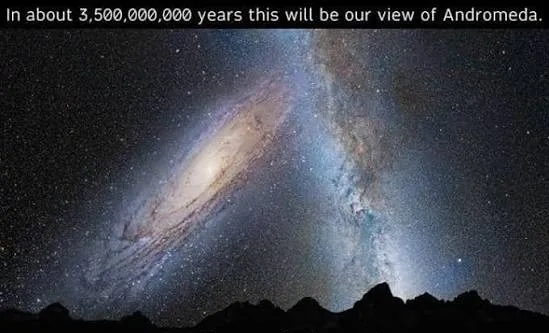
Milky Way and Andromeda galaxy merger in 4 billion years.
Meet Low-Energy-Kraken-Heracles
The team named the progenitor Low-energy-Kraken-Heracles to recognize three earlier lines of research. The name does not describe three separate galaxies. Instead, it unifies evidence previously discussed under different labels.
LKH probably contained around 500 million solar masses in stars. That estimate resembles the stellar mass assigned to Gaia-Sausage-Enceladus. However, the Milky Way itself was far smaller at the time. Therefore, LKH represented a considerable addition to the developing galaxy.
The peer-reviewed Nature Astronomy study estimates that the event occurred about 12.3 billion years ago. NASA’s official Hubble summary gives a rounded estimate of roughly 11.8 billion years. “Around 12 billion years ago” captures the result without suggesting false precision.
Why the Discovery Changes the Milky Way’s Story
This discovery challenges a simpler picture of the Milky Way’s earliest growth. Some earlier interpretations gave most of the credit to stars that formed within the main galactic ancestor. LKH shows that external stars and clusters also arrived during this early period.
The ancient Milky Way merger may have contributed greatly to populations now hidden in the inner halo. It also shows why the galactic center contains overlapping histories that are difficult to separate. Material from early systems mixed rapidly as the Milky Way evolved.
The result supports the wider view that large galaxies grew by combining many smaller building blocks. It also demonstrates the value of age-metallicity relationships. Chemical evidence alone can overlap between native and imported stars. Adding precise ages and dynamics helps distinguish their origins.
Limits and the Search for More Galactic Fossils
Hubble did not photograph the merger as it happened. Researchers reconstructed it from clusters that remain inside the Milky Way. Their timeline also uses the end of cluster formation as an indicator of when accretion occurred. The merger’s final completion may have followed later.
Other small galaxies may remain hidden. Some might have formed no surviving globular clusters. Others may have lost their clusters completely. The current study therefore reveals one major contributor, not necessarily every early merger.
Future Hubble observations will expand the cluster sample. Better ages and orbital measurements could expose more branches in the Milky Way’s complex family tree.
Ancient Milky Way Merger Rewrites Our Galactic History
LKH no longer appears as a separate galaxy, but its globular clusters preserve its identity. Hubble measured their ages and chemical patterns, while Gaia helped trace their movement. Together, those records reveal a major contribution from outside the infant Milky Way.
The ancient Milky Way merger shows that our galaxy began assembling from multiple systems remarkably early. Even after 12 billion years of mixing, its oldest clusters still carry evidence of where they began.
Main Sources:
NASA — Hubble Solves Merger Mystery From Milky Way’s Early Years
Nature Astronomy — Evidence of a Massive Accretion Event Before the Gaia-Sausage-Enceladus Merger
ESA/Hubble — Hubble Solves Merger Mystery From Milky Way’s Early Years
Universe Magazine — Hubble Solves Mystery of a Merger From the Early Days of the Milky Way